
Follow our live coverage here.
SINGAPORE – Allowing any party to illegally weaponise an international waterway would set a dangerous precedent, and other maritime chokepoints could be similarly targeted, said Prime Minister Lawrence Wong.
Singapore feels this acutely as it sits along the straits of Malacca and Singapore, which are among the world’s busiest maritime routes, PM Wong told world leaders at an April 17 meeting on the Strait of Hormuz that was hosted by France and Britain.
The world therefore cannot afford to go down this path, he stressed.
“If we were to do so, we will end up in a more disorderly and unstable world – one governed by coercion and force rather than rules,” he said.
Noting that the right of transit passage is enshrined in the United Nations Convention on the Law of the Sea (UNCLOS), PM Wong said it is in the collective interest of the international community to uphold navigational rights and freedoms, and to ensure that critical sea lanes remain open, secure, and accessible to all.
Singapore knows the current ceasefire is fragile and continues to urge all sides to work towards a durable and lasting resolution, he added.
A ceasefire between the US and Iran was brokered by Pakistan on April 8, and is set to end on April 22. The possibility of another round of talks is in discussion.
PM Wong said that, as many other leaders noted, the conflict cannot truly be over if the Strait of Hormuz remains closed or subject to arbitrary controls.
Iran has blockaded the strait since the conflict broke out in late February. On April 13, the US started its own naval blockade of Iranian ports and turned away ships attempting to pass through the strait.
“The restoration of safe, predictable and unimpeded passage through the Strait of Hormuz must go hand in hand with efforts to end the war,” he said.
In a Facebook post after the meeting, PM Wong noted that every nation present, even those without sea borders, recognised the critical importance of upholding international law in the strait.
According to a note sent to invited nations, the aim of the meeting was to reaffirm full diplomatic support for unfettered freedom of navigation through the Strait of Hormuz, as well as to address economic challenges facing the shipping industry and the safety of more than 20,000 stranded seafarers and trapped commercial vessels.
The meeting was also to outline preparations for the deployment of a “a strictly defensive multinational military mission” to ensure freedom of navigation once fighting ended, with key tasks including mine-sweeping and ensuring no tolls were levied for passage.
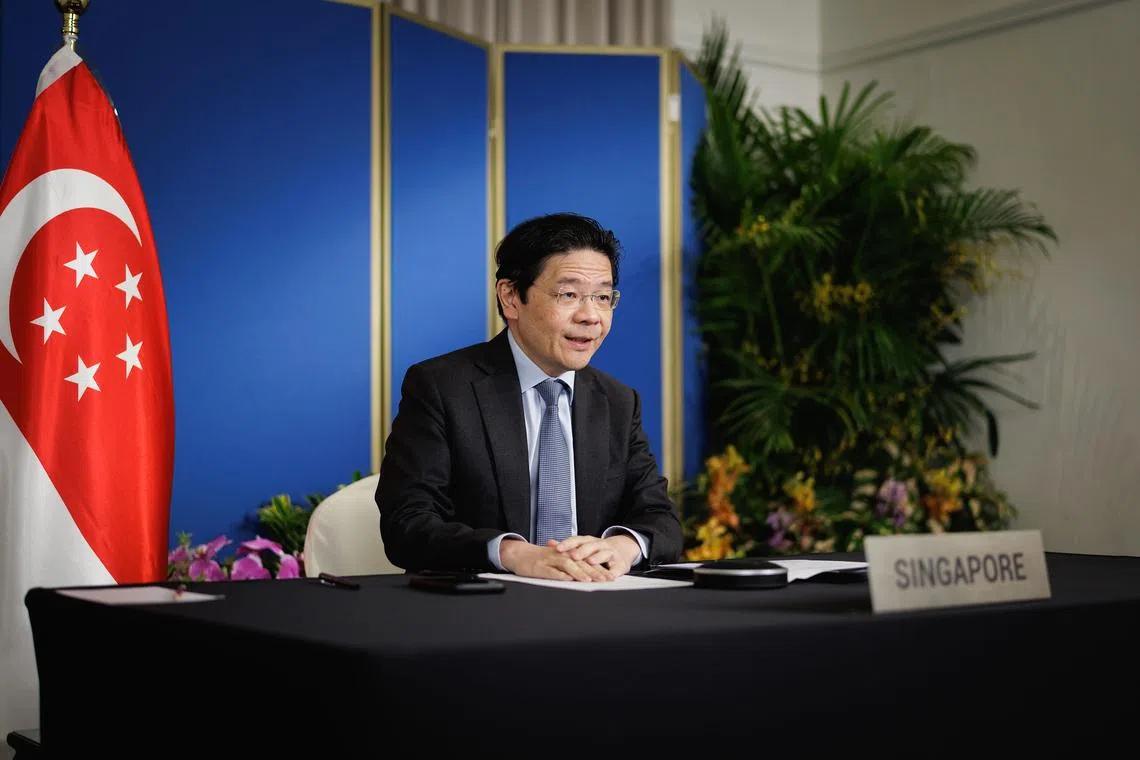
PM Wong attended the meeting via video conference, while French President Emmanuel Macron, British Prime Minister Keir Starmer, and other world leaders such as German Chancellor Friedrich Merz and Italian Prime Minister Giorgia Meloni met in person in Paris. Some 30 other heads of state and government also joined via video conference.
PM Wong said Singapore has consistently supported efforts to keep critical sea lanes open and stands ready to work with partners to restore a free and open Strait of Hormuz, in accordance with international law, with “no tolls, no restrictions, and a return to the situation before the war”.
He cited Singapore’s statement at the UN General Assembly on April 16, on behalf of countries that played founding roles in the conclusion of UNCLOS.
In a joint statement delivered on behalf of Fiji, Jamaica, Malta and Singapore, the Republic’s Permanent Representative to the UN in New York Burhan Gafoor said the right of unimpeded transit passage has been, and continues to be, of fundamental importance to international maritime trade.
Singapore was also an early co-sponsor of UN Security Council Resolution 2817, said PM Wong.
The March 11 resolution condemned in the strongest terms attacks by Iran on its neighbouring countries, and reaffirmed that the navigational rights and freedoms of commercial vessels must be respected, particularly around critical maritime routes.
Iran said on April 17 that the Strait of Hormuz was “completely open” to all vessels for the duration of the 10-day ceasefire between Israel and Lebanon, but US President Donald Trump said Washington’s naval blockade on Iran will “remain in full force” until a deal with Tehran is struck.
At the meeting, PM Wong also called on countries not to impose any unnecessary restrictions on the flows of trade, energy and critical supplies.
The Republic has been working with like-minded countries in the region – including Australia, New Zealand and Brunei – to strengthen supply chain resilience and provide mutual support to one another, he said.
“As a global trading hub and a major oil refining centre, this is Singapore’s position – it is clear and unequivocal. We continue to support free and open trade,” he said.