
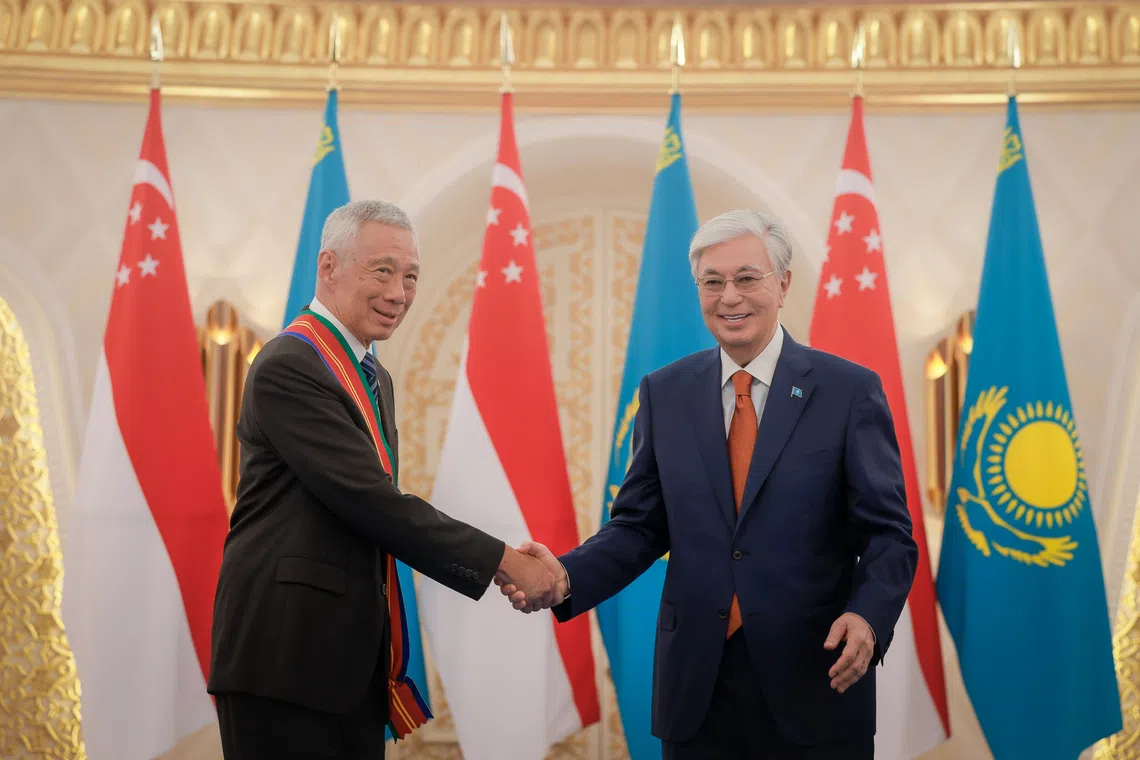
ASTANA – Singapore will explore ways to deepen ties between South-east Asia and Central Asia when it takes over as Asean chair in 2027, as it looks beyond the grouping’s traditional partners and towards a region with growing economic potential.
Senior Minister Lee Hsien Loong said on Aug 26 that Singapore would explore how the two regions could step up cooperation in areas including transport, connectivity, energy and sustainable development.
“As ASEAN Chair next year, Singapore looks forward to creating more opportunities for ASEAN to engage partners beyond our traditional networks,” said Lee at a ceremony in Astana, where Kazakhstan President Kassym-Jomart Tokayev conferred on him the Order of Dostyk, or Friendship, of the First Class.
“We will explore how Southeast Asia and Central Asia can work more closely together.”
The award is a Kazakh state honour recognising contributions towards strengthening friendship and cooperation. Lee said he accepted it on behalf of the many Singaporeans and Kazakhs who had worked to bring their two countries closer together over the past three decades.
The push to strengthen links between the two regions comes as Singapore and Kazakhstan expand their own cooperation into new areas, with agreements signed on Aug 26 covering the digital integration of a major Eurasian trade route and water management.
Under the first agreement, the Singapore Cooperation Enterprise (SCE) and Kazakhstan-based transport and logistics company Middle Corridor Multimodal will work together on the digital integration of the Middle Corridor, a trade route connecting China and Europe through Central Asia and other areas. Experts say it has grown in importance as conflicts disrupt other routes between the two markets.
Potential areas of cooperation include trade documentation, multimodal logistics and supply chain management, said SCE. The partnership could also create opportunities for Singapore companies in digital trade, logistics and related services.
In an interview on Aug 26, SCE chief executive Kong Wy Mun described the link-up as a “very strategic alternative” for the flow of goods, with volumes growing by about 30 per cent each year.
But the route crosses several countries with different customs standards and processes, which can create bottlenecks. Kong said Singapore could share its experience to help improve customs interoperability and the efficiency of goods moving across borders.
“Our companies would certainly benefit in terms of possibilities of getting projects in this particular region and area,” he said, adding that these could provide a platform for them to expand further into Central Asia.
A second agreement between SCE and Kazakhstan’s Ministry of Water Resources and Irrigation will see Singapore share its experience in managing water resources.
It provides for a study visit programme in Singapore for Kazakh officials covering areas such as water sustainability, flood management, water reclamation and digitalisation. The agreement also could also pave the way for Singapore agencies and companies to build partnerships in Kazakhstan’s water sector.
Kazakhstan faces several challenges on this front, and Kong said this included the effects of climate change on glaciers that feed its rivers, as well as falling water levels in the Caspian Sea.
Singapore could share its experience in water resource planning and management, while companies could eventually find opportunities in areas such as digital water solutions and smart metering, he added.
Kazakhstan’s Minister of Water Resources and Irrigation Nurzhan Nurzhigitov said the country had been working with SCE for about 18 months, and that Kazakh water specialists would soon travel to Singapore for training.
He said Kazakhstan needs a “new culture of using water”, and was looking to further develop and digitalise its water infrastructure as it adapts to challenges from climate change, rising temperatures and declining water resources.
Singapore’s Ministry of Foreign Affairs and the Kazakhstan Agency of International Development (KazAID) also agreed to conduct a second Joint Training Programme on the theme of AI, digital development, and science, technology, engineering and mathematics in Astana within the next two years. The programme will train up to 30 mid-to-senior government officials from Central Asian countries, MFA said.
The new agreements build on a relationship that has expanded since Singapore and Kazakhstan established diplomatic ties in 1993. A bilateral Services and Investment Agreement entered into force in March 2025, giving Singapore companies greater market access to Kazakhstan.
Kazakhstan is Singapore’s largest trading partner in Central Asia. Bilateral trade in goods amounted to $326.6 million, while trade in services was $159 million. Singapore’s stock of direct investment in Kazakhstan stood at $2.1 billion, with 158 Singapore overseas affiliates operating there.
Lee noted in his speech that the relationship between the two countries stretches back to before Kazakhstan gained independence in December 1991.
Three months prior, in September 1991, then-senior minister Lee Kuan Yew visited the former Soviet republic at the invitation of its President at the time, Nursultan Nazarbayev. He addressed the Kazakhstan Supreme Soviet on Singapore’s development experience and the transition to a market economy.
Successive leaders had continued to build on those ties, including through an exchange of state visits in 2023 and 2024, Lee said.
Despite their geographical differences, Lee said Singapore and Kazakhstan shared an interest in integrating with their respective regions while remaining connected to the wider world.
“Both our countries seek to integrate within our regions, build friendships beyond, and stay connected to the world,” he said.

Senior Minister Lee Hsien Loong calls on Kazakhstan Prime Minister Olzhas Bektenov at Ukimet Ui (Government House) in Astana on Aug 26.
ST PHOTO: GAVIN FOO
Lee noted that Singapore could serve as a gateway for Kazakhstan and other Central Asian businesses seeking opportunities in South-east Asia, while Kazakhstan could serve as a bridge for Singapore businesses looking towards Central Asia and the wider Eurasian region.
“Our conversations have strengthened my conviction that we can do much more together. I am confident that the next generation of Singaporeans and Kazakhs will take this relationship further still,” Lee said.
Lee also met and was hosted to dinner by Prime Minister Olzhas Bektenov. Bektenov said Singapore companies had invested in the country and their projects had helped create thousands of jobs. He also pointed to cooperation with companies such as PSA International, ST Engineering and Surbana Jurong in areas including technology transfer and engineering consultancy.
There was room to do more, said Bektenov. He added: “We believe that the full potential of our partnership has yet to be realised.”