
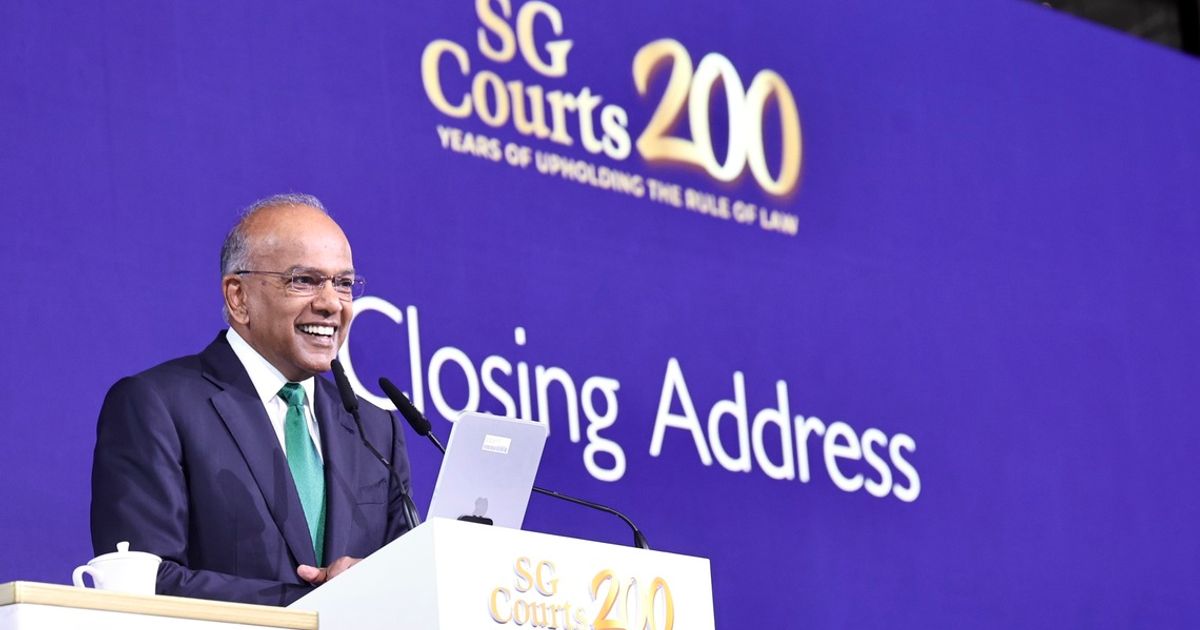
SINGAPORE – The Government, Parliament and the judiciary must respect the boundaries of each institution and not overreach beyond their limits, said Senior Minister K. Shanmugam on Nov 26.
This mutual respect must start from the Government, which also has the primary responsibility of making the boundaries clear in the Constitution and legislation, he added.
Even with mutual respect, the executive and the judiciary will not always agree, he said at the closing address of the Global Rule of Law Conference 2026 organised as part of the bicentennial celebrations of the courts.
Shanmugam, who was law minister from 2008 to 2025, noted that on occasion, the courts may interpret the law in a way that is different from the Government’s policy objectives.
When that happens, the Government must respect the court’s decision, he said.
But if it considers that the law needs to be changed, it must go back to Parliament, explain its position, and seek legislative change, he added, noting that such situations have been quite rare.
His comments come after Chief Justice Sundaresh Menon said the day before that reviews or changes by Parliament sparked by a judicial decision simply reflect the way the different branches of government exercise their responsibilities within their respective constitutional lanes.
Shanmugam noted that successive Singapore Governments have sought to maintain the mutual respect between the institutions.
The understanding has also been helped by the considerable continuity in the leadership of Singapore’s legal institutions, he noted, pointing out that Singapore has only had four law ministers and four chief justices since independence. The fifth chief justice Sushil Sukumaran Nair will take office in February next year.
“Each institution has to understand the limit of what it should do, and not overreach, because overreach often invites a reaction, and that is not good,” said Shanmugam, who is also Coordinating Minister for National Security and Home Affairs Minister.
The case of Section 377A of the Penal Code, which criminalised sex between men, illustrates how each institution played its role, he noted.
The constitutionality of the law had been challenged in 2022 following several prior applications being dismissed by the courts.
In its judgment in 2022, the apex court had begun by setting out the limits of its own role, stating that repeal or retention was beyond the remit of the court and that Parliament was best placed to come up with a solution that accommodates divergent interests.
The court eventually ruled that those who brought the case had no standing to challenge the law as there was no real threat of prosecution since the Government had said it would not enforce the law.
Noting that Menon had cited the same case a day earlier during the conference to illustrate how the court addressed the legal questions that properly fell within its province, while leaving the broader social and political question to Parliament, Shanmugam said: “If the Court of Appeal had actually struck out Section 377A: our society as a whole would have been worse off – and we could not have built the consensus and trust based on compromise.”
Eventually, after wide consultation, the Government moved to repeal the law and also amend the Constitution to provide assurance on issues relating to marriage, he said, noting that the legislation had been carefully crafted to strike a compromise between different groups in society. Parliament eventually passed both changes together.
Such mutual respect between the institutions is easier to maintain when each is clear on where its powers begin and end, said Shanmugam.
Where the boundaries are unclear, the courts may find themselves having to decide questions with far-reaching policy consequences, such as what fuel should be used in public buses and even how to distribute specific medicine through public healthcare programmes, as has happened elsewhere.
Shamugam said the courts could have been left with no choice as the law may not have been clear in limiting judicial intervention in matters of policy.
Singapore’s takeaway from these cases is that the Government has the primary responsibility to draw these boundaries clearly in the constitution and in the laws, he said.
Shanmugam also said it is the responsibility of the Government to uphold the independence and integrity of the courts and to defend judges against public attacks, whether it agrees or disagrees with a particular judgment.
While publicly criticising unpopular rulings might offer short-term political gain, it will inflict long-term damage to the judiciary and the country as a whole, he said.
“Confidence in the courts is not a given. Once lost, it is very hard to win back,” he said.
“We have to protect the prestige and standing of the judiciary. Otherwise, the talk of rule of law will be less than credible.”
His remarks follow findings by international civil society organisation World Justice Project of a decline in the rule of law, as well as increased social media backlash against courts and judges worldwide.
At a panel discussion of the chief justices of Canada, Hong Kong, Jamaica, Malaysia and New Zealand, moderated by Singapore Chief Justice Sundaresh Menon on the same day, several panellists spoke about how online outrage could affect judicial independence.
During his closing address, Shanmugam said judges, unlike politicians, cannot go out and publicly defend themselves against attacks on their integrity, which is why the government of the day has the primary responsibility to protect the judiciary from such attacks.
In Singapore, the Government had done so by introducing the Administration of Justice (Protection) Act 2016, which codified the law of contempt.
This lowered the threshold for being found guilty of scandalising the judiciary, going against the grain of what was happening elsewhere, such as in the United Kingdom, he said.
He added that it does not mean judgments cannot be criticised.
Rather, baseless attacks on the integrity and impartiality of judges will not be tolerated as they risk undermining public confidence in the administration of justice.
He cited the example of the City Harvest Church case in 2018, when the sentences of six church leaders convicted of criminal breach of trust sparked public angst and outrage stemming from a perceived injustice by those who did not understand the nuances of the law.
In the case, the Court of Appeal had upheld the High Court’s sentences of the church leaders, based on the reading of the law that directors of a company were not considered agents of the company who would face heavier penalties.
Noting that this had contrasted with common-sense wisdom, Shanmugam said the sentiments of the public then were understandable.
But to impugn the integrity of the judges by saying things like how they were lenient because of their faith was unacceptable, he added.
The Government subsequently amended the law to ensure that directors and other senior officers could be liable for aggravated criminal breach of trust, carrying the higher penalties.
“If the Government feels strongly about the issue, it should change the law, and not criticise or attack the courts in Parliament or in public, even if it is politically opportune to do so,” he said.
In his address, Shanmugam also noted that it is “necessary and honest” to acknowledge that Singapore maintains exceptions to the rule of law.
These include the executive powers to detain individuals without trial under the Internal Security Act and preventive powers to issue retraining or blocking orders under the Maintenance of Religious Harmony Act, Maintenance of Racial Harmony Act and Foreign Interference (Countermeasures) Act.
He contrasted Singapore’s practice with the approach in the United States after the Sept 11 attacks, where terrorism suspects were held without trial at Guantanamo Bay in Cuba based on the argument that due process did not apply outside US territory.
He said when detention without trial is used in Singapore, the Government says so directly, explains the rationale and implements safeguards. It lets the voting public decide whether to accept it, rather than paying lip service to due process, he added.
Such carefully and clearly defined exceptions are paradoxically necessary to strengthen and support a stable society government by the rule of law, he said.
“The legitimacy of this legislation ultimately rests on the public confidence that the powers will be exercised responsibly, and not arbitrarily,” he said.
“In Singapore, over time, a high degree of public trust in the Government and in the institutions exercising those powers has been built up.”
Shanmugam also in his speech noted the challenges to the rule of law in the international context.
Citing recent remarks by US Secretary of State Marco Rubio that international law was an “instrument” to advance the interests of a global elite “under the pretense of universal principles”, Shanmugam said it essentially means the US does not consider itself bound by international law.
In fact, the idea that the strong do what they can while the weak suffer what they must, drawn from the ancient Greek historian Thucydides, has been an underlying feature of international law, he noted.
Rubio had taken that proposition to a new level, and the international rule of law will face challenges in the foreseeable future, he added.
Singapore’s rule of law, however, is on a much firmer footing, and without it, the country would not be a successful economy, Shanmugam said.