
SINGAPORE –From
self-driving shuttles in Punggol
to new MRT stations to a long-awaited cross-border rail link, 2026 will bring some of Singapore’s biggest transport changes in years.
After a year marked by
rail disruptions
and reliability concerns, the public can expect new travel options, greener fuels in the air and at sea, and infrastructural upgrades aimed at smoother, faster journeys at home and to and from Johor Bahru.
Here is what to expect in the transport realm in 2026, and a round-up of the biggest developments in 2025.

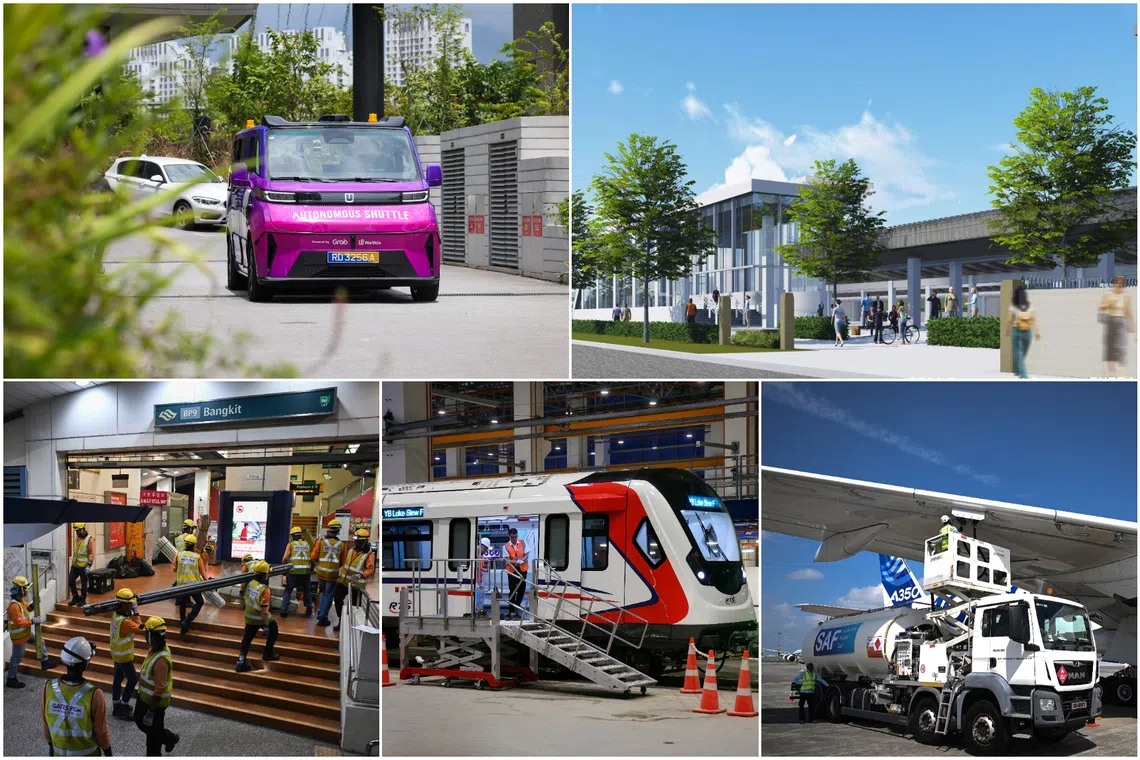
The self-driving shuttles will run on three routes serving parts of Punggol that are harder to reach by public transport.
PHOTO: ST FILE
Residents in Punggol can expect self-driving shuttle services to
start carrying passengers in early 2026
.
From then, the public will be invited to try the autonomous shuttles for free, ahead of the launch of paid services later in the year. For safety, a trained operator will be on board at all times during the initial roll-out to monitor the vehicles and intervene if necessary.
The shuttles – a mix of five- and eight-seater vehicles – will run on three routes serving parts of Punggol that are harder to reach by public transport, potentially cutting travel times by up to 15 minutes.
Two routes, operated by technology company Grab and autonomous driving technology firm WeRide, will connect residents to key amenities including Punggol Coast MRT station, Punggol Coast Bus Interchange, shopping malls and the polyclinic. A third route
will be run by transport company ComfortDelGro
using driverless vehicles supplied by autonomous driving firm Pony.ai.
Beyond Punggol, six driverless buses will be deployed from mid-2026 on
public routes in Marina Bay, Shenton Way and one-north in Buona Vista
as part of a three-year pilot by the Land Transport Authority (LTA).
Looking ahead, Acting Transport Minister Jeffrey Siow said Singapore aims to have between 100 and 150 self-driving vehicles on its roads by the end of 2026.

The sixth stage of the Circle Line will debut in the first half of the year, adding three underground stations – Keppel, Cantonment (above) and Prince Edward Road.
PHOTO: LTA
Passengers will have new travel options in 2026 with the opening of several MRT stations.
The sixth stage of the Circle Line (CCL6) will debut in the first half of the year,
adding three underground stations
– Keppel, Cantonment and Prince Edward Road – to close the loop between HarbourFront and Marina Bay. Once operational, CCL6 is expected to shorten travel times and give passengers alternative routes that bypass the crowded City Hall and Raffles Place interchanges.
In the second half of 2026, the fifth stage of the Thomson-East Coast Line (TEL5), comprising Bedok South and Sungei Bedok stations, will begin service. At the same time, the 2.2km Downtown Line (DTL) extension in the east will open, linking Expo station to the future Xilin and Sungei Bedok stations.
The
TEL5 and DTL projects faced delays
due to complex construction challenges, including tunnelling near critical infrastructure. But once completed, they will offer faster, more convenient connections for passengers.
In 2026, there may also be an update on the proposed Seletar MRT Line,
which LTA is studying
. Mr Siow said he hopes to provide this update probably during the Budget debate in 2026, which typically takes place between February and March.
If approved, the line could serve areas such as Woodlands, Sembawang, Sengkang West, Serangoon North, Whampoa, Kallang and the Greater Southern Waterfront.

Passengers flying out of Singapore from October 2026 will pay a levy of between $1 and $41.60 that will go towards the purchase of sustainable aviation fuel.
PHOTO: ST FILE
Travellers flying out of Singapore from Oct 1, 2026,
will pay a levy of $1 to $41.60
to support the purchase of sustainable aviation fuel. The levy applies to tickets sold from April 1, 2026, for flights departing Singapore on or after Oct 1.
Economy and premium economy class passengers will pay $1 to $10.40, while business and first-class travellers will pay $4 to $41.60, depending on the destination. Passengers on longer flights will incur higher levies due to greater fuel consumption. Business and first-class passengers will pay up to four times more than economy passengers, based on industry norms for calculating carbon emissions.
Singapore is also taking a major step towards greener shipping in 2026. From Jan 1, the Maritime and Port Authority will issue five-year licences to supply methanol as marine fuel at the Port of Singapore, furthering its ambition to become a sustainable multi-fuel bunkering hub. This move will strengthen Singapore’s position as a regional leader in clean shipping, helping to scale up the use of sustainable fuels as the maritime industry moves to greener alternatives.

When it opens by the end of 2026, the 4km light rail will whisk passengers between Bukit Chagar in Johor Bahru and Woodlands North in about five minutes.
ST PHOTO: KEVIN LIM
The
Johor Bahru-Singapore Rapid Transit System (RTS) Link
will be a long-awaited game-changer for cross-border travel.
When it opens by the end of 2026, the 4km light rail will whisk passengers between Bukit Chagar in Johor Bahru and Woodlands North in about five minutes. It is designed to ease huge crowding at
the Causeway, where more than 300,000 people cross daily
by road.
The service will run daily from 6am to midnight, with trains every 3.6 minutes at peak hours and capacity for up to 10,000 passengers per hour in each direction. Trains have already started arriving for testing, and the project is
on track for its planned launch
.
The RTS will feature co-located Customs, Immigration and Quarantine (CIQ) facilities, meaning passengers clear both sides’ checks at the start of the journey, for a smoother experience.
In early December, Singapore and Malaysia inked an
additional deal on the RTS Link
that will facilitate preparations for the co-located CIQ facilities and the eventual operationalisation of the rail link.
Officials and businesses said the link will boost connectivity and economic ties between Singapore and Johor, supporting daily commuters, tourism and investment.

Workers manoeuvring a 9m-long power rail replacement set into Bangkit LRT station on Nov 15.
ST PHOTO: AZMI ATHNI
Renewal works for the Bukit Panjang LRT (BPLRT) Line, which began in 2018, are
expected to be completed in the fourth quarter of 2026
, promising residents a more reliable ride on the ageing 8km network.
The main remaining task is replacing the power rail, which supplies electricity to the trains. LTA said in November that about a fifth of this work has been done, with completion scheduled for late 2026.
This is the first time the power rail system has been replaced since the BPLRT began operations in 1999. Each night, roughly 45m of the power rail – or 0.26 per cent of the 17km network – is replaced.
Other upgrades are complete, including a new communications-based train control signalling system and a fleet refresh: All 19 first-generation trains have been replaced with third-generation ones, and all 13 second-generation trains upgraded to be compatible with the new system. The BPLRT has a history of reliability issues, with
two major disruptions reported in July 2025
.

There were at least 15 delays and interruptions between July and September.
ST PHOTO: LIM YAOHUI
Rail reliability was thrust into the spotlight in the second half of 2025 after a string of service disruptions across Singapore’s MRT and LRT networks.
In response to at least 15 delays and interruptions between July and September, the LTA and public transport operators SMRT and SBS Transit
set up a task force
to find immediate solutions to improve service reliability and responses to disruptions.
The task force is supported by a five-member international advisory panel of rail experts, reviewing maintenance practices, incident response and system operations. It is expected to submit final recommendations by the end of 2025.
One recommendation is that MRT passengers can
expect more scheduled closures that last longer
, giving maintenance workers extra time for major upgrades.
“Longer closures allow repair work to be done more safely and efficiently,” said Mr Siow. Shortening operating hours for such work by closing stations early or opening them late is no longer considered sufficient.
To keep passengers better informed of the status of the train network, LTA launched a new webpage on Dec 13 with
real-time updates for all rail lines
, including ongoing delays. SMRT and SBS Transit will also prioritise on-site communications for minor delays at the affected stations.
The webpage was launched after some passengers expressed frustration at the absence of updates on SMRT’s social media channels during two separate train disruptions on Nov 18 and Dec 2.
Separately,
SMRT was in July
fined $2.4 million
over a major six-day disruption that affected a stretch of the East-West Line in September 2024. The penalty was reduced from the $3 million LTA had intended to impose.

T5 is designed to handle about 50 million passengers a year.
PHOTO: CHANGI AIRPORT GROUP
In May, Prime Minister Lawrence Wong
broke ground on Changi Airport Terminal 5 (T5)
, a project more than a decade in the making that will prepare the airport for an expected surge in air travel across the Asia-Pacific and beyond.
Designed to handle about 50 million passengers a year, T5 will effectively double Changi Airport’s footprint and increase its total capacity from 90 million to 140 million passengers yearly, a rise of more than 55 per cent.
National carrier Singapore Airlines and its budget subsidiary Scoot will consolidate their operations under one roof at T5 when the terminal opens in the mid-2030s.
Meanwhile, Changi Airport’s total passenger traffic in 2025 is expected to exceed pre-pandemic figures, after
67.7 million travellers passed through in 2024
, slightly short of the 68.3 million in 2019.

Jetstar Asia’s final flight landed on July 31, more than 20 years after its maiden flight in December 2004.
ST PHOTO: SHINTARO TAY
On June 11, travellers awoke to the news that Singapore-based low-cost carrier
Jetstar Asia would be shutting down
. Its final flight landed on July 31, more than 20 years after its maiden flight in December 2004.
Jetstar Asia operated about 180 weekly flights from Changi Airport and carried 2.3 million passengers in 2024, around 3 per cent of the airport’s traffic. More than 500 employees, including over 100 pilots and nearly 300 cabin crew, were retrenched.
Australian flag carrier Qantas, its parent company, said rising costs and stiff regional competition had eroded Jetstar Asia’s ability to offer low fares. The airline had been profitable for only six of its 20 years.
The announcement left passengers with future bookings disappointed and frustrated, with some lamenting the loss of a budget travel option. Yet many
rallied around the cabin crew
, leaving gifts and handwritten notes to thank them for their service.
Hundreds of people, including former employees, thronged the arrival hall at Changi Airport Terminal 4 on
Jetstar Asia’s final day of operations
in an emotional farewell.

Category A COEs, which are for the registration of smaller, less-powerful cars and electric vehicles, peaked at a record $128,105 on Oct 8.
ST PHOTO: CHONG JUN LIANG
The certificate of entitlement (COE) premium for smaller cars
hit record highs
over three consecutive bidding exercises in September and October, even though more certificates were available.
Category A COEs, which are for the registration of smaller, less powerful cars and electric vehicles (EVs), peaked at a record $128,105 on Oct 8. Prices
dipped after the Oct 23 tender
.
LTA said the persistently high prices were due to sustained strong demand, despite the supply of Category A COEs rising by 29 per cent compared with a year earlier. The lower costs of EVs, especially
those from China
, as well as the impending reduction of incentives for cleaner-energy vehicles, also added to demand.
Industry watchers said demand was boosted by buyers rushing to lock in purchases after LTA announced in September that incentives for EVs and hybrid vehicles
would be cut by up to $10,000 from January 2026
.
In other words, even though more COEs were available for bidding, demand rose even faster, driven in part by consumers trying to beat the impending reduction in vehicle incentives.

First-time offenders caught riding on a pedestrian-only path can be fined up to $2,000, jailed for up to three months, or both.
ST PHOTO: KEVIN LIM
From July 1, cyclists and riders of non-motorised personal mobility devices (PMDs), such as kick scooters, can be
fined for using pedestrian-only footpaths
across Singapore.
More than 200km of footpaths next to cycling lanes have been converted into pedestrian-only paths since the initiative was
announced in August 2024
.
These paths are reserved for pedestrians and users of personal mobility aids (PMAs), such as electric wheelchairs, and are marked with the words “pedestrians only” painted on the ground.
Cycling paths, in contrast, are painted red.
First-time offenders caught riding on a pedestrian-only path can be fined up to $2,000, jailed for up to three months, or both.
Pedestrians who stray into cycling paths will not face penalties, though the LTA advises them to keep to pedestrian-only paths for their safety.
After cyclists raised concerns about being unfairly targeted, Minister of State for Transport Baey Yam Keng said enforcement
officers will take a reasonable approach
, focusing on reckless riders who endanger others.