
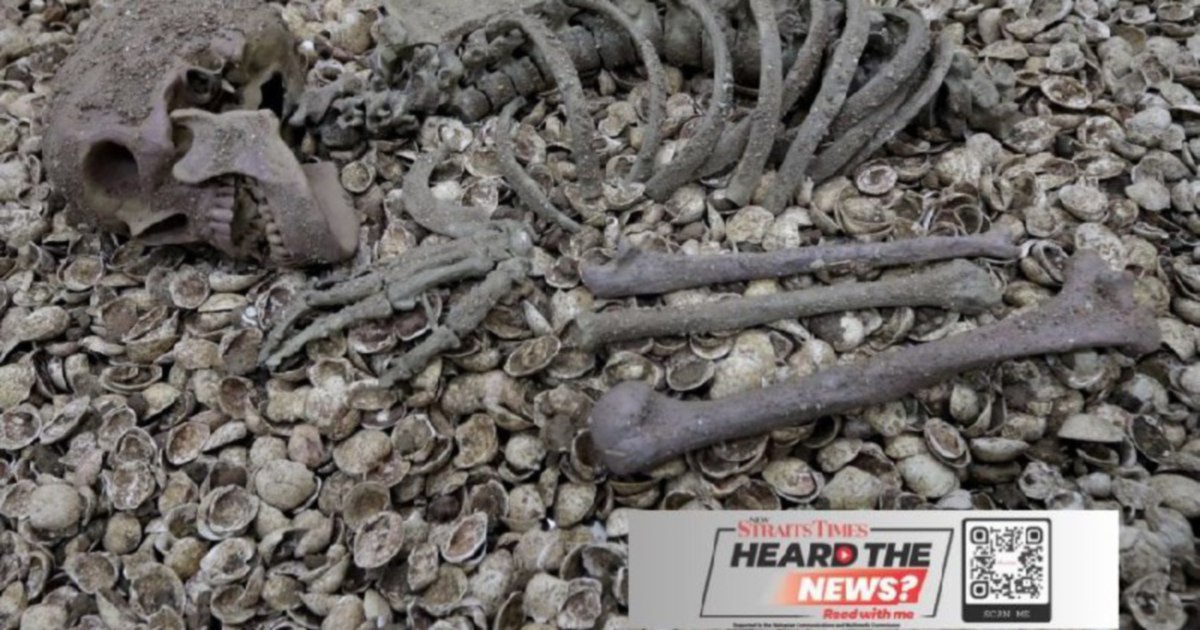
GEORGE TOWN: Forty-one ancient human skeletons excavated from the Guar Kepah shell middens by British archaeologists between 1851 and 1934 are set to be returned to Penang next month — nearly a century after they were taken abroad.
State Tourism and Creative Economy Committee chairman Wong Hon Wai said Malaysian representatives travelled to the Netherlands to formally receive the skeletal remains, now under the custody of the National Heritage Department.
The skeletons had been on display at the National Natuurhistorisch Museum in Leiden for decades before the Penang and Malaysian governments initiated discussions with the Dutch authorities for their repatriation.
“We are scheduling a handover session next month with the National Heritage Department and the Tourism, Arts and Culture Ministry,” he said after attending the project handover ceremony for the automotive gallery in Jalan Macalister here yesterday.
Meanwhile, an official opening ceremony for the Guar Kepah Archaeological Gallery, where the skeletons would be kept, would be arranged soon.
“The prime minister is expected to officiate at the ceremony in the first quarter of next year,” he said, adding that more time was needed to properly prepare the exhibits.
The gallery was originally slated to open last year but was delayed pending the return of the skeletons.
In December 2022, the New Straits Times reported that the Penang government was expecting the repatriation of several dozen skeletons from the Netherlands in the first quarter of 2024.
DutchNews.nl reported at the time that the skeletons, believed to be around 5,000 years old, were excavated by British archaeologists in Penang between 1851 and 1934.
The Guar Kepah site consists of three shell middens — A, B and C — from which the 41 skeletons were excavated.
Shell middens are accumulations of kitchen waste, primarily shells and food remnants, and serve as important indicators of ancient human settlements. In some cases, they were also used as burial sites.
Earlier in August 2022, the NST also reported that researchers from Universiti Sains Malaysia achieved a major breakthrough five years after discovering a prehistoric human skeleton, dubbed the “Penang Woman”, believed to be at least 5,000 years old.
With the help of Cicero Moraes, a 3D graphics expert from Brazil, they used a 3D virtual reconstruction method to recreate the Penang Woman’s facial features based on scientific data obtained from a CT scan on the skeleton.
The skeleton was found in the shell midden C during clearing work for the construction of the Guar Kepah gallery in Kepala Batas in 2017.
© New Straits Times Press (M) Bhd