
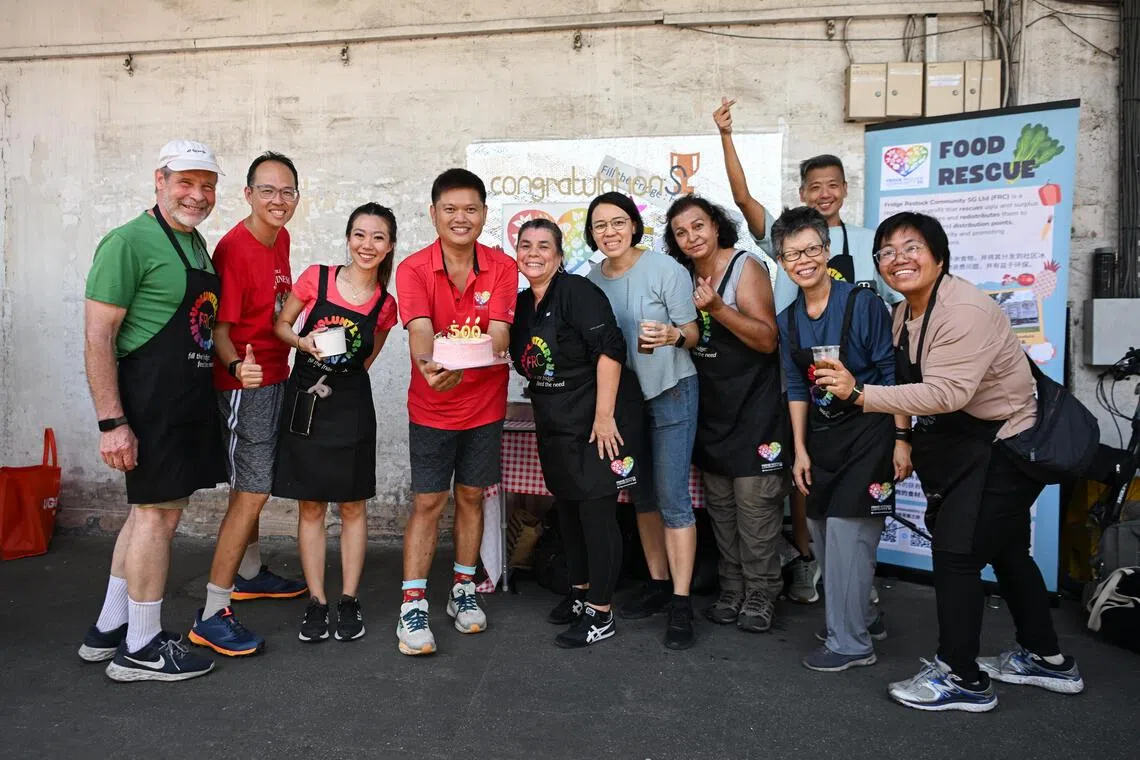
SINGAPORE – Five years after its first humble mission, Fridge Restock Community (FRC) has reached its biggest milestone yet – completing its 500th food rescue.
The group has saved more than 1.6 million kg of “ugly” produce from going to waste.
On Dec 5, it marked the event at Pasir Panjang Wholesale Centre, where its rescue missions take place.
The non-profit has grown from a small volunteer-led effort into one of Singapore’s most active food waste fighters.
Since its founding in 2020, the organisation has rescued about 75 truckloads worth of produce from being thrown away and used it to stock community fridges and distribution sites islandwide, said its founder, Mr Daniel Yap, 48.

A basket of rescued vegetables and fruits collected by FRC volunteers on Dec 5, 2025.
ST PHOTO: AZMI ATHNI
Produce typically thrown away includes potatoes, long beans, pineapples, oranges, tomatoes and watermelons, usually marked with black spots and darker roots.
According to the National Environment Agency’s website, the total amount of food waste generated in Singapore in 2024 was 784,000 tonnes.
Today, FRC supports 44 distribution locations islandwide, set up by community centres and residents’ networks, Mr Yap added.
The rescued produce reaches an estimated 6,700 households each month, supplying lower-income communities with fresh produce that would otherwise be thrown away.
The 500th rescue, like all previous missions, was carried out without fanfare, with volunteers methodically collecting, sorting and loading produce onto lorries for delivery across the island.

The rescued produce, which typically includes potatoes and other vegetables marked with black spots, reaches an estimated 6,700 households each month.
ST PHOTO: AZMI ATHNI
“When we first started, I never expected we would come this far,” said Mr Yap, recalling how much of the early work involved convincing retailers at Pasir Panjang Wholesale Centre to set aside produce for rescue.
“Our presence every week touched their hearts, when they saw how we distributed this ‘ugly’ produce to our partners.”
Mr Yap, who was a
finalist for The Straits Times’ Singaporean of the Year award in 2024
, said the organisation faced numerous challenges – a lack of volunteers and funding, and even scepticism from residents who were unfamiliar with rescued produce.
“Residents can be quite fussy when they see fruits and vegetables that look rotten,” he said, adding that public perception and awareness matter.
“We really depended on the help of community volunteers at our distribution points to explain to them that even if the produce is not perfect, it is still edible.”
The organisation started with weekly rescues in 2020 that increased to twice a week in 2023, said Mr Yap. This was supplemented by additional monthly Friday missions in 2024, which grew to two or three a month in 2025.

Expressing gratitude to volunteers, donors, wholesalers and community partners, FRC founder Daniel Yap said: “We will not stop here.”
ST PHOTO: AZMI ATHNI
Nine missions were conducted in 2020, followed by 54 in 2021, 99 in 2022, and 104 missions in 2023. The following year saw 113 missions, and as at Dec 5, the organisation has carried out 121 missions in 2025, bringing the total to 500 rescues.
While Mr Yap does not have data on the number of beneficiaries from 2020 to 2022, in 2023, Food Restock Community helped about 5,000 families.
The number increased to 6,400 in 2024, and as at September, 6,700 families benefited from the produce in 2025.
In total, the organisation provides fruits and vegetables to 14 community fridges and 30 distribution points.

FRC has more than 50 active volunteers, as well as some occasional student volunteers and corporate employees who join through educational programmes and corporate events.
ST PHOTO: AZMI ATHNI
The largest food distribution point is at Bishan Community Centre, which serves 500 households per distribution, Mr Yap said.
“Residents are also educated about rescued produce and encouraged to incorporate ‘ugly’ vegetables and fruits into their daily meals,” he said.
“This approach not only ensures that the rescued food is used effectively, but also raises awareness about reducing food waste within the community.”
Food waste is a problem both in Singapore and globally, and one-third of all food produced is lost or wasted – around 1.3 billion tonnes of food annually, according to the Food and Agriculture Organization of the United Nations.

A salad made from rescued vegetables and fruits by FRC volunteer Barbara Nicaud, 57.
ST PHOTO: AZMI ATHNI
From 2021 to September 2025, FRC collected more than 1.6 million kg from its rescue missions, in addition to more than 120,000kg from ad-hoc rescues. In 2024 alone, the group rescued nearly 490,000kg of produce, a 55 per cent increase from the previous year, said Mr Yap.
By 2025, the average weekly haul reached a record 10,554kg, with total weekly rescues now ranging between 8,000kg and 9,000kg, he added.
The organisation has more than 50 active volunteers supporting these rescue missions, said Mr Yap, along with occasional student volunteers and corporate employees who join through educational programmes and corporate events.
Volunteers Kiwi Lim, 51, and Barbara Nicaud, 57, have been with FRC since 2020, and have seen it grow to both help reduce food waste and support the community.
Mr Lim, who works in real estate, recalled crying during his first mission, saying: “I had tears coming down my face because I saw the food that was being thrown.

Volunteers Barbara Nicaud (left), 57, and Kiwi Lim, 51, have been with FRC since 2020.
ST PHOTO: AZMI ATHNI
“The food you see is market quality, and when I saw so much being thrown away… I thought about the families and people out there who have to go hungry at night, and I cried.”
That experience convinced Mr Lim to become a regular volunteer. “We believe that food should be free and given to everyone who needs it,” he said.
Ms Nicaud, a private chef, said volunteering opened her eyes to food insecurity in Singapore. “Through rescuing, I learnt that the responsibility falls on everyone to be responsible for the amounts of things that are being thrown away.”
Both volunteers hope more individuals will volunteer with the organisation and do it regularly, to develop a “rhythm” to the rescue. “Volunteering makes you think not just about yourself, but also those around you,” Mr Lim said.
At 190 Boon Lay Drive – the site of the 500th rescue distribution – trolleys lined the void deck as residents waited for their turn to collect rescued food. About 3.2 tonnes of food was ready to be distributed to more than 300 families.
The Boon Lay resident network volunteers organised them with queue numbers, and priority was given to those in wheelchairs and those with trouble walking.
Boon Lay resident Ng Poh Zhu, 64, said the weekly distribution is a lifeline for many in the area, which is surrounded by rental flats.
“Residents can save money,” she said, recalling that she first collected a bag of produce in 2020.

About 3.2 tonnes of food was ready to be distributed to more than 300 families.
ST PHOTO: AZMI ATHNI
Queueing for vegetables and fruits, a weekly thing for some 100 residents, has allowed them to make friends and catch up with each other, said Ms Ng, who is retired and is part of a team that helps to hand out produce to residents here.
“I am quite close to most of the residents here,” she said. “They are very happy (during the distribution), especially those who live alone.”
Mr Yap said FRC’s work will continue beyond its 500th mission, as it looks to support even more families by the end of 2025.
Expressing gratitude to his passionate volunteers, donors, wholesalers and corporate and community partners, Mr Yap said: “We will not stop here, and we will continue what we are doing for the environment, and for the community.”