
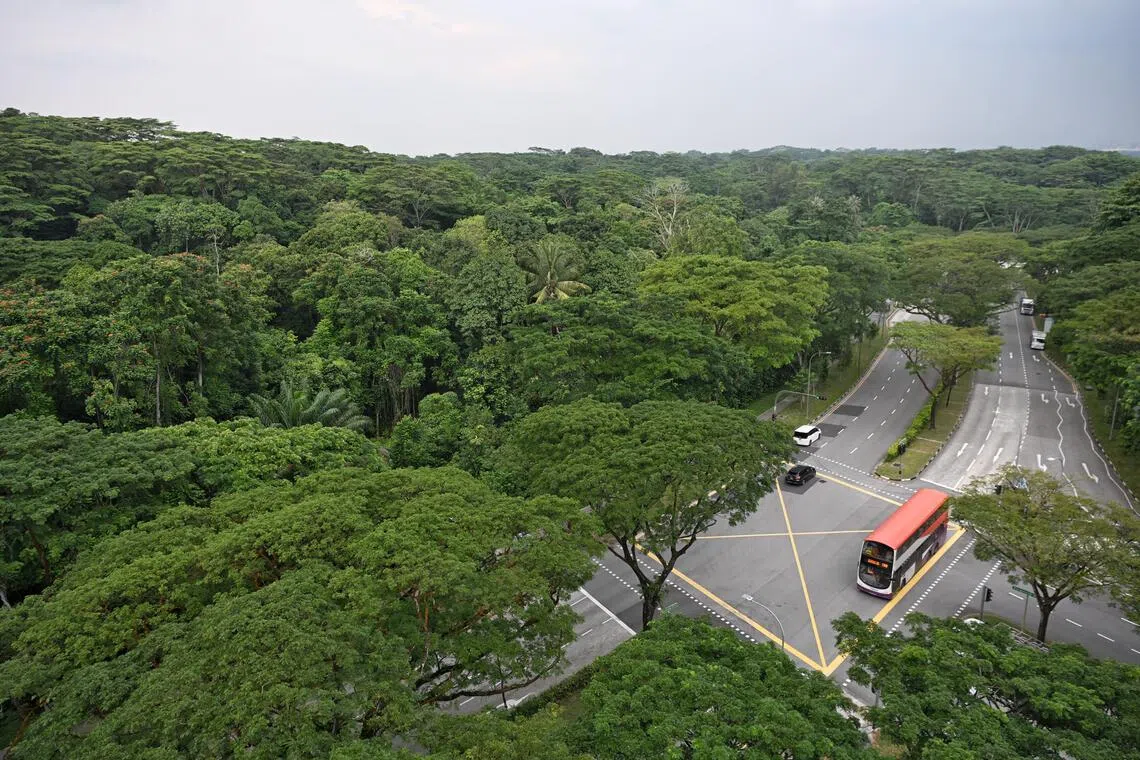
SINGAPORE – More than 52ha of forested land and streams near Nanyang Technological University is slated to be cleared for the expansion of an industrial district in Jurong.
JTC Corporation said on Dec 1 that the clearance is for the development of CleanTech Park and Bahar precinct of the
620ha Jurong Innovation District, a five-district advanced manufacturing hub
which has been progressively built since 2019.
The 116ha project site for CleanTech Park, which will be Singapore’s first eco-business park, and Bahar is located along Jalan Bahar, near the Pan-Island Expressway intersection.
Larger than Thomson Nature Park, the forested area comprises a mix of mature forest patches, vegetation that has recolonised abandoned kampungs and plantations as well as forest streams, a rare habitat here that cannot be easily re-created.
A total of 56 flora and fauna species significant for conservation are expected to be affected, including the heavily trafficked Sunda pangolin and the harlequin butterfly, a reddish brown insect adorned with silver spots on the brink of extinction in Singapore.
The size of the area was tabulated by The Straits Times based on figures in an environmental impact assessment commissioned by JTC Corporation, that was released for public consultation on Dec 1.
The report, prepared by consultancy Aecom Singapore, proposed that about 14.5ha of the natural areas be retained as parks as well as other measures to limit environmental damage caused by the project, which cuts into a key ecological corridor here.
These spaces will preserve the only known active breeding hotspot for harlequin butterflies on mainland Singapore, and protect trees that harbour a group of non-synchronous bent-winged fireflies and roosting spots for bamboo bats considered to be nationally vulnerable.

A male harlequin butterfly.
PHOTO: KHEW SIN KHOON
On the other hand, total loss of the area’s forest patches and streams – when combined with other concurrent projects like HDB’s Tengah Town and the nearby MRT station – will result in major impact on flora and fauna that depend on these areas for survival, the report said.
The
project area
cuts into one of Singapore’s four key ecological corridors – a chain of forested areas used by fauna to move between Western Catchment Forest and Tengah Forest.
The loss of this corridor would create a “bottleneck” for wildlife moving between these two biodiversity hotspots, the report said.
This will be especially detrimental for forest-dependent species that rely on the linked habitats to move around, such as the harlequin butterfly, the Sunda pangolin and leopard cat.

A Sunda Pangolin in Windsor Nature Park.
PHOTO: NPARKS
The 596-page report, which compiled data collected between February 2023 and November 2023, also noted that forest habitats make up less than 30 per cent of Singapore’s land area.
Other measures proposed by the report to limit the development’s environmental impact, including trans-locating flora where possible, and building passageways for wildlife.
However, even with these mitigative measures, the loss of over 40 per cent of habitats and food sources will take a major toll on wildlife.
JTC said that it will study how to retain the natural areas to complement existing green spaces in Jurong Innovation District such as The Potter’s Garden – the recently rejuvenated 5ha park that was formely Jurong Eco-Garden.
The developer said it will adopt some recommendations in the report. This includes clearing the site in phases and evaluating the feasibility of planting native vegetation to strengthen existing forest areas.
Conservationists and scientists welcomed the proposed mitigation plan, but called for the proposed measures to be refined, as well as for tougher action to blunt the impact on wildlife.
Butterfly enthusiast Khew Sin Khoon said that while JTC has agreed to defer development of the breeding ground of the harlequin butterflies as long as possible, it should not be turned into a public park with man-made amenities.

Artist’s impression of CleanTech Park in Jurong Innovation District.
SOURCE: JTC
The architect, who was consulted by JTC along with other nature groups, said: “This is usually the opposite of what we should do for sensitive conservation efforts, where critical sites should be left untouched and monitored.”
He cited the example of Dover West, where after discussions with nature groups, HDB designated half of the site meant for housing flats as a conservation park, with no easy access for the public.
On the bright side, the harlequin butterflies have successfully survived being relocated to Sungei Buloh Wetland, and have also been regularly spotted at the former Jurong Eco Green near the planned expansion.
Said Mr Khew: “Whilst not as many are seen at the same time, at least there is hope that they have moved laterally across the Cleantech buildings and found a new place to breed.”
Dr Charlene Yeong and Ms Sharon Chan, representatives of the Singapore Pangolin Working Group, said that although the report is comprehensive, several aspects had to be reconsidered to ensure that the critically endangered mammal thrives.
For instance, the report did not adequately address what happens to pangolins after they are displaced from the site. The representatives called for habitat enhancement or expansion in nearby areas, which will also minimise the
chances of pangolins being killed on the road
.

They cautioned that the extensive hoarding plan could also create barriers for pangolins, which are known to be active in the area near Nanyang Avenue, which may wind up on the road. Dr Yeong and Ms Chan urged JTC to find ways to provide safe passage for the animals, such as road closure at night.
They also called on the project to safeguard the ecological corridor, suggesting that existing waterways can be adapted to act as animal corridors to minimise roadkill.
Mr Sankar Ananthanarayanan, a co-editor of conservation initiative Singapore Terrestrial Conservation Plan, lauded JTC’s plan to study the areas for retention and to rehabilitate existing vegetation.
However, the NUS doctoral candidate studying local reptile extinctions warned of long-term drawbacks that arise from translocating wildlife to nearby green spaces.
“Even if flora and fauna found in these spaces are translocated to protected sites, it is restricting the populations to a smaller area, potentially placing additional pressure on the ecosystems they are a part of.”
The environmental impact assessment is available for viewing and feedback at
https://www.jtc.gov.sg/about-jtc/championing-sustainability/environmental-studies
till Dec 28.
JTC said it will review the findings and recommended mitigation measures in the report, as well as the feedback received during the public disclosure period, before finalising the mitigation measures it will undertake, and the extent of development works for the project site.
Meanwhile, non-invasive site preparation works such as soil investigation and surveys will begin in the first quarter of 2026.
JTC said construction works will only proceed after both the environmental impact assessment report and development plans are finalised.