
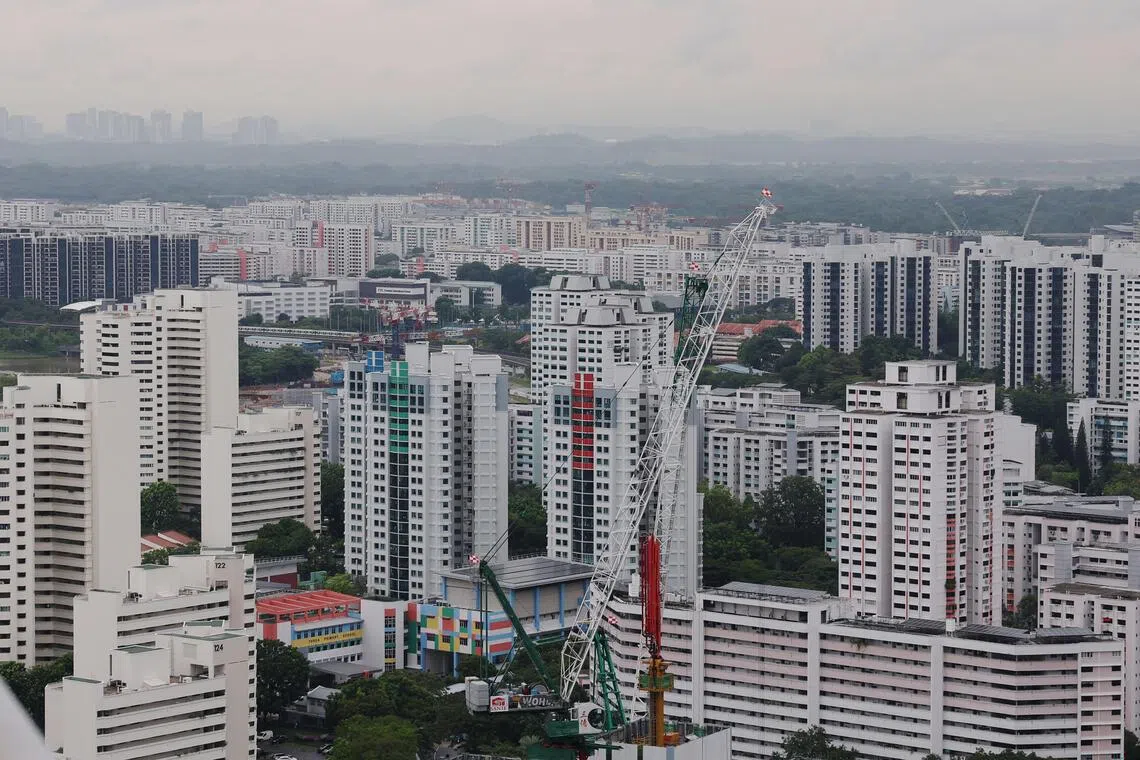
SINGAPORE – Residents were less satisfied in several aspects of HDB living – including cleanliness, noise level and privacy within their flats – although overall levels mostly remain above 90 per cent.
Satisfaction levels dropped in 13 out of 17 areas compared with the previous survey in 2018, results of the
latest HDB Sample Household Survey published on Nov 27
showed.
About 7,000 households and more than 1,600 single occupiers across all HDB towns and estates were surveyed in 2023 and 2024 for the latest study, which is conducted once every five years.
The survey, which asked respondents about their level of satisfaction with 20 areas of the HDB physical living environment, found that the areas with the lowest satisfaction were noise levels and cleanliness.
Satisfaction with noise levels had slid to 74 per cent in the latest survey from 75.7 per cent in 2018, while that for cleanliness fell to 76.4 per cent from 77.4 per cent.
In its report, HDB said the main reasons for dissatisfaction with noise levels were disturbances by neighbours or noise from the external environment, such as from traffic.
The reasons cited regarding cleanliness were irregular cleaning and inconsiderate behaviours such as littering and hoarding of common areas.
Professor Sing Tien Foo, provost’s chair professor of real estate at NUS Business School, said that as HDB has maintained a very high standard for public housing, residents tend to be sensitive to “soft” components that affect their daily lives, such as cleanliness and noise disturbances.
“These factors are much more difficult for HDB to plan for, and would require residents to play a bigger role in mitigating noise and to take greater responsibility for keeping their neighbourhood and the surrounding areas clean,” he said.
Remote working could have also led to
the decrease in satisfaction for cleanliness and noise levels, as such people would be directly affected by the living environment due to being at home for longer periods, he added.
Other areas that saw a fall in satisfaction included the size of flat, view from flat, spaciousness of housing estate and the ease of cycling within the respondent’s HDB town.
The highest drops compared with 2018 were: maintenance of the housing estate, which went down by 6.9 percentage points to 85.5 per cent, privacy within flat (down by 6.6 percentage points) and variety of flat types offered (down by 4.9 percentage points).
Meanwhile, four areas showed an increase in satisfaction. Safety from traffic, safety measures within the precinct and provision of carpark went up marginally, between 0.1 and 0.9 percentage points, while the purchase price or rental rate of the respondent’s flat was up 7.4 percentage points to 88.9 per cent.
Three areas – wayfinding within estate, accessibility or walkability to transport nodes, and amenities and services – could not be compared with the 2018 survey as they were new or asked differently. This section of the report was introduced in 2018.
Sociologist Tan Ern Ser, an adjunct principal research fellow at the Institute of Policy Studies, said the percentage changes up or down were marginal and not statistically significant, but they could have social significance.
For instance, the decreased satisfaction levels relating to noise and cleanliness could be a result of the lack of civic consciousness shown by some residents, he said.
ERA Singapore key executive officer Eugene Lim said there has been a shift in how HDB homes and neighbourhoods are built and designed, which could have led to satisfaction drops in areas such as size of flats and variety of flat types offered.
He noted that flats have become smaller in size – currently, four-room flats are typically between 86 sq m and 89 sq m, compared with 90 to 104 sq m in older flats built in the 1980s and 1990s.
Fewer five-room flats are also being offered in Build-To-Order (BTO) sales exercises, with such larger flats being confined to non-mature estates, he added.
Pointing out that satisfaction levels for “view from flat” dipped by 4.1 percentage points to 87.8 per cent, Mr Lim said many newer HDB units face inwards in their estate, overlooking other blocks or communal areas such as the multi-storey carpark.
“While some new HDB developments are trying to address this by adding sea-view or waterfront-facing units, these improvements benefit only a small number of flats, usually those on higher floors or with advantageous orientations,” he added.
Mr Nicholas Mak, chief research officer at property portal Mogul.sg, said that while the differences in satisfaction level were mostly muted, sentiments on the purchase price or rental rate of respondent’s flat saw the most significant change with its 7.4 percentage point increase.
“Despite the rise in prices of HDB resale flats and BTO flats in 2023 and 2024, the survey result indicates that the respondents view the HDB flats as value for money,” he said, noting that the rise in private home prices could have played a part in perpetuating this view.
A new three-bedroom condominium unit in the suburbs – which would be around the size of a four- or five-room flat – would cost about $2 million to $2.5 million currently, he said.
The report also found that respondents were more likely to be proud of their flat the longer they live in it, with the sense of pride being the highest, at 67.1 per cent, among households that have lived in their flat for more than 30 years.
Meanwhile, those who have lived in their flat for 20 years or less showed higher proportions of being neutral or not proud of their flat.
Prof Sing said these findings suggest that frequent movers would not be able to grow their sense of belonging, familiarity with neighbours and with their living environment.
The 10-year minimum occupation period for Prime and Plus BTO flats should therefore not be perceived as a negative factor in selecting these flats, he added.