
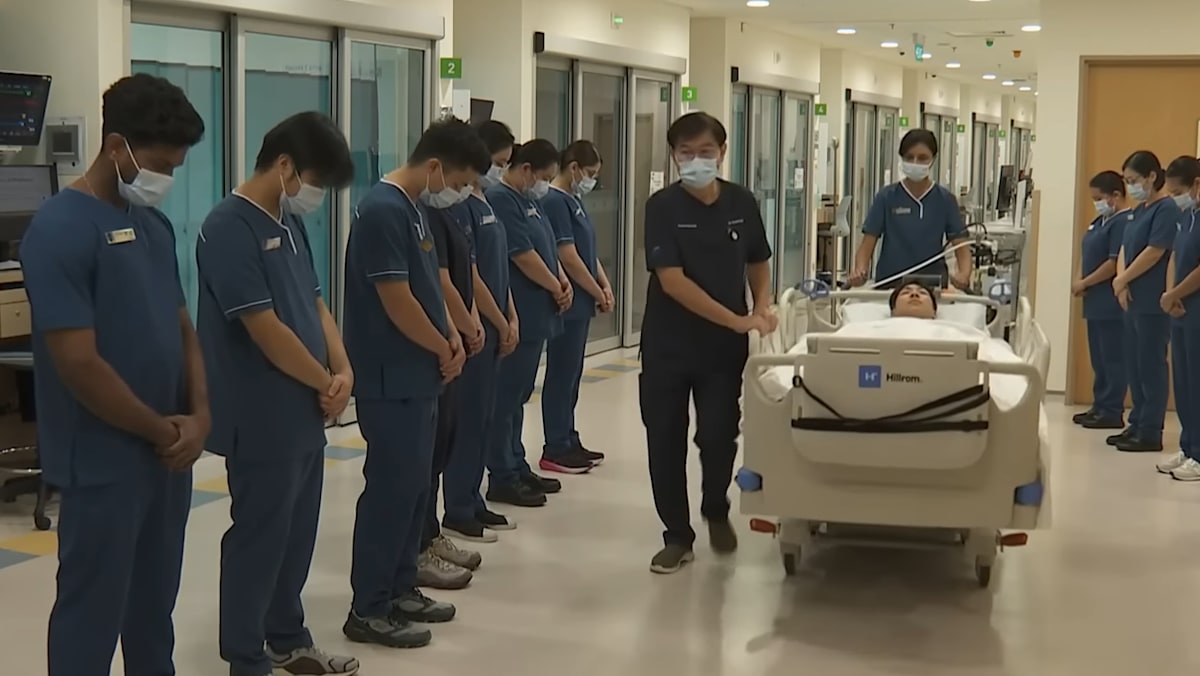
While a single donor can save up to seven lives, the annual number of deceased donors remains in the low double digits, according to data from the ministry.
Each donation requires fast, tightly coordinated work across multiple hospital units – all while ensuring the donor’s and family’s wishes are respected.
HOW ORGAN DONATION WORKS
Organ donation in Singapore is governed by two legal frameworks.
The Human Organ Transplant Act covers the kidneys, heart, liver and corneas. It applies to all Singapore citizens and permanent residents aged 21 and above who are not mentally disordered, unless they have opted out.
Those who opt out will have a lower priority on waiting lists if they need an organ transplant in the future. Opt-out rates have stayed stable at 3 per cent annually.
The second framework is the Medical (Therapy, Education and Research) Act. It allows all nationalities aged 18 and above to pledge additional organs, tissues or even their whole body for transplant, education or research.
On average, about 800 people have made such pledges every year for the past five years.
However, organ donation may not work out for various reasons, including unsuitable conditions or the absence of consent from a donor’s next-of-kin under the Medical Act, said MOH.
Last year, 16 patients with end-stage kidney failure did not receive a transplant because organ donation could not proceed.
“This underscores the importance of having timely conversations and making one’s organ donation preferences known, so that our loved ones are able to make informed decisions with clarity and confidence,” added an MOH spokesperson.
Ms Kong said having such a conversation is “indeed very sensitive and very challenging”, both for family members and the healthcare team.
She recounted a situation where a donor’s son was doubtful about whether his mother truly understood the laws and willingly consented to donating her organs.
The team acknowledged that it was a very difficult time for the family and supported him along the process, she added.
For families suddenly confronted with loss, such support can make the difference between clarity and uncertainty.
“At the end of it, he found comfort that his mother’s action could impact so many lives, because it was not just the recipients but also the family’s lives that the mother had saved in a way,” Ms Kong added.
“After the donation, he expressed gratitude to the team for being there for him, caring for the family and also caring for their mother, and he invited the team to the wake (where) he proudly shared with the attendees how (his) mother’s gift left a lasting legacy.”
Healthcare workers now undergo regular training on how to navigate such conversations as part of end-of-life care.
MOH also runs the Live On campaign to foster broader discussions and awareness about organ donation in Singapore.
Those interested in making their wishes known can log in to the Organ Donor Registry with Singpass to update their donor status.