
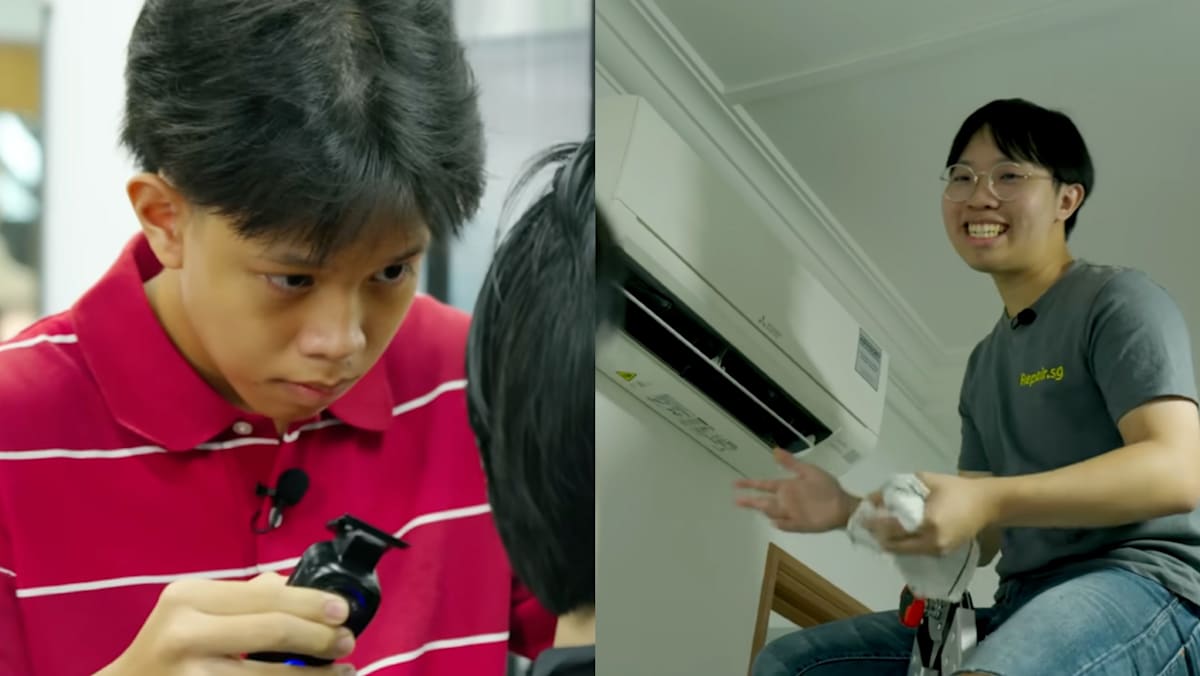
Then we have 26-year-old Zames Chew and his younger brother, Amos, who chose to become handymen right after graduating from polytechnic. Instead of pursuing degrees, the brothers jumped straight into entrepreneurship — and are now co-founders of a company with more than 20 staff.
Zames first conceived the idea of starting a repair services business when he was just 16. Fresh out of his O-Levels and still underage, he had his father register the company on his behalf.
Nine years on, their company, Repair.sg — which offers handyman, plumbing, electrical, pest control and air-conditioning services — recorded S$1.7 million in revenue in 2024.
Zames shares: “Since young, we’ve always enjoyed fixing things, taking things apart, doing things that requires both our minds and our hands and so we [decided] to try and do something together.”
“It was nothing like what it is today, but we took it step by step from there,” he continues, adding that their parents were supportive of their choices, though they worried when they realised the brothers had no plans to continue with school.
When they first started, both Zames and Amos learned repair skills by watching YouTube tutorials. Over time, they took courses at institutions such as Singapore Polytechnic and BCA Academy to deepen their professional expertise and better serve customers.
Recalling their early struggles, Amos shares: “On a month-to-month basis, [our income] was fluctuating up and down. Sometimes, we didn’t even know whether this business was viable, and there were times we thought of giving up.”
It took years before the business turned profitable, but passion drove them forward — along with the satisfaction they found in building something of their own.
“We wanted to be able to sort of control our own destiny,” Amos adds.
When asked whether blue-collar jobs are more “future proof” than white-collar roles, Zames says: “I think there’s some truth to that saying, however, I think it’s important to point out that it’s not necessarily whether it’s blue-collar or white-collar. If the work you do simply follows a step-by-step process and you’re just supplying a unit of labor, it’s more likely to be replaced by AI.”
Amos adds his perspective: “A lot of young people are a lot more entrepreneurial now compared to 10, 20, years ago, so even in the blue-collar space, we are seeing some younger folks finding it more fulfilling, so that’s great.”
You can catch the full episode of Gen Z Crash Course on YouTube, or watch it below.