
SINGAPORE – Inmates who reside in halfway houses, or who are under community supervision, will be able to enrol in courses under a new initiative that will include on-campus training at educational institutes.
Yellow Ribbon Singapore on Dec 19 said it will curate courses to help inmates develop skills for sectors such as retail and food services.
Making the announcement at Temasek Polytechnic, Yellow Ribbon said the new hybrid model is being introduced under the SkillsFuture Career Transition programme (SCTP), a train-and-place certification initiative introduced in 2022.
The new initiative follows a successful pilot of the SCTP’s Environmental Services Specialist course, which was conducted from May to December.
It saw inmates start their training within correctional facilities in Changi Prison Complex and continuing on campus at Temasek Polytechnic.
When studying in the polytechnic, the inmates were moved to halfway houses or based at home as part of the community-based programmes, where they remained under community supervision.
From April 2026, Yellow Ribbon will expand its training pathways to enable more supervisees to pursue opportunities in their preferred sectors.
The courses will include offerings delivered by Continuing Education and Training Centres, including institutes of higher learning such as polytechnics.
Mr Leslie Jin, deputy director of skills at Yellow Ribbon, said the SCTP is a good opportunity for the inmates.
He added that the majority of the inmate population may not have a chance to go to a tertiary institution for education otherwise.
Mr Jin said inmates under the pilot programme benefited from learning in a structured, realistic working environment.
They also gained access to equipment that they would otherwise have been unable to encounter.
Most importantly, he said the hybrid approach significantly accelerated the training timeline, allowing more material to be taught in a few weeks, instead of a few months.
When ex-offenders successfully complete their sector-specific training, those who have secured employment will be presented with the SIM People Development Fund’s (SIMPDF) Progression Award.
The award, valued at $600 per recipient, is expected to benefit close to 80 inmates every year, from 2026 to 2028.
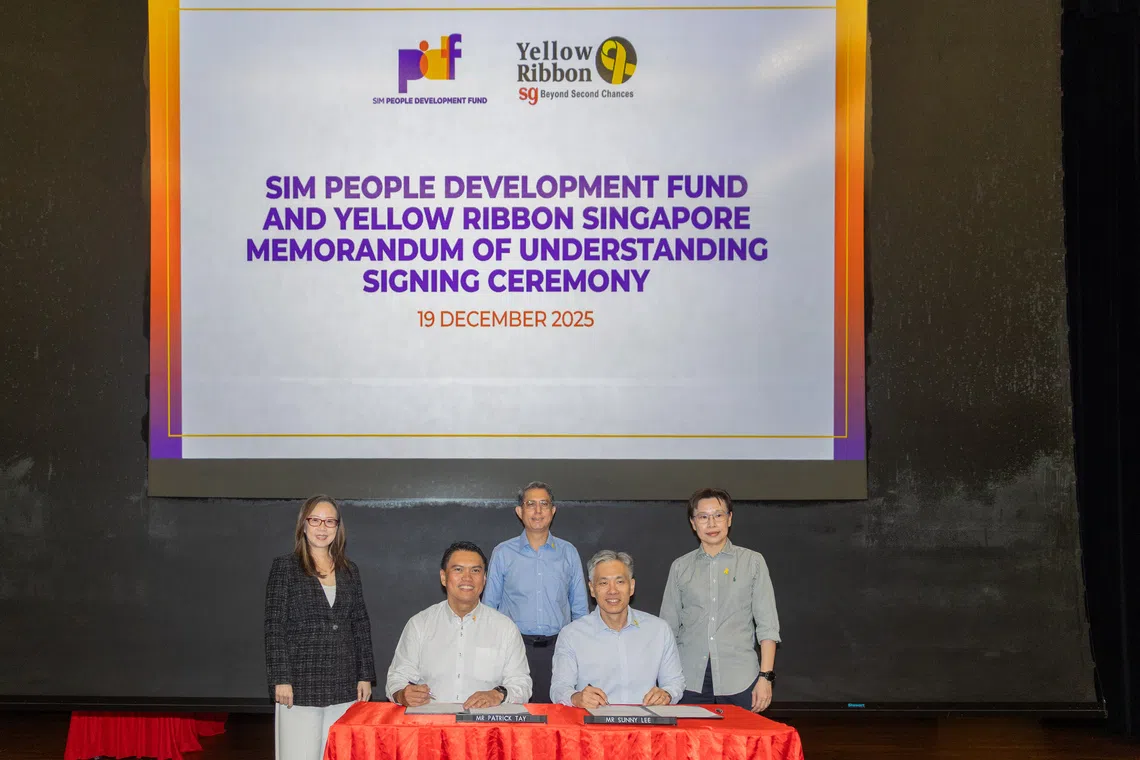
Yellow Ribbon on Dec 19 signed a three-year memorandum of understanding with SIMPDF, which pledged to commit up to $150,000 to support supervisees.
Mr Patrick Tay, chairman of SIMPDF, said the award would help offset expenses incurred over the course of the programme and serve as a powerful form of encouragement for ex-offenders as they embark on their new career.
Commenting on the new programme, Associate Professor Muhammad Faishal Ibrahim, Senior Minister of State for Home Affairs, described the rehabilitation process for inmates as a community effort.
“It involves the Government, industry, educators, donors and community partners all moving in the same direction,” added Prof Faishal, who is also Acting Minister-in-charge of Muslim Affairs.

Associate Professor Muhammad Faishal Ibrahim speaking at the event on Dec 19.
PHOTO: LIANHE ZAOBAO
The SIMPDF Progression Award was given to 23 supervisees, including 19 who have been offered employment at a recent job fair organised by Temasek Polytechnic and the Environmental Management Association of Singapore.
Dave (not his real name), who was among those who received the award, said he enrolled in the course because of his fascination with plants and animals.
He added that as part of his community supervision stint, he was allowed access to a phone and laptop.
These resources were unavailable to him during his time in Changi Prison.
Dave said the hybrid model of the course helped transform him into a more self-directed learner, adding that the award made him feel appreciated for his hard work.
Although his third incarceration had been fraught with difficulties, when he heard about the SCTP, he thought to himself: “This time, I want to make a change.”