
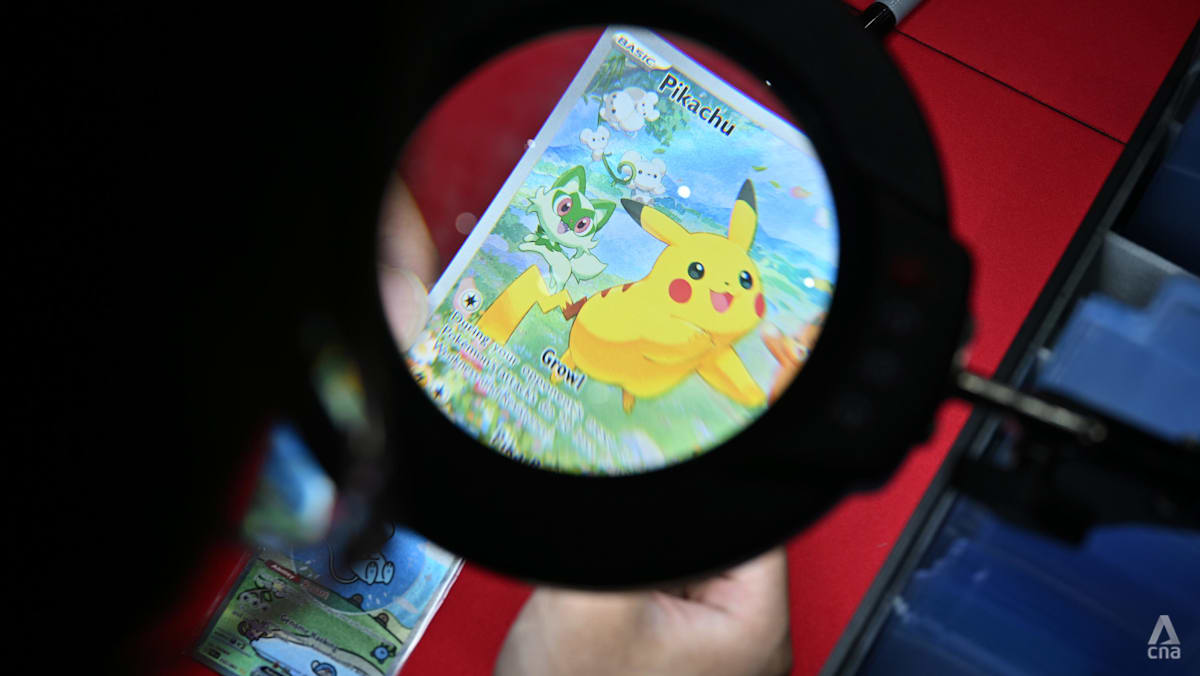
SINGAPORE: Under bright lights and high magnification, the corners are scrutinised, the surface scanned for the faintest scratch and the edges checked for symmetry.
Like gemstones, these highly collectible trading cards are being judged by tiny imperfections that could mean a difference of tens of thousands of dollars.
On most afternoons, this painstaking ritual plays out behind a glass counter, where Mr Fong Shi Wei, 36, can be found inspecting stacks of cards featuring Pokemon characters or sports personalities before they are sent abroad for professional grading.
Mr Fong is not a card grader – a title reserved only for a handful of establishments in the United States, Japan and South Korea that provide such services.
But in Singapore, the booming card collecting trend has fuelled a small but highly sought-after service known as “pre-grading”, a solution that Mr Fong has gladly provided since founding Concept Grading in Singapore.
“This shows how crazy this stage of the hobby is at and it’s not stopping,” Mr Fong said.
As a pre-grader, Mr Fong’s job is to assess the cards before they are sent for professional grading elsewhere. The overseas process that can take three months and cost at least S$35 per card – a small price to pay if a card is proven to be worth a hefty sum.
Nevertheless, the grading process could still get expensive quickly, especially given the fact that collectors often come to his shop with stacks of plastic sleeves and shoe boxes containing hundreds of ungraded trading cards.
Hence, pre-graders act like a filter – they provide an early assessment to help collectors decide which cards are worth submitting and which are unlikely to achieve a grade that justifies the expense. They also screen out lower-quality cards and help newer collectors better understand grading standards.
“We’re not the ones grading the cards, but we have experienced collectors working on our team that inspect the condition of the card and advise customers what should be sent for grading and what shouldn’t,” Mr Fong told CNA.
“So we look at the condition of the card and assess potential monetary value.”
Often, only cards in the top condition are sent to companies in the United States, Japan and South Korea for authentication and appraisal. Some notable firms are Professional Sports Authenticator (PSA), Certified Guaranty Company (CGC) and Beckett Grading Services (BGS).
The cards are then graded on a scale from one to ten depending on their condition, with ten being virtually perfect.
In October 2025, the value of these rare cards made headlines after the authorities said it was investigating a case of a 25-year-old man who had entered Singapore without declaring his cargo of assorted Pokemon trading cards worth more than S$30,000.
Rare cards are so in demand that a grade seven card can fetch eye-watering prices.
Mr Fong said he recalled how one customer handed him an old card he had found in storage – a 1997 signed basketball card featuring the late Kobe Bryant and likely worth more than S$90,000.
“Only 73 of these cards in the world,” he said.