
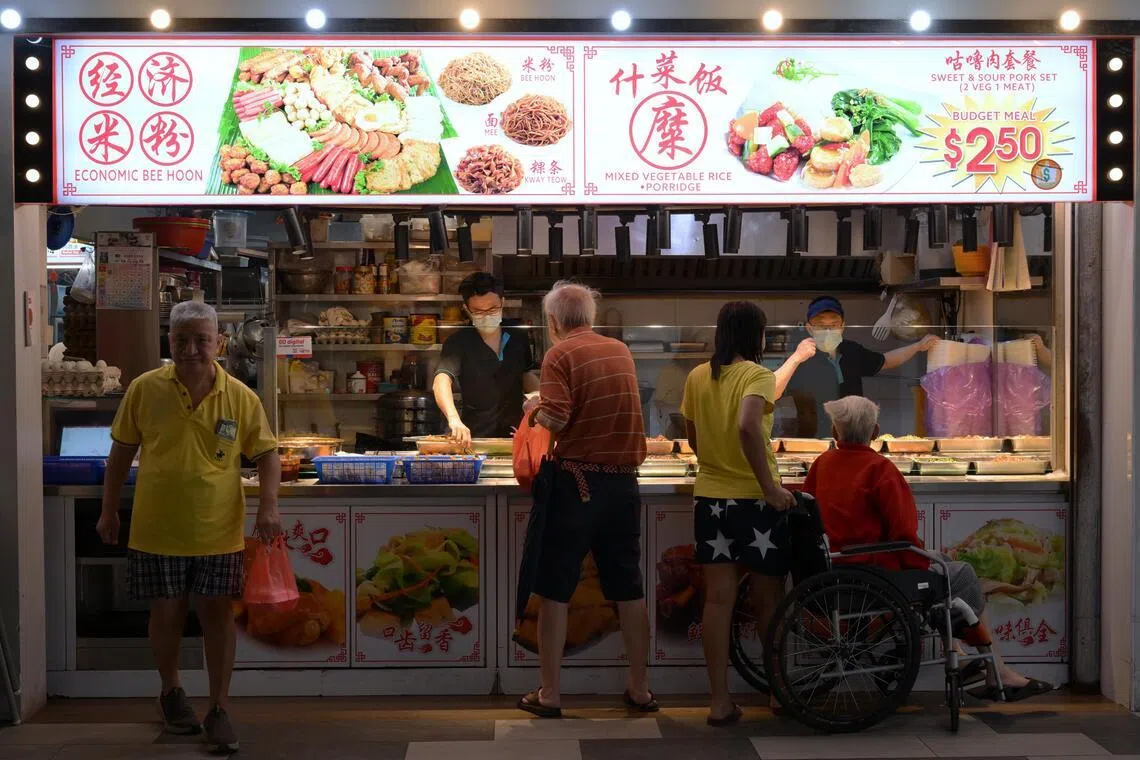
SINGAPORE – Coffee shop operators and stallholders said
making budget meals optional
will ease some pressure, given the challenges of rising costs.
The move also acknowledges shortcomings in
the previous scheme
, which had drawn some criticism over uneven food quality and low take-up among customers.
The Housing Board announced on Jan 10 that coffee shop operators renewing leases from that date would no longer be required to sell budget meals, a scheme aimed at keeping food affordable in the heartland.
Stallholders told The Straits Times that demand for budget meals varies widely, with some stalls selling as few as 50 meals a month while others sell around 50 a day. Several said keeping prices at $3.50 or less often meant serving smaller portions to manage costs.
HDB said it does not set budget meal prices, which are proposed by operators and typically priced at around $3.50.
At a FoodHub-operated coffee shop at Block 40 Margaret Drive, demand for budget meals varies widely. At Al-Madina Famous Prata Corner, the $2.50 option – consisting of rice, chicken, chicken curry, and cabbage – attracts about 50 customers a month.
Stall assistant Rahim said it mainly appeals to older patrons.
“Young people won’t be full,” he said, pressing his fingers together to show the modest serving. “It’s really meant for old people.”
At Shu Vegetarian, fewer than 40 budget meals are sold monthly. Stall assistant Ng Cheng Yong said the $2.50 meal is the same portion size as a regular dish but without mock meat, leaving only noodles and vegetables.
Demand is highest at the economy rice stall, which sells 50 to 60 budget meals daily. Each set, limited to two vegetable dishes and one meat dish with no substitutions, is kept small to meet the price cap, said Mr Wong Yin Keong, 48.
“This is old people’s food,” he said in Mandarin.
Mr Paul Kok, managing director of FoodHub, said that some stalls have struggled to offer budget meals priced at $3.50 or less amid rising operating costs. Some operators reduced portions to cope, which sometimes led to customer complaints.
Under the new optional framework, operators who choose to offer budget meals will receive more support. HDB-let coffee shops will get a 5 per cent rental discount across the full three-year tenancy instead of just the first year, while privately owned outlets will receive discounts on temporary occupation licence fees.
Participating operators must pass the full value of incentives to stallholders providing budget meals.
“If the amount is acceptable to the stallholders, we will opt in. But if it is not enough to cover expenses, we will listen to their feedback and may decide not to opt in,” said Mr Kok.

The revised scheme also standardises budget meal requirements. Operators who opt in must provide three meal choices and two drinks, including an economy rice option with one meat and two vegetable dishes, one halal meal, and one breakfast item.
Mr Kok said the managers of each FoodHub outlet will discuss with stallholders whether to opt in when leases are renewed, with each outlet making its own decision. Of FoodHub’s more than 40 coffee shops, about two are up for lease renewal in 2026.
Nearby, at a Koffee Time coffee shop in Block 85 Dawson Road, demand for budget meals is limited, with only about 10 orders a month at the Malay stall.
Ms Siti Aliza, who mans the stall, said most customers prefer to pay 50 cents to $1 more for a full meal.
Patrons said they understand the constraints that stallholders face. Ms Sharon, 58, who wanted to be known only by her first name, said: “They have to work within a price they can sell, so there’s only so much they can do.”
Another patron, who wanted to be known only as Madam Lee, 75, said the portions, though small, suit her needs. “What can you expect, given the price?” she said, adding that she appreciates the $2 breakfast set of coffee, two eggs, and kaya toast at the coffee shop in Margaret Drive.
“Not everyone can afford to eat more expensive food,” she said.
Mr John Tan, 35, who used to own and operate a coffee shop in Beo Crescent in Bukit Merah, said offering budget meals was a challenge. Stallholders were struggling to make ends meet as costs, such as electricity and utilities fees, had gone up, he added.
Mr Tan sold the coffee shop in 2024 but continued operating it until late 2025.
Veteran food critic K.F. Seetoh said the changes have no impact on operators, who are still collecting rents. But it is good news for hawkers, who will no longer be forced to offer budget meals with little demand.
He said stallholders “should have an open field to charge whatever they think is fair” as they know their customers best.
Mr Seetoh, who is the founder of local food guide Makansutra and curator of the Urban Hawker food centre in New York City, added that the changes are an acknowledgment that the previous scheme did not work as intended.
“It is good the Government has its ear to the ground, but they have to keep listening to the hawkers,” he said.
Mr Seetoh suggested alternative approaches in the spirit of keeping meals affordable, such as direct subsidies for hawkers. Those who are truly disadvantaged and need cheap or even free meals could be identified through a system similar to the CHAS card.
“Many hawkers are happy to give them a free or cheap meal and to pay it forward,” he said. It is unfair to put the pressure of “taking care of the poor” on hawkers struggling with the bottom line, he added.
Making the scheme voluntary improves its sustainability to some extent, he said. “It at least takes the burden away from hawkers.”
-
Additional reporting by Ng Sor Luan