
SINGAPORE, Jan 11 — Securing tickets to return home to Malaysia during Chinese New Year has become an annual challenge for many Malaysians working in Singapore, with airfares surging and alternative transport options quickly selling out.
The Straits Times reported that for logistics executive Tan Yik Xuan, getting a seat on a flight back to his hometown of Ipoh required early planning and a willingness to pay more.
The 26-year-old purchased his return tickets in October 2025 — four months ahead of Chinese New Year 2026 — paying about S$630 (RM2,174).
“It’s much more expensive than the usual off-peak fare of under S$320 (RM1,104),” he reportedly said, adding that he still prefers flying over taking a bus due to the shorter travel time and the ability to avoid traffic congestion.
Checks by The Straits Times in the week beginning Jan 5 showed that return economy-class tickets from Singapore to Ipoh for travel between Feb 14 and 19 cost between S$822 and S$1,222 (RM2,834–RM4,216) — more than six times the S$124 to S$191 (RM428–RM659) charged in the preceding week.
Chinese New Year falls on Feb 17 and 18, with many Malaysians travelling home for reunion dinners on the eve. Those making last-minute plans are expected to face steeper prices across air and land transport.
Return airfares to Kuala Lumpur in the days leading up to the festival range from S$420 to S$1,245 (RM1,449–RM4,290), compared with S$99 to S$345 (RM342–RM1,190) from Feb 7 to 12. Flights to Penang during the Feb 14 to 19 period cost between S$628 and S$1,049 (RM2,166–RM3,620), up from S$107 to S$469 (RM369–RM1,618) the week before.
Singapore Airlines and its budget arm Scoot declined to disclose booking figures, citing commercial sensitivities, but said they continue to see “healthy passenger demand” during the Chinese New Year travel period.
Bus fares have also climbed. Round-trip tickets from Singapore to Kuala Lumpur cost between S$89 and S$276 (RM307–RM952) for Feb 14 to 19, compared with S$51 to S$153 (RM176–RM527) in the previous week.
Return bus tickets to Penang during the same period range from S$198 to S$370 (RM683–RM1,277), while fares to Ipoh can reach between S$214 and S$330 (RM738–RM1,139).
By contrast, a week earlier, return bus tickets to Penang were priced between S$83 and S$133 (RM286–RM459), while trips to Ipoh cost between S$71 and S$104 (RM245–RM359).
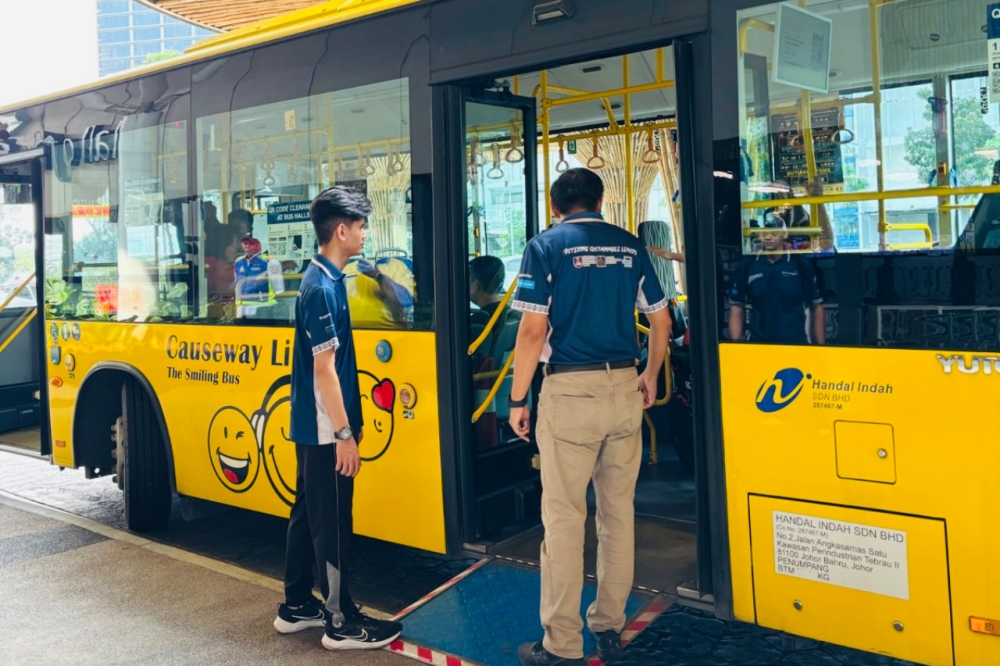
Malaysian bus operator Causeway Link said it expects heavy crowds and strong ticket demand during the peak season, adding that backup buses will be deployed when necessary. It declined to share ridership figures.
To keep costs down, insurance agent Lim Cin Min, 27, plans to take a Causeway Link bus from Woodlands Checkpoint to Johor Bahru before transferring to another bus at Larkin Sentral for her journey home to Batu Pahat on Feb 13. The entire trip will cost her about S$8 (RM28).
“That’s far cheaper than a direct bus, which can cost up to S$40 (RM138) during the festive period,” she said, adding that she prefers crossing immigration on her own rather than being stuck in traffic queues.
Meanwhile, some travellers are turning to rail following the launch of the first electric train service (ETS) from Johor Bahru to Kuala Lumpur on Dec 12, 2025. However, demand has been strong.
ETS tickets from Johor Bahru to Kuala Lumpur between Feb 13 and 16 are sold out, as are seats for the daily Johor Bahru–Ipoh service from Feb 11 to 22, except for designated wheelchair spaces.
ETS tickets from Kuala Lumpur to Butterworth for travel to Penang during the same peak period are also unavailable.
Tickets for the Keretapi Tanah Melayu Shuttle Tebrau linking Woodlands Checkpoint to Johor Bahru Sentral are similarly sold out from Feb 13 to 15.
Data analyst Justin K, 29, was among the few who managed to secure an ETS ticket, booking in December 2025 for a Feb 24 return journey from Kuala Lumpur to Johor Bahru.
He said extending his stay beyond the peak travel period allowed him to get a seat. For the outbound leg, he will fly to Kuala Lumpur on Feb 14 after failing to secure an ETS ticket, paying S$230 (RM794) for a one-way AirAsia flight — more than double the usual fare.
By comparison, his ETS ticket cost RM110 (S$35), including a RM20 festive surcharge.
“That’s a much more palatable increase than airfares,” he said, adding that he plans to rely on ETS for future trips home due to its punctuality, fixed travel times and comfort — even if it means booking weeks in advance.