
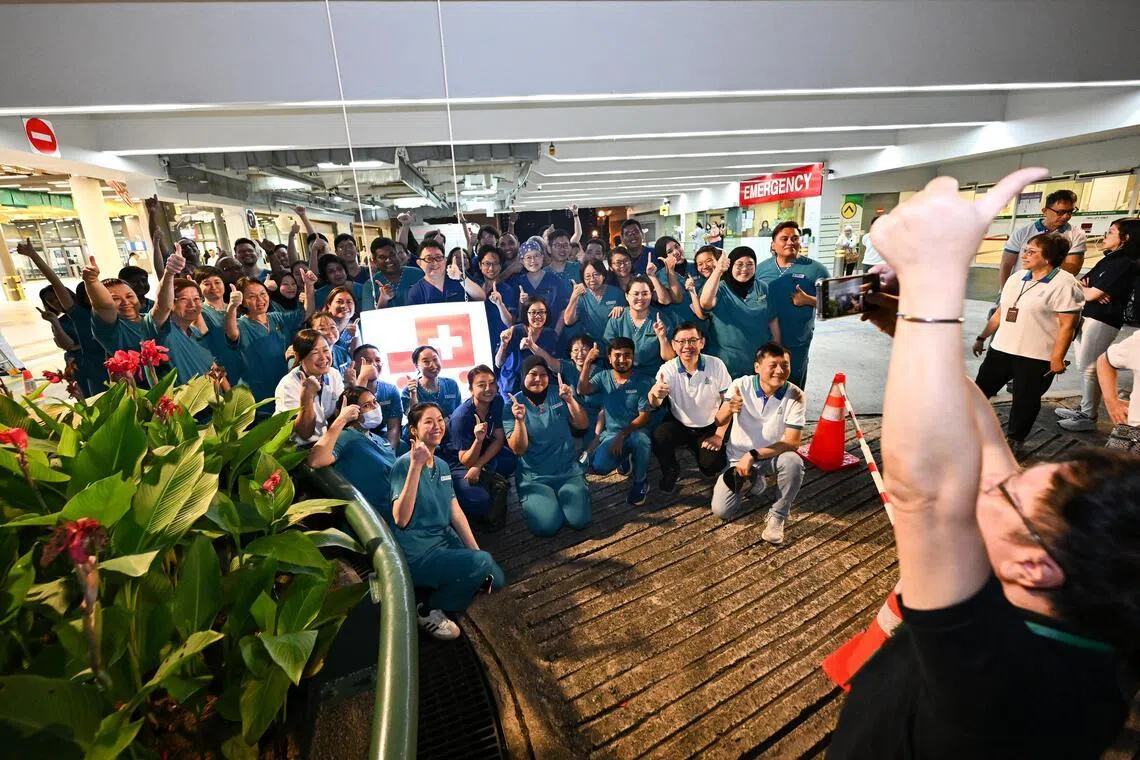
SINGAPORE – It was only 6.30am on Jan 18, but the area outside Singapore General Hospital’s (SGH) old emergency department (ED) at Block 1 was already a hive of activity as doctors in scrubs, nurses in uniform and ED operations personnel gathered to capture photos of the department’s former location before its 7am move to its new home.
At 6.48am, a lively group of nearly 200 people walked from the old facility to the SGH Emergency/National Neuroscience Institute building at 1 Hospital Boulevard.
The journey took only about a minute but marked a significant milestone in the hospital campus’ 20-year masterplan to
modernise its ageing infrastructure
and prepare for future healthcare needs.
What had been planned as a symbolic walk by eight nurses, a nurse manager and the ED head, Associate Professor Kenneth Tan Boon Kiat, before the start of the first shift at the new ED, grew into a group of more than 150 people in an unplanned show of solidarity to mark the move.

SGH staff carrying the old “emergency” sign to the new premises on Jan 18.
ST PHOTO: LIM YAOHUI
The groundbreaking ceremony for the building took place on April 3, 2018. It was expected to be ready by 2023, but the Covid-19 pandemic delayed its opening.
SGH, which traces its origins to a small wooden shed established in 1821 for British troops, started its emergency services as a “Casualty and Outpatient Service” in 1948. This evolved into the first 24-hour emergency unit in Singapore by 1964.
The hospital opened the ED at Block 1 in 1977 when demand largely came from a much-younger population. It was one of the first facilities to open its doors to the public when today’s SGH was rebuilt, said Prof Tan.
Moving an emergency department is one of the most complex relocations a hospital can undertake, and they have experienced this first-hand, he said.
“The biggest challenge we’ve faced is helping people navigate our split campus set-up. It can be confusing for patients and visitors because vehicular access to our ED is through College Road and Hospital Crescent, not through the main building entrance that most people expect,” he added.
The phased relocation began in December 2024, and the team had been operating at the former ED location while simultaneously preparing for a complete shift to the new location.
“It’s like trying to change the tyres on a moving car,” said Prof Tan.

The first ambulance arriving at the new emergency department at 8.31am on Jan 18.
ST PHOTO: LIM YAOHUI
The unpredictable nature of emergency services also makes any major change like a relocation much more complex, he told The Straits Times.
In his address to staff gathered at the new facility minutes before 7am, Prof Tan thanked them for their efforts and said the move is bittersweet for him.
“I think for all of us, this has been our fortress and home for a long time, and we have done many things together (including the Covid-19 pandemic and going back to business as usual),” he said.
The staff also received thanks from several members of the hospital’s senior management who were there to witness the transition. Those present included SGH’s chief executive, Associate Professor Tan Hiang Khoon; medical board chairman, Associate Professor Loo Chian Min; and chief nurse Ng Gaik Nai.

Associate Professor Kenneth Tan Boon Kiat speaking to staff at the new emergency department on Jan 18.
ST PHOTO: LIM YAOHUI
The excitement among staff was palpable. Nurse clinician Nur Aisah Sulaiman said she will miss the old ED, which was where friendships were forged during the Covid-19 pandemic, when staff from various departments were roped in to manage the surge in patients.
She was part of the 7am team staffing the first shift at the new ED, but had arrived at work half an hour earlier than usual at 6am to celebrate the department’s move with her colleagues.
To prepare for the new, larger ED, the hospital has increased its nursing staff over the past year, and ED nurses had been busy familiarising themselves with the new expanded facilities, Ms Aisah said.

The last batch of nurses working in the old emergency department taking a group picture before moving to the new premises on Jan 18.
ST PHOTO: LIM YAOHUI
The new ED, expected to be officially opened by June 2026, is much bigger and more advanced. For instance, it has 10 triage rooms, compared with four in the previous location, and 12 resuscitation rooms, an upgrade from the resuscitation area for six patients in the old ED.
Furthermore, it has a current capacity of 53 patients in the critical care area and 55 observation beds. In contrast, the old ED could care for only 15 patients at a time in the critical care area and its observation area had a capacity of 37 patients.
Ms Aisah, who has two young sons, said she was attracted to the adrenaline rush at the ED when she was transferred there from the internal medicine department six years ago.
The excitement has gone up a notch with the new space.
“It is not just about us working in a new environment with new equipment and in a new, bigger space, but it is about providing positive outcomes for patients,” she said.

The new emergency department, expected to be officially opened by June 2026, is much bigger and more advanced.
ST PHOTO: LIM YAOHUI