
There are two main types of dialysis to replace kidney function when kidneys fail. In Singapore, haemodialysis (HD) is more common. Blood is removed, cleansed and returned to the body in a procedure carried out at dialysis centres.
The other is home-based peritoneal dialysis (PD) where 1.5 litres to 2 litres of fluid is inserted into the abdominal cavity. Body waste passes through the peritoneal membrane into the fluid in the abdominal cavity for some hours before the fluid is drained, and a fresh supply is inserted.
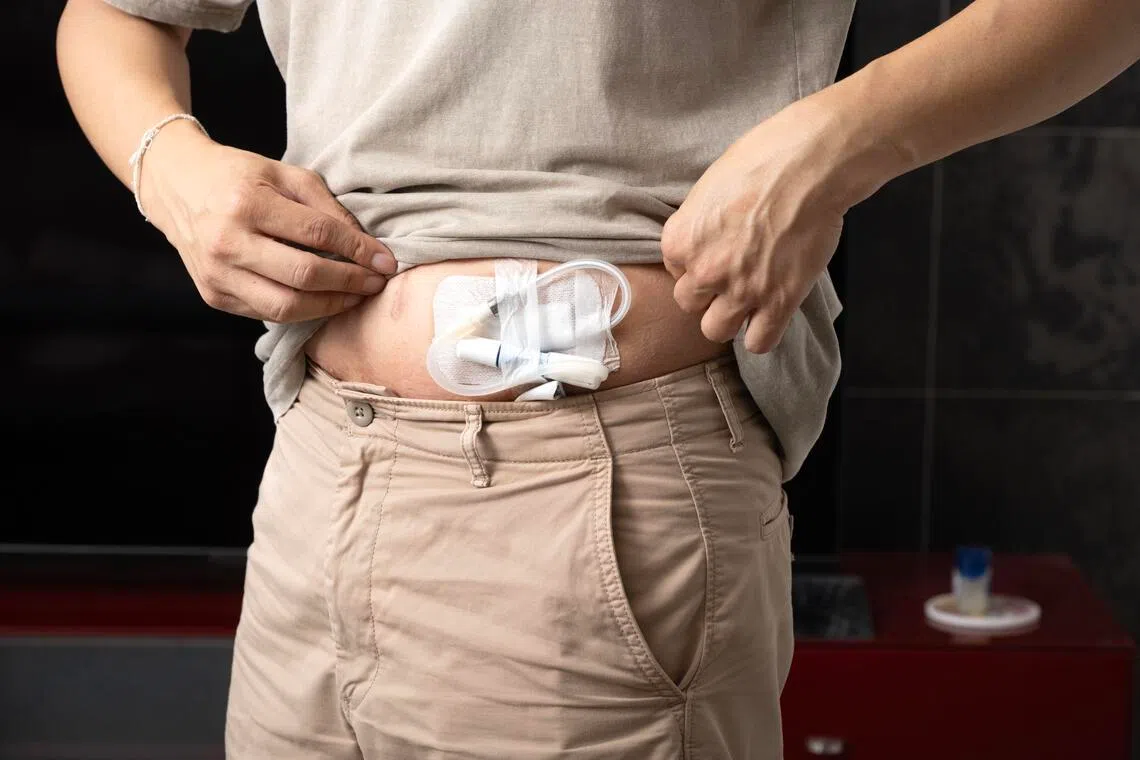
In PD, a permanent catheter is surgically placed, with one end in the abdominal cavity and the other on the outside to allow the dialysis fluid to flow into and out of the abdominal cavity.
There are two types of PD. Automated peritoneal dialysis occurs overnight with the help of a machine that cycles the fluid through the abdominal cavity three or four times over eight to 10 hours.
Continuous ambulatory peritoneal dialysis is done three or four times a day. It takes about 30 minutes each time to drain the fluid from the abdomen and replace it with fresh fluid. This can also be done outside of the home at a clean location.
In both types of PD, the fluid is left in the abdominal cavity throughout the day to continuously absorb waste. In cases where the kidneys are still working to some extent, the abdomen may be left dry between sessions.
The Ministry of Health has been urging hospitals and social service organisations to encourage patients who are eligible to opt for PD. Health Minister Ong Ye Kung said in 2024: “This is because PD can be done at the patient’s home, providing greater convenience and freedom to lead a more normal life, and with outcomes comparable to haemodialysis.”
It will also reduce the need to build more HD centres.
-
It is painless, done through a catheter, unlike HD where two thick needles are inserted for each dialysis session.
-
It is gentler on the body as it mimics natural kidney function and body rhythm.
-
It can preserve residual function in the kidneys for a longer period.
-
It saves time as patients do it at home instead of spending three to four hours at a dialysis centre three times a week.
-
Patients enjoy a more flexible lifestyle, including being able to travel easily.
-
There are fewer dietary restrictions, such as being able to drink more freely as fluid is removed daily. Patients on HD are usually limited to less than 1 litre of liquid a day, including gravy and soups.
-
Unlike PD where fluid is removed gently over time, HD is more aggressive, removing 2 to 3 litres in the three to four hours of dialysis, often resulting in a fluctuation in blood pressure.