
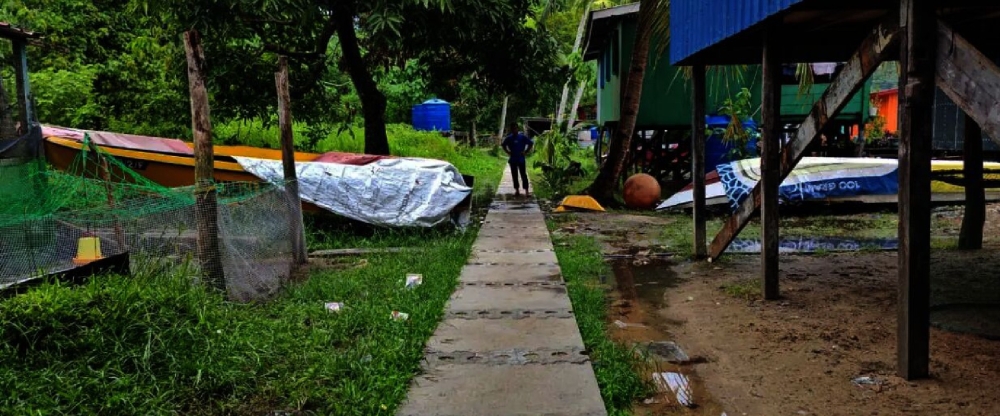
LABUAN, Jan 20 — In Kampung Lobong on Pulau Gaya, off the coast of Kota Kinabalu, stands a new pedestrian walkway constructed largely from plastic waste.
Connecting the local sports court to a timber bridge, the 0.9 metre-wide, 130-metre-long walkway was completed in October 2025.
It is also Malaysia’s first pedestrian infrastructure built from upcycled ocean debris and island-generated plastic waste, marking the successful completion of a pilot project under the United Nations Development Programme’s (UNDP) Island Waste Innovation Challenge.
Led by Sabah non-profit organisation Meraki Daat Initiative, the project diverted 813 kilogrammes of plastic waste, equivalent to tens of thousands of plastic bottles, preventing it from being burned or washed back into the surrounding marine ecosystems.
Closing loop on island waste
Unlike the plastic-modified asphalt roads trialled on the mainland, which rely on factory-generated waste and heavy machinery, the Pulau Gaya project was designed around the logistical realities of island communities.
All processing and construction works were carried out on-site, effectively closing the waste loop without transporting materials to or from the mainland.
“This was a logistical feat that forced us to rethink how waste is handled in remote areas,” said Meraki Daat Initiative founder and charter president Michelle de la Harpe, who also served as director of the pilot project.
“We proved that unmanaged plastic waste, which is often seen as a burden, can be transformed into a durable community asset when the right systems, expertise and community participation are in place,” she told Bernama in an interview recently.
Pulau Gaya is home to several water villages that face persistent challenges related to waste management, limited infrastructure and exposure to environmental risks.
Plastic waste, in particular, has long been a visible problem, accumulating along shorelines and waterways due to limited disposal options.
Materials for the Pulau Gaya pedestrian walkway were sourced through three coordinated collection channels over several months.
Floating marine debris was intercepted from waters around Pulau Gaya and Sepanggar Island through collaboration with Sabah’s Marine Research Foundation, using its Mobula vessel to recover plastic waste before it entered deeper marine environments.
At the community level, villagers were encouraged to segregate PET (polyethylene terephthalate) bottles and household plastic waste, with local participation playing a central role in ensuring a consistent supply of recyclable material.
Additional plastic was collected during the ‘Cabaran Kampungku Bersih’ (My Clean Village Challenge) programme organised by Kota Kinabalu City Hall, which saw villagers conducting daily shoreline clean-ups between August and September, reinforcing community ownership of the Pulau Gaya walkway project.
Constraints
Launched in January 2025, the project encountered significant technical and logistical hurdles, including the absence of three-phase electricity on the island and limited access to conventional construction materials.
Project manager Adora Shariman said these constraints led the technical team to develop a hybrid construction method combining eco-pavers made from upcycled plastic with conventional concrete slabs.
“Due to mould limitations and time constraints, we innovated a system of alternating eco-pavers with concrete slabs while maintaining safety and durability standards,” she said.
Rainwater harvesting was utilised for concrete mixing, while local beach sand was sourced to minimise transportation needs and reduce the project’s carbon footprint.
The initiative brought together a multidisciplinary team with backgrounds in engineering, construction, standards compliance, environmental management and project administration to ensure quality control, safety and regulatory alignment.
Beyond a pilot project
With the construction of the walkway completed, the team is now conducting final stress tests and certification processes as part of efforts to commercialise their eco-paver technology for wider deployment across Sabah.
According to de la Harpe, the pilot project is intended as a scalable model rather than a one-off intervention to resolve Pulau Gaya’s plastic waste issue.
“We are solving what we call the island waste trap,” she said.
On the mainland, concrete and machinery are easily accessible, but on islands, bringing in materials is expensive and unsustainable, yet plastic waste is everywhere, she pointed out.
“Our solution is engineered specifically for these conditions,” she said, adding that their initiative aims to address two persistent challenges in Sabah – deteriorating rural infrastructure and escalating plastic pollution – through a single integrated approach.
Call for policy partnership
Following a presentation to Sabah state officials earlier this month, Meraki Daat Initiative is now seeking formal collaboration with the Sabah Ministry of Works and Utilities and the Ministry of Local Government and Housing to integrate the eco-paver technology into rural development planning.
“We have the data, the technology and the proof of concept,” de la Harpe said.
“What we need now is policy-level partnership, not just approvals but adoption. By embedding this solution into state development frameworks, Sabah can improve rural connectivity while cleaning its coastlines at the same time.”
She stressed that scaling the initiative would require coordinated support, technical validation and alignment with public works standards to ensure long-term sustainability.
Meanwhile, in Kampung Lobong, the new pedestrian walkway has made it safer for the villagers to move around their settlement, especially during high tides and heavy rain.
More than just a structure made of recycled plastic and concrete, it demonstrates how environmental innovation, community participation and infrastructure development can intersect, even in the most resource-constrained settings, to deliver solutions that are both durable and locally grounded.
For Pulau Gaya, the walkway is a small but significant step forward. For Sabah, it may signal a new direction in how waste, infrastructure and rural development can be reimagined together. — Bernama