
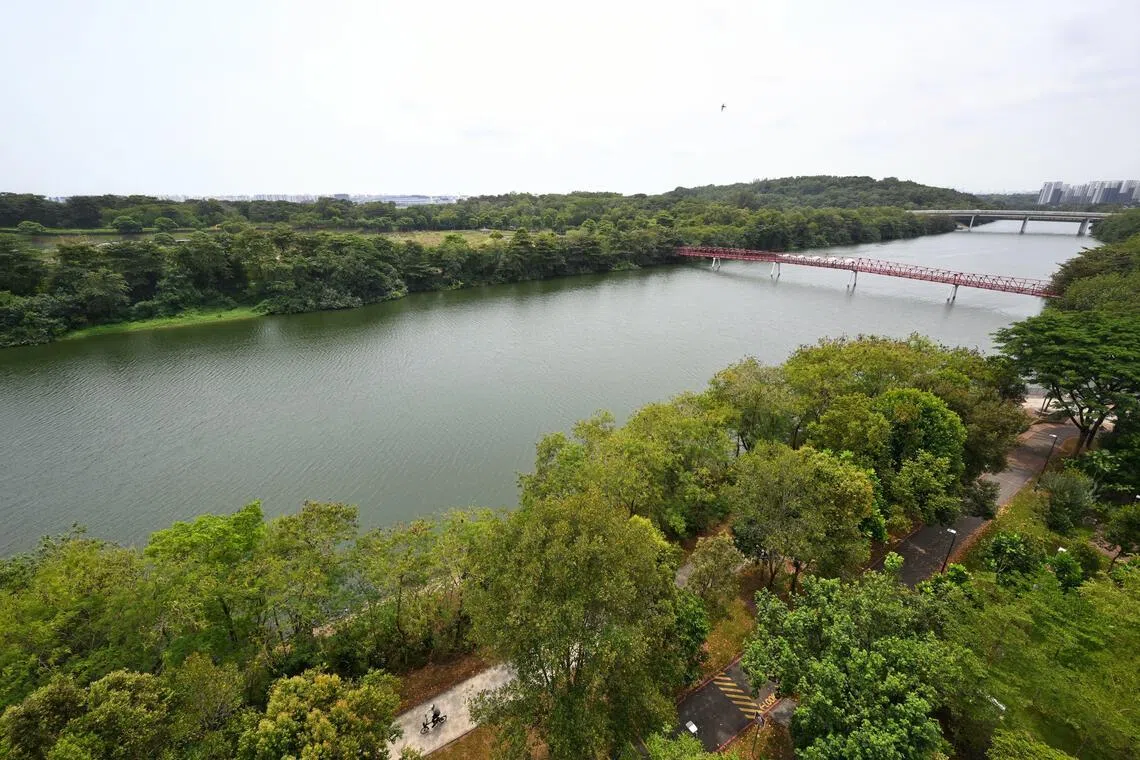
SINGAPORE – The Nature Society Singapore (NSS) is proposing that almost a third of the vegetation in and around Paya Lebar Air Base be retained as green spaces, ahead of redevelopment of the area set to begin in the 2030s.
The Straits Times has learnt that the society submitted a report to the Urban Redevelopment Authority (URA) detailing its proposal to retain 389ha of land in the area, which comprises forest, parkland and water bodies.
URA said it will assess the proposal.
Based on NSS’ estimates, the area slated to be redeveloped for housing and industrial purposes after the airbase is relocated amounts to 1,271ha – an area slightly bigger than the size of Woodlands.
Of this, 805ha comprises areas of biodiversity importance, said the society. These refer to areas that are critical to support flora and fauna, and parts of it, at least, should be preserved, it believes.
NSS spokesman Tony O’Dempsey said the greenery in the area represents one of the last “wild growth areas” in north-east Singapore.
“The anticipated loss of some 805ha of viable habitat within the approximate 1,271ha area to be developed is significant and calls for mitigation measures that maintain some of the original wild growth habitat and to provide connectivity throughout the area,” said NSS in the report seen by ST.
Wildlife connectivity allows animals to move freely between habitats to find food and thrive.
Together, green patches in the airbase, along with the adjacent vegetated areas extending from Tampines Road to Coney Island and Bedok Reservoir Park, serve as habitats and ecological corridors for native wildlife, the society said.
These include the Paya Lebar Air Base and forests adjacent to the Serangoon Reservoir as well as the Tampines Quarry woodland.
A URA spokesperson told ST it has received NSS’ proposal for Sungei Serangoon and Paya Lebar Air Base, and will assess it as it reviews wider development plans in the area.
The spokesperson added that the URA and agencies will be conducting further studies for the airbase site in the upcoming years to guide the development of future plans and take into consideration the feedback received, including NSS’ proposal.
Plans to relocate the airbase and redevelop the area were announced at the 2013 National Day Rally by then Prime Minister Lee Hsien Loong.
The relocation of the airbase – which is about 800ha – is set to begin in the 2030s and will pave the way for housing and industries.
A new town will sprout up in the space and its surrounding areas, comprising housing and recreational facilities, as well as employment opportunities.
In 2022, it was announced that an
estimated 150,000 new public and private homes
– roughly the number in Punggol and Sengkang combined – can be built in the future town.


One of the main features of the NSS’ proposal is a 100m buffer along the banks of the Serangoon Reservoir, which extends over 6km, according to its estimates.
“Wherever there is a water body, there is an exceptional opportunity of habitat because more life can survive close to a water body,” said Mr O’Dempsey, adding that animals such as birds and bats also use the water body as a transport corridor where they move along the open space with no obstruction.
The animals can also help to distribute seeds from wherever they come from, he said.
The rest of the proposal includes a branch of the fauna corridor, building a naturalised waterway, as well as retaining the Tampines Quarry woodland and terrain at the north end of the airbase.
It added that public access paths should be established throughout the fauna corridor to enable the public to appreciate the nature in their midst.
A fauna corridor refers to original vegetation that allows wildlife to move and can be enhanced when needed, Mr O’Dempsey said.
He said the society appreciates the need to develop the area for residential and industrial development.
But he added: “Our view is that if you were to completely wipe out this whole area without any consideration for the environment, then you are doing a lot of ecological damage.”
NSS surveys of the area had shown the presence of 193 species of birds, of which 60 were of concern for conservation and 33 are dependent on the forest.
These include threatened species such as the great knot and the globally critically endangered straw-headed bulbul.
The area also features other common reptile and mammal species like the striped bronzeback, oriental whip snake and wild boar, NSS noted.
According to the conceptual plan for a future town at Paya Lebar Air Base on URA’s website, there is a potential green connector along the airbase that could be part of the redevelopment.
While Mr O’Dempsey acknowledged the potential green connector in the redevelopment area, he said it does not seem to connect between vegetated areas.
He added that an environmental impact study should be done for the entire redevelopment area.
“A proper environmental study needs to be done over the whole area so that this concept of retained forest and connectivity can be fine-tuned… (There is) a need to understand and be transparent about what is being lost,” he said.
The redevelopment of the area along the Serangoon Reservoir had recently come under scrutiny in Parliament.
On Jan 14, Hougang MP Dennis Tan had highlighted the clearance of vegetation in the area for a bus depot without a proper environmental study, and called on the House to rethink the redevelopment and preservation of green spaces in Singapore.
Minister of State for National Development Alvin Tan said in response that government agencies
are reviewing plans
to develop more vegetation along the eastern bank of the Serangoon River.
In its reply, the URA spokesperson said the authority will evaluate the potential environmental impact and conduct further studies if such impact is assessed to be significant when planning for the area.
“We will also carefully plan for the provision of greenery and recreational spaces in the area,” the spokesperson said.
“We continue to welcome the public to share their feedback on future developments, and will work closely with stakeholders to incorporate environmental considerations while ensuring that the future town supports the diverse needs of our city-state and communities.”