
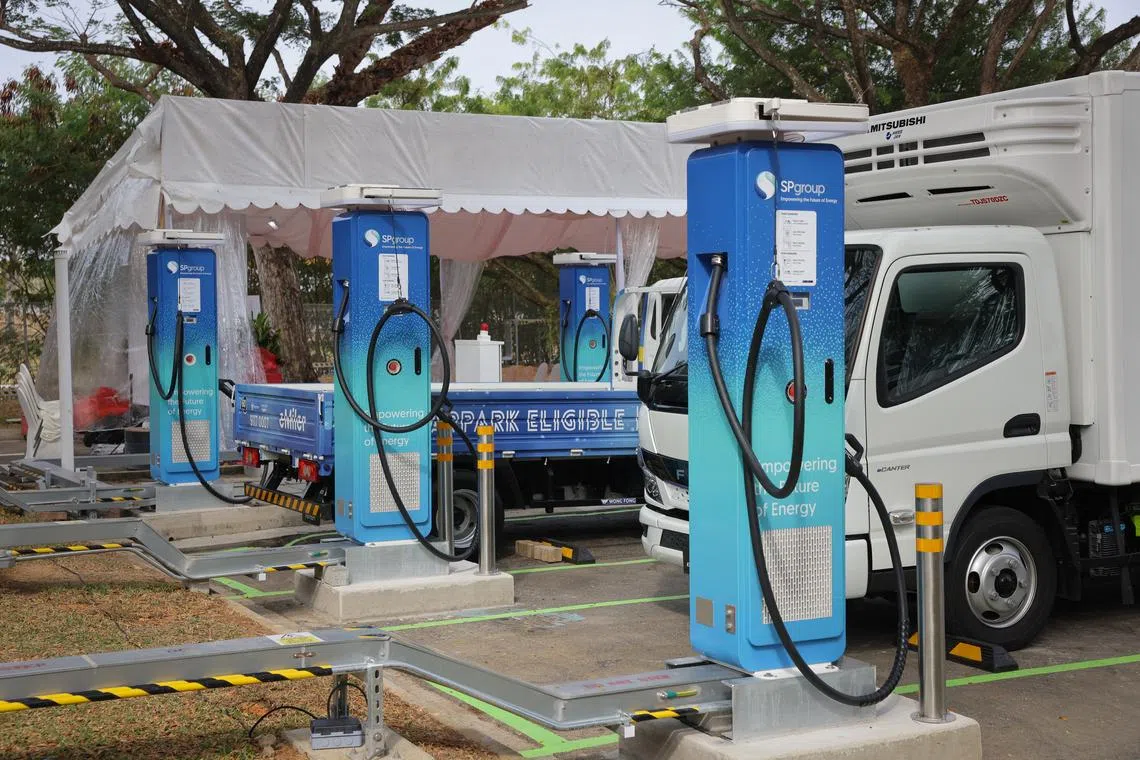
SINGAPORE – An ultra-fast charger launched in Tampines on Feb 6 can add over 300km of range to an electric vehicle (EV) in just 10 minutes.
In contrast,
standard overnight chargers in Housing Board carparks
would add no more than 10km of range in the same time.
The new charger has been set up to serve large commercial vehicles like trucks and tour buses, as well as cars.
Located near the stadium in Temasek Polytechnic along Tampines Avenue 1, the open-air charging area has large parking bays and ample space for heavy commercial vehicles to turn around.
Minister of State for Transport Baey Yam Keng attended the launch on Feb 6.
The charger, which is rated at 400 kilowatt (kW), is connected to four charging points. Like other EV chargers with multiple charging points, the speed is reduced when more than one EV is plugged in.
Charging speed is also limited by an EV’s maximum capability. Many mass-market EVs max out at around 100kW, although newer models with faster charging capability have been introduced in recent months.

Minister of State for Transport Baey Yam Keng (centre right) at the launch of the ultra-fast EV charger in Tampines.
ST PHOTO: ONG WEE JIN
The service costs 77.4 cents per kilowatt-hour, which is the same as the 100kW charging points located in other carparks within the campus. The 22kW chargers there charge 68.7 cents per kilowatt-hour.
These rates are comparable to the cost of charging in the nearby Tampines and Simei housing estates.
The prices do not include parking in the campus, which costs 2 cents per minute, with a 15-minute grace period.
Like the other 20 charging points located within the polytechnic, the ultra-fast ones are open to the public around the clock and is operated by SP Mobility. As with the other charging points in SP’s overall network, charging and payment are handled through the operator’s mobile application.
SP Mobility said that with the number of charging points in Temasek Polytechnic, the location serves as a strategic transport hub for the eastern part of Singapore.
The effort to support larger EVs aligns with Singapore’s push to electrify the heavy commercial vehicle fleet. From Jan 1, companies buying an electric heavy vehicle can qualify for up to $40,000 in incentives. The Government will also co-fund up to half the cost of installing chargers on companies’ premises for these vehicles.
The ultra-fast charger uses a battery energy storage system to get around the power supply limitation.
The storage system takes up an area about the size of an office cubicle and is located near the charging points. When ultra-fast charging is needed, the stored electricity will be dispensed together with power from the electricity grid.

Ms Mildred Yeo, head of partnership and product at SP Mobility, demonstrating the use of the EV charger with an electric truck.
ST PHOTO: ONG WEE JIN
SP Mobility said that the battery storage system enables the operator to install ultra-fast EV chargers in places where the electricity infrastructure is not able to support them.
Huawei, the Chinese technology company that supplies the hardware, said that Singapore is the first country in the Asia-Pacific to deploy its ultra-fast charger with battery storage system.
Mr David Wang Long, director of Huawei Singapore’s charging network business, said that following the launch in Tampines, the company plans to introduce similar charging stations with other operators in the northern and western parts of Singapore.
The deployment of Singapore’s public charging network, which includes fast chargers, comes under EV-Electric Charging (EVe), a subsidiary of the Land Transport Authority.
In late January, Huawei’s ultra-fast chargers began operation in Great World, a mixed-use development in the River Valley area. Some 20 charging stations, rated at 480kW, are located in the complex’s carpark.
Singapore aims to phase out pure internal combustion engine cars by 2030, allowing only cleaner-energy cars, which include EVs and petrol hybrids, to be registered. EVs have been gaining traction in recent years, rising from 18.1 per cent of total car registrations in 2023 to 45 per cent in 2025.