
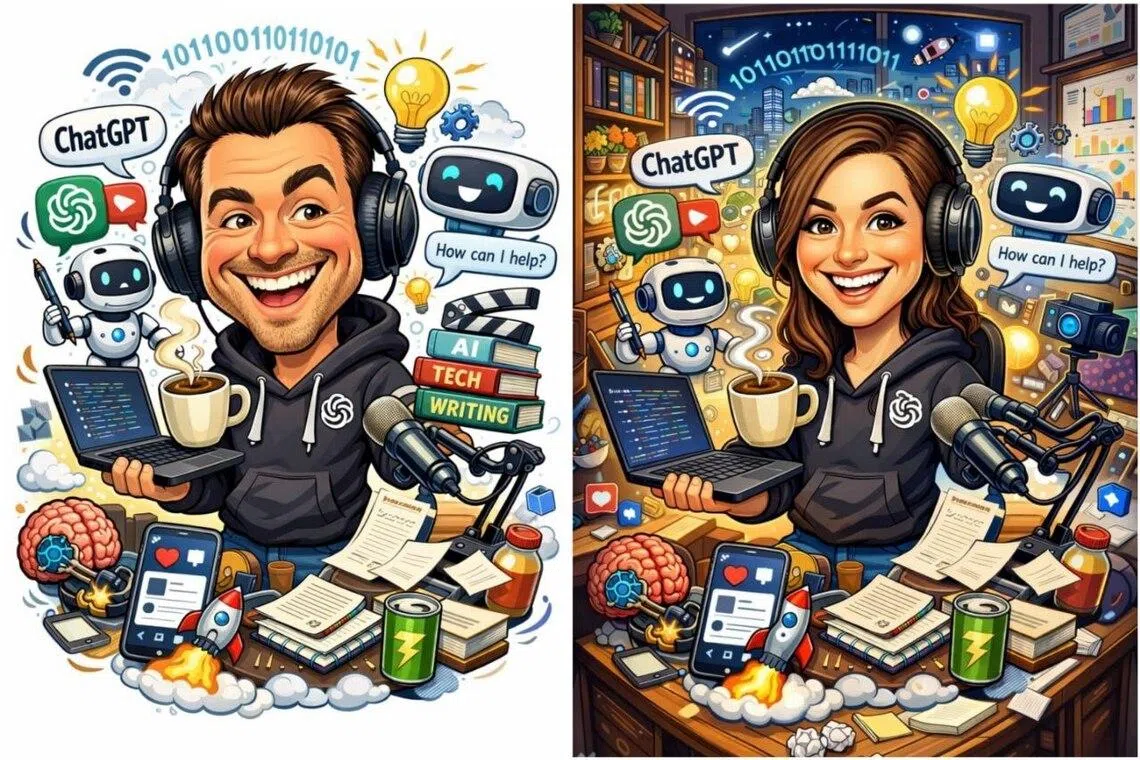
SINGAPORE – A new trend harnessing the seemingly unlimited power of artificial intelligence (AI) has emerged, this time in the form of users generating portrait-style caricatures.
And for those looking for the ChatGPT prompt, here it is: “Create a caricature of me and my job based on everything you know about me.” This also works on other generative AI tools, such as Google Gemini.
After entering the prompt, users will be asked to upload a selfie. Those with sufficient history with ChatGPT will experience a smoother process thereafter.
However, users who have not revealed enough about themselves will be asked to provide further details about their interests, occupations and more.
Some may also be asked to share information on aspects of their personalities or describe their home environments or living situations.
The caricatures generated often resemble those hand-drawn by street artists at tourist destinations, with semi-exaggerated facial features, depicting individuals engaged in their jobs or hobbies.
They are also hyper-detailed, containing references to other aspects of the individual’s life, such as pets, food or living environment.
People worldwide have since jumped on the bandwagon, echoing previous trends such as the
Ghibli-style portraits of yesteryear
, with everyone from influencers to professionals generating these images.
Amid ChatGPT owner OpenAI’s
push to
expand
global AI use in everyday life
, the days when privacy concerns were part of the pushback against AI models seem like a distant memory, as users continue to jump on such trends.
In 2023,
experts told The Straits Times
that sharing data with external providers carries security and privacy risks. ST also found that AI bots can
encourage emotional dependency while quietly eroding self-awareness
– part of a larger exploration into how people are increasingly turning to AI for emotional and practical support.
Ms Jessica Eaves Mathews, a US-based lawyer, cautioned against the new caricature trend, which she said furthers the normalisation of providing AI models with increasingly personal details in the name of what appears to be harmless fun.
“In a world where data is currency – where companies have built empires by collecting, storing and monetising the most intimate details of our lives – it is naive to treat this as a harmless art project”, she said on her website.
Ms Mathews, who specialises in AI, trademark and copyright law, as well as privacy and data protection, said that those who feed their personal information into ChatGPT risk making themselves “easier to find, easier to map, easier to target”.
After all, OpenAI is a private company whose entire business model depends on collecting, processing and leveraging data at enormous scale, she said, urging users to exercise restraint and protect their personal data, while also reminding them that free products are not truly free.
“You are paying with information, attention and participation. You are contributing to the refinement and expansion of a system designed to become more powerful, more integrated and more indispensable,” she said.