
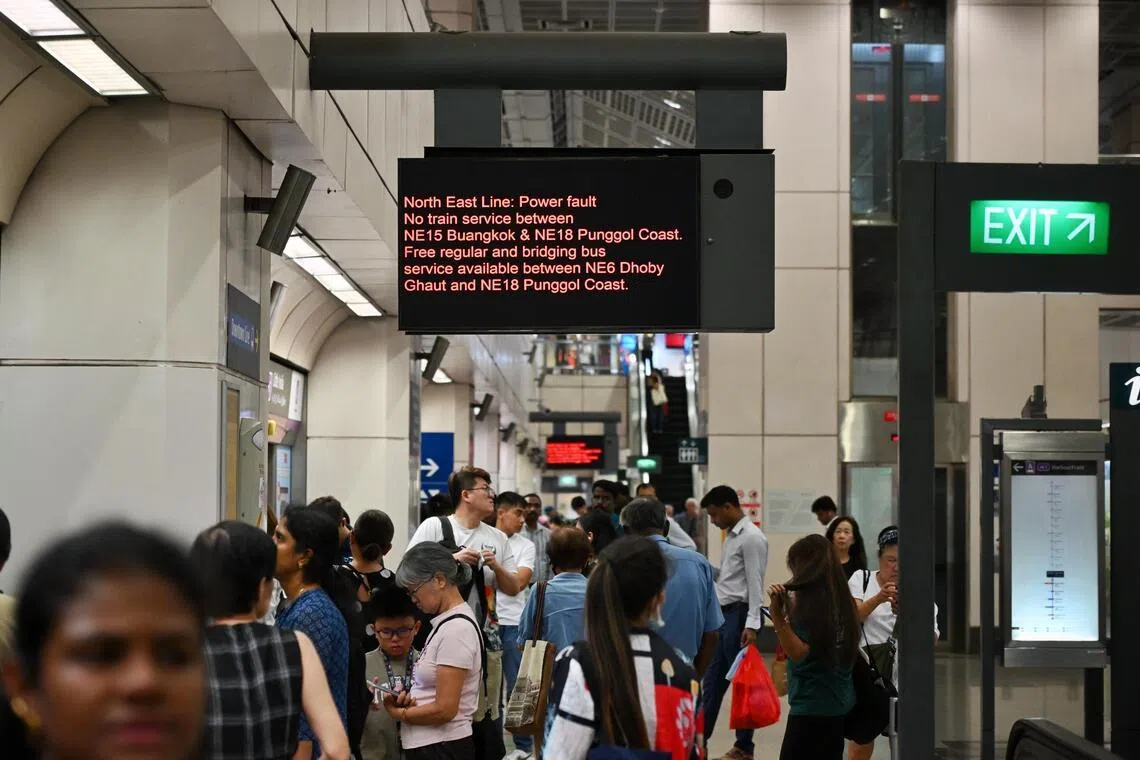
SINGAPORE – Renewal works involving the power supply system for the North East Line (NEL) will begin in 2026, following recommendations from a task force looking into solutions to improve rail reliability, which the Government accepted on Feb 13.
This includes upgrading the existing power intake at the NEL depot in Sengkang – which supplies power to the line – to one with a higher capacity, and installing more traction power substations that convert electricity from the grid into the appropriate voltage to power the railway system.
The works will take several years to complete, and to facilitate this, longer service closures may be needed, the Land Transport Authority (LTA) said in a joint statement with rail operators SMRT and SBS Transit (SBST). The task force comprised the chief executives of LTA, SMRT and SBST.
The need to implement a more resilient backup system for the NEL was recommended by the rail reliability task force in its report,
which was submitted to Acting Transport Minister Jeffrey Siow on Dec 30.
Besides the renewal of rail assets, the report also made recommendations in areas such as improving service recovery during disruptions, spare-part management, standardising the way in which the condition of the rail network is monitored, and better equipping the rail workforce.
In its report, the task force advised prioritising the renewal of three “core” rail systems – trains, signalling, and power – as well as shortening the time taken to renew these systems.
In the case of the NEL, the group said the upgraded power intake would be able to “comfortably” power the entire line by itself, while also having a buffer to cater for future needs.
For the longer term, the task force also recommended that a new power intake with a higher capacity be built in the city, to act as a back-up for the NEL.
Other than the NEL, the work will also be carried out for the Sengkang-Punggol LRT, with the aim of improving the reliability of the two lines, which are run by SBST.
The push to make the NEL and Sengkang-Punggol LRT more resilient comes after investigations found that a
failure of the power switchboard
at a NEL depot substation caused an outage in August 2025, resulting in a three-hour disruption on the MRT line, and tripping up the LRT for about 10 hours until service was fully restored.
This is because the substation also powered the LRT system.
It was one of at least 15 disruptions that took place across the MRT and LRT networks between July and September, which prompted the
creation of
the
task force on Sept 19, 2025
.
Chaired by LTA chief executive Ng Lang, the group was advised by a five-member independent advisory panel made up of
rail experts from across the globe
.
While the task force found that the underlying causes of multiple rail disruptions during the three-month period were unrelated, there were
several areas of improvement
that could be made.
Some of the suggestions included rolling out more bypass systems, as well as
full-day service closures
to carry out critical maintenance works.
Currently, trains make use of an in-built system that automatically activates their emergency brakes when a fault in signalling equipment is detected on board.
These faults must be resolved before the train can move automatically again.
However, metro systems in cities such as Hong Kong, Taipei and Guangzhou already make use of a bypass feature that allows affected trains to be manually driven at slower speeds while signalling faults are being looked into.
This way, passengers can disembark at the next station, rather than on the tracks. The affected train can also be withdrawn more quickly, the report said.
LTA and the rail operators will study how this can be rolled out.
In addition, the authority will also be changing the positioning of coupling levers, which help connect train cars, and brake isolation valves on trains to make them more easily accessible by rail staff. Brake isolation valves can isolate or cut off the brakes on a specific train car.
This will “speed up the coupling of trains when a faulty train has to be moved using a rescue train,” the statement said.
Other than physical upgrades, LTA plans to take a standardised approach to how it monitors the condition of rail assets.
Although condition monitoring is already being carried out, the current systems in use operate differently.
By having a baseline standard, it will allow for “more comprehensive monitoring of asset health and earlier fault detection,” it said.
LTA and the rail operators will also collect more data to improve its ability to forecast the need for spare parts and build extra buffer into their projections for spares, with plans to stockpile them.
Spare parts that are immediately available to replace faulty ones can help speed up the resolution of major rail incidents.
In the future, standardised and modular designs of rail systems will be used, allowing for “easier and faster upgrades or replacements”. This will also make planning for maintenance more straightforward.
The task force also called for improvements to be made in terms of how passengers receive information and are supported during rail disruptions.
As it takes time to mobilise bridging buses and redeploy them from regular bus services, it recommended having buses on standby at different locations, so that they can be deployed more quickly.
More can be done to disseminate information to passengers during delays and disruptions, the task force said. LTA and the rail operators have been implementing various initiatives, ranging from a
web
page showing delays on the network in real time
to
digital signs offering
direction and information
being trialled at Serangoon station
.
LTA is working with Google Maps to give personalised journey time estimates to passengers who are caught in disruptions. This will be based on their location and destination, and the aim is to get this ready by the first quarter of 2026.
LTA’s Mr Ng said that the work of the task force comes at “an opportune time” when SIngapore’s is juggling between an ageing system and a rapidly expanding rail network. The task force’s recommendations will go towards sustaining the country’s rail reliability, he said.
Mr Jeffrey Sim, group chief executive of SBST, stressed the importance of investing in people running the rail system to ensure that they have the right skills to better operate and maintain complex train systems.
SMRT Trains president Lam Sheau Kai said the operator is working closely with LTA to proactively renew rail assets, and collaborating with the manufacturers of the train systems.
“We believe this is the way to go to sustain the high (rail) reliability for Singapore,” he said.