
The revision to the preferential additional registration fee (PARF) rebate, announced during Prime Minister Lawrence Wong’s Budget speech on Feb 12, means newly registered cars will soon be worth less over their lifespan.
The effects of the change will be felt on many fronts. It will weaken the incentive to scrap one’s car early, narrow the gap between electric vehicles (EVs) and non-EVs, and alter the used-car market.
Unlike raising upfront car taxes, the move is unlikely to directly push up car prices.
But the total cost of car ownership will rise with the cuts to the PARF rebate, which is the scrap or residual value when a car is deregistered by its 10th year.
This is the new reality that car buyers have to contend with. They can no longer count on the PARF rebate as a payout when their car is deregistered by the end of their 10-year certificate of entitlement (COE).
With the significantly smaller rebate, owners may find it more compelling to forfeit the PARF rebate and renew their COE to extend the use of their existing vehicles.
PM Wong
announced that the PARF rebate will be lowered by 45 percentage points across the board,
and its cap will be halved from $60,000 to $30,000.
This revised cap will impact higher-value, larger models rather than smaller mass-market cars, because of the higher taxes imposed on these costlier cars at registration.
The PARF rebate is calculated as a percentage of the additional registration fee (ARF, or main vehicle tax) a car owner has paid and varies according to the car’s age.
The changes take effect from the current COE bidding exercise, which ends on Feb 20.
As an example, a car that would have qualified for a 70 per cent PARF rebate in its fifth year will receive only 25 per cent after the change takes effect. In the final year of the car’s COE, that rebate will be reduced from 50 per cent to 5 per cent.
The PARF rebate scheme was set up in 1975 to encourage owners to deregister their cars early and switch to newer, cleaner-emission vehicles, by returning a portion of the ARF that they pay at registration.
PM Wong noted that as EVs become more common here, the need to encourage the early deregistration of cars has been reduced.
EVs, which are less pollutive than conventional petrol cars, accounted for 45 per cent of new cars sold in 2025, up from 18.1 per cent in 2023.
The revision is consistent with Singapore’s overall direction of nudging more buyers towards EVs.
This is because the gap in the PARF rebates between EVs and non-EVs will be narrowed significantly with the latest revision.
Across the board, PARF rebates for petrol-hybrid and internal combustion engine (ICE) cars will be slashed much more than for EVs.
The PARF rebates for EVs are already lower because of the generous tax rebates dished out for such vehicles during registration.
Combined, the
EV Early Adoption Incentive (EEAI)
and Vehicular Emissions Scheme (VES) bring down the upfront ARF for an electric car by up to $30,000.
Take the MG 4, for instance. The EEAI and VES completely offset the $23,775 in ARF that the EV is otherwise subject to. This means that the car would net a PARF rebate of zero even before the revision.
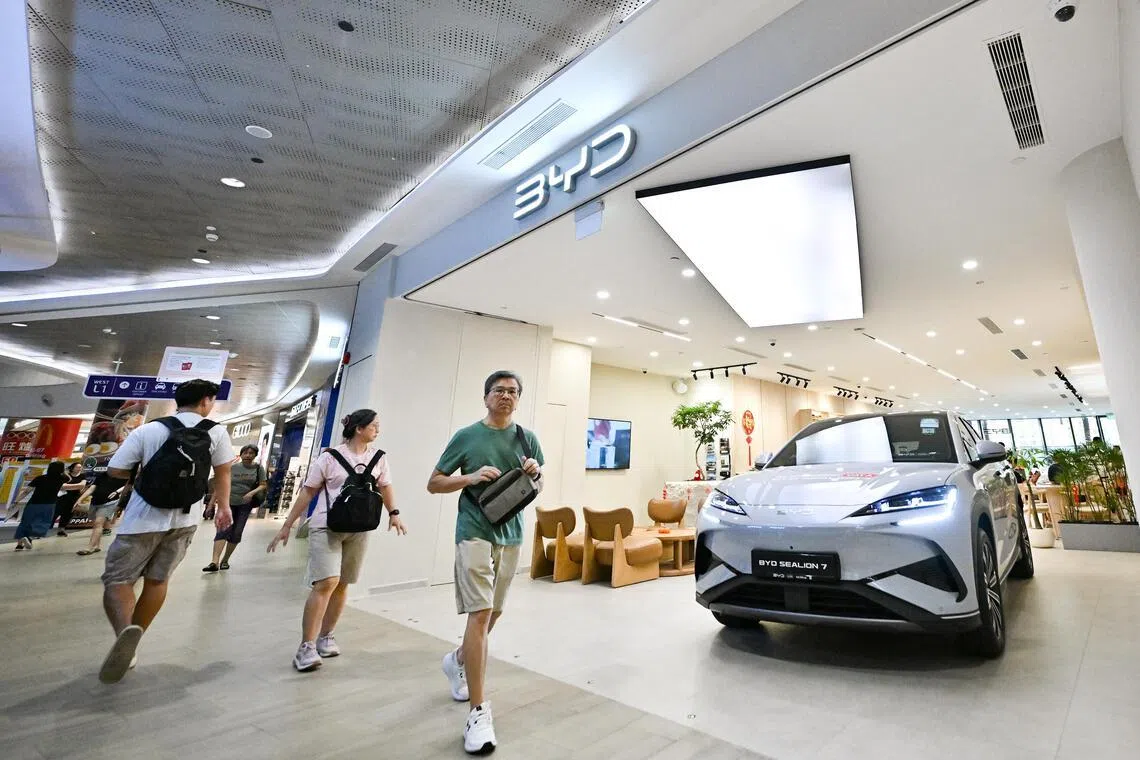
Then there are models such as the BYD Atto 3. The revision brings the PARF rebate down from $851.50 to just $85.15.
By contrast, consider a comparable ICE car, the Honda HR-V, a compact crossover sport utility vehicle.
Before the revision, the car qualified for $8,528 in PARF rebates if it was deregistered in its 10th year. With the change, the PARF rebate comes up to only $853.
Hence, the PARF advantage of the Honda over the BYD is significantly lowered from $7,676.50 to just $767.85 with the change.
Notably, the reduction in PARF is a double whammy for ICE cars.
Being more pollutive, such vehicles have attracted a hefty surcharge under the revised VES since January, which raises their upfront price. The surcharge is excluded from the PARF rebate calculation.
To dissuade buyers from getting EVs, dealers of petrol and hybrid vehicles have often argued that EVs have zero, or near-zero, PARF benefit at the end of their COE lifespan.
With PM Wong’s announcement, which will hit PARF rebates for non-EVs dramatically, this argument no longer holds.
The move will further erode the appeal of buying a non-electric car.
As one would expect, EV dealers are now already using this point in their pitch to convince customers to stay away from petrol and hybrid vehicles, and to choose electric cars instead.
For consumers who simply do not want an EV, the reality is that there will be fewer non-electric options on the market going forward.
Motor dealers are expected to avoid bringing in such models if they can.
That said, those representing Japanese mass-market brands – which still prioritise hybrid models over EVs in their line-up – will soldier on because they do not have many electric alternatives.
But to stay competitive, they may cut prices to compensate for the reduced PARF rebate. If this comes to pass, it will hit their profit margins.
They may also bring in cheaper non-electric models with fewer features, but consumers may not be keen to pay for sparsely equipped cars when EVs can offer more without being pricier.
Ultimately, the tweaks to the PARF rebate will have the effect of making new car buyers consider EVs more than before, as non-EVs become increasingly marginalised.
With EV adoption set to continue, the move also signals that the Government is prepared to accept an ageing vehicle population, as the incentive to scrap cars early will soon be weakened.
This comes as Singapore is pushing to lower land transport emissions by allowing only electric and hybrid cars to be registered from 2030.
Down the road, as cars with lower PARF rebates become the majority, more motorists may opt to renew their COEs beyond the 10th year because it makes financial sense.
If so, car ownership could increasingly extend to 15 years or more. That raises a separate question for EVs bought today: Will they remain relevant and reliable over such a timeframe, or will rapid technological advances render them outdated by then?
Obsolescence is less of a concern for ICE and hybrid cars, as such technologies have been quite stable over the past decades and there is an existing ecosystem of mechanics, spare-part suppliers and motor workshops to keep them running well beyond their 10-year COEs.
Apart from the new car market, the PARF changes will also have an impact on used cars.
The revision effectively creates two classes of used cars on the market: some with relatively high PARF rebates, and others with much lower rebates. In its 10th year, a car registered before the revision could draw a PARF rebate up to 10 times the amount of one registered after the change.
Even so, certain used-car models under the old scheme will not be worth that much more when resold in the middle of their COE lifespan.
In the case of the Honda HR-V, if it is deregistered just after its fifth year, the PARF rebate under the old scheme would be $11,938.50, instead of $4,263.75 after the revision. That gap will likely translate into a higher valuation for units registered before the change.
For buyers of used cars in the years ahead, always check the vehicle registration logcard to verify the PARF rebate amount before you commit to a purchase.
Over time, as cars registered under the old scheme work their way out of the system, the expectation of a substantial scrap value may give way to a new norm, where end-of-life rebates play a smaller role in ownership decisions and keeping cars for longer becomes routine.