
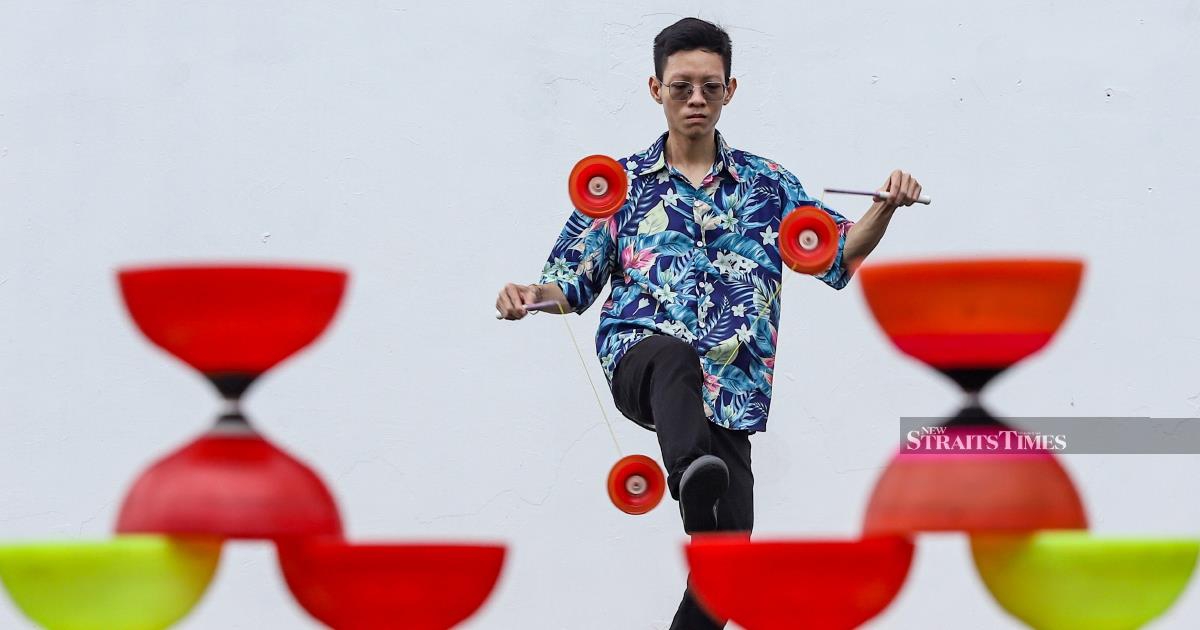
KUALA LUMPUR: By day, Ong Hock Eng works at an advertising agency, juggling client briefs and campaign deadlines. By night, he chases world-class routines with a diabolo, training in pursuit of a dream few in Malaysia even know exists.
Diabolo, sometimes known as the Chinese yo-yo, is a traditional juggling prop that dates back more than 900 years.
It consists of a spool-shaped object balanced and spun on a string attached to two sticks, with players performing a series of tricks, throws and catches that combine coordination, rhythm and creativity.
The 27-year-old emerged as the only Malaysian medallist at the inaugural World Diabolo Contest in Taiwan last November, claiming one silver and one bronze against competitors from seven countries.
“I have to practise outside working hours and it can be very tiring after work, but I want to compete at a higher level and that motivates me not to give up,” he said.
Hock Eng entered four categories at the World Diabolo Contest and advanced to the finals in all of them, a result he did not expect given the depth of the field and his limited preparation time.
“I was not sure if I could make the finals in all four events, but when I managed to do it and even win two medals, I felt very humble and that I had really put in the work,” he said.
The achievement was particularly significant as only five competitors at the world meet won two medals, with Hock Eng among them.
His journey began not in an elite academy but in primary school, when his elder brother brought home a diabolo from a co-curricular class and sparked his curiosity.
“It looked fun and there were many tricks you could create on your own, and when you succeed you feel very excited,” he said.
He joined the school’s co-curricular club at the age of nine and competed in his first year-end competition as part of a team event, even though he did not feel ready at the time.
“I didn’t feel ready to compete, but because it was a group event we worked together, and that made it better.”
After primary school, Hock Eng continued honing his craft in secondary school, learning from seniors and online videos in the absence of formal coaching.
“I think if I had more coaching when I started, maybe I could progress faster, but most of my tricks now I learn on my own and it just requires discipline,” he said.
His first international outing came in 2016 at the Diabolo Malaysia Open, where he admitted his performance was disappointing but eye-opening.
“My performance was not good, but I learnt a lot and seeing players from other countries inspired me,” he said.
That inspiration fuelled years of persistence, often squeezed between advertising campaigns and late-night practice sessions, as he self-funded his training and competitions.
“For now everything is out of my own pocket and I hope to get sponsors or government support to help with expenses and motivate me to continue competing at the highest level,” he said.
Hock Eng believes Malaysia can close the gap on traditional powerhouses Taiwan and Japan, where diabolo is more deeply embedded in schools and supported by a stronger professional ecosystem.
“In Taiwan, many schools have diabolo classes and there are many coaches, and in Japan they have facilities and some are full-time professionals.
“I hope Malaysia can also produce champions internationally if we have the same structure.”
For now, he continues to balance advertising pitches with precision spins, proving that even without full-time backing, passion and discipline can still propel a Malaysian athlete onto the world stage.
© New Straits Times Press (M) Bhd