
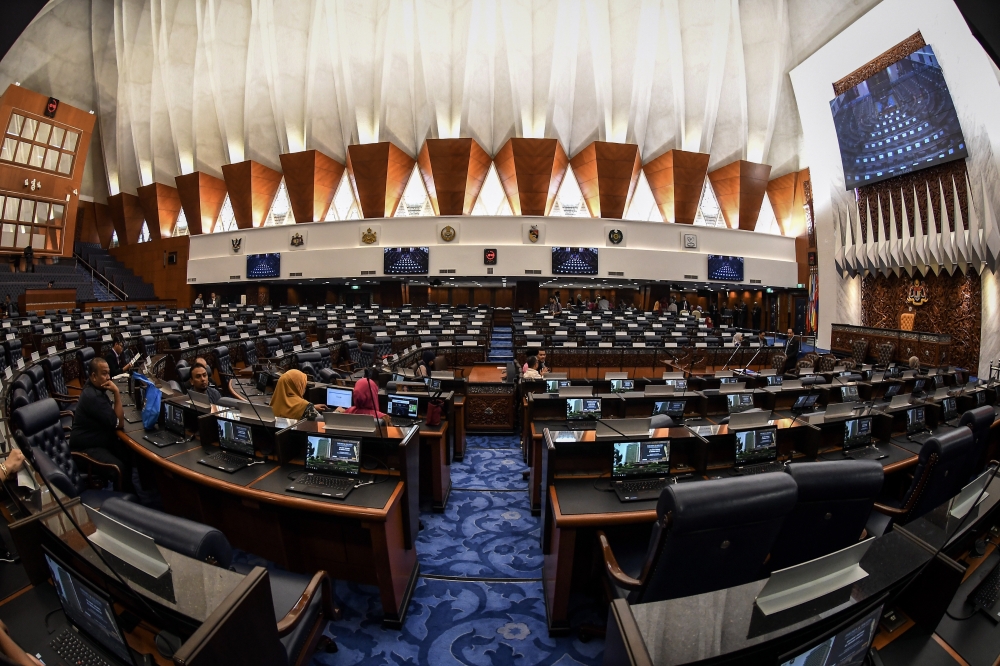
KUALA LUMPUR, Feb 25 — Parliament today passed the Environmental Quality (Amendment) Bill 2026.
The amendment, made in line with Article 95C of the Federal Constitution, reflects the federal government’s commitment to strengthening governance while honouring the spirit of the Malaysia Agreement 1963 (MA63).
Natural Resources and Environmental Sustainability Minister Datuk Seri Arthur Joseph Kurup said the move followed a decision reached at a meeting of the Special Council on the Malaysia Agreement 1963 (MKMA63) on April 14, 2022, chaired by Prime Minister Datuk Seri Anwar Ibrahim together with the Sabah and Sarawak state governments.
“The proposed amendment not only aims to strengthen the governance of scheduled waste disposal management, but also reflects the Madani government’s commitment in fulfilling its obligations and preserving the rights and autonomy specifically allocated to Sabah and Sarawak since the formation of Malaysia,” he told Parliament today.
The Bill, tabled on February 11, sought to amend Section 1 of Act 127 to include a new subsection (3) granting the minister the power to suspend the operation of the whole or any provision of the Act in different parts of Malaysia.
What is Article 95C?
Article 95C of the Federal Constitution allows Parliament to delegate certain legislative or administrative powers to Sabah and Sarawak, recognising their special constitutional position within Malaysia.
The provision enables federal laws to be implemented differently in the two states or allows specific powers normally exercised by the federal government to be carried out by state authorities.
It serves as a key constitutional mechanism used to operationalise decentralisation measures agreed under MA63.
In the case of the Environmental Quality (Amendment) Bill 2026, the Article provides the constitutional basis for granting the two states authority over scheduled waste management, while ensuring the changes remain consistent with the Federal Constitution and the national legal framework.
Checks and balances built into suspension powers
Addressing concerns over the amendment, which grants the minister authority to suspend the operation of the Act — either wholly or partially — in different parts of Malaysia, Arthur said the ministry is committed to incorporating clear checks and balances into the process.
“Any policy decision to suspend the enforcement of Act 127 must first undergo scrutiny by the Attorney General’s Chambers and obtain approval from the Cabinet before any action can be taken.
“This is to ensure the interests of the rakyat are protected and that legal uniformity across the country is maintained,” he said, adding that the mechanism is structured, transparent and cannot be exercised arbitrarily.
According to Arthur, scheduled waste management is currently regulated under the Environmental Quality Act 1974 (Act 127), and the suspension of the Act must first take place before enactments or ordinances passed by the respective state governments can come into force.
“This is intended to prevent overlapping laws and to ensure a smooth transition of authority.
“The amendment is proposed because Act 127 presently does not contain any provision empowering states to suspend the enforcement of the Act,” he said.
He also noted that such clauses are not unusual and already exist in several federal laws.
He cited existing legislation such as the Architects Act 1967, the Electricity Supply Act 1990, the Gas Supply Act 1993, the Energy Commission Act 2001 and the Renewable Energy Act 2011, where similar provisions have been used to accommodate differing state regulatory frameworks.
In one example, he said, provisions under renewable energy legislation were suspended in Sabah beginning January 3, 2024.