
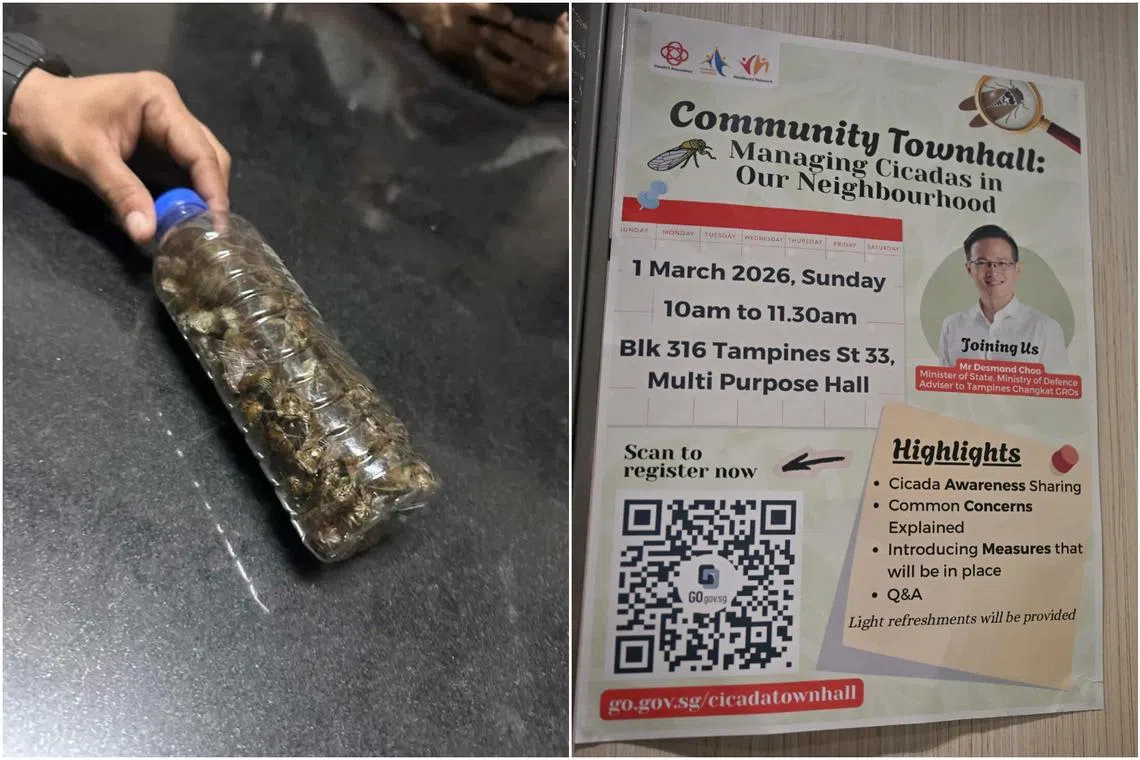
SINGAPORE – A cicada management effort touted as the nation’s “most comprehensive” will kick off at Tampines Changkat from March to deal with swarms of the insects entering homes there.
The constituency’s office said in a statement on Feb 26 that the five-month-long initiative will trial novel and safe strategies to deal with the cicadas, which seasonally emerge in swarms to the dismay of many residents there.
The solutions include placing mats to cover soil near the trees and wrapping tree trunks with foil to disrupt the life cycle of cicadas, the constituency said.
No further details on the measures were provided, although a town hall on the issue will be held in the constituency on March 1.
Cicadas, known to be one of the world’s loudest insects, usually live in areas with mature trees, feeding on their sap.
In recent years, they been making an unusual appearance in urban Tampines Changkat, with residents reporting the growing presence of cicadas in and near their homes since 2022.
Residents say the cicadas typically emerge in swarms during hotter months from March in noisy groups of about 10, with their population eventually declining after three to four months. Cicadas often emerge in groups from the ground at the same time, unleashing a cacophony as the males sing to attract their mates.
When night falls during those months, residents said the insects – roughly the size of two 50 cent coins – would buzz around the lights, darting to and fro in common spaces and flats.
When The Straits Times visited Blocks 321 and 322 of Tampines Street 33, where the previous cicadas swarms were reported, on Feb 25, the faint calls of the bugs could be heard, but they remained unseen.
Nine out of the 10 households interviewed said they have noticed the insects’ presence since 2022, and that their numbers seem to go up every year.
Most of them also felt the population needed to be controlled, as the noise, as well as the large swarms of insects in the corridors and their homes, have disrupted their daily routines.

The faint calls of cicadas could be heard when the Straits Times visited blocks 321 (pictured) and 322 of Tampines Street 33, but the bugs remain unseen.
ST PHOTO: ARIFFIN JAMAR
Resident Carlos Kennerley, 58, said: “You would hear people screaming inside the lifts because the cicadas were getting inside the lift.
“There was no reprieve at all… They were all over the place.”
The operations manager, who has lived in his sixth floor flat for more than two decades, recalled how the cicadas would repeatedly fly and bang against the windows and doors, making it impossible for his family to leave them open during months the insects were active.
The incessant buzzing from the cicadas has prompted Mr Kennerley to shift the gongfu class that he teaches to a nearby event hall.

Operations manager Carlos Kennerley, 58, recalled how cicadas would repeatedly bang against the windows of his flat.
ST PHOTO: ARIFFIN JAMAR
Similarly, Madam Yu, a fifth-floor resident who declined to give her first name, told ST in Mandarin that she was “frightened to death” as she dodged groups of up to seven to eight cicadas flying along the corridor at night.
The accountant said: “(My family and I) would be too scared to enter our home, because the floor would be covered with cicadas.”
Residents said in previous years, the Tampines Town Council had put up posters saying that cicadas are not considered pests.

Cicadas are not identified as pests, according to posters put up by Tampines Town Council in 2022 and 2024.
PHOTO: ST READER
But it moved to act on the matter in May 2025.
Residents said they observed a dip in numbers after the town council implemented a slew of measures, which included removing trees with higher cicada activity and using National Environment Agency-approved insecticides.
It remains to be seen whether the removal of these trees will limit cicada numbers in 2026 during the months when the insects are the most active, the residents said.
The upcoming initiative in Tampines Changkat will be led by the area’s MP, Mr Desmond Choo, in collaboration with grassroots organisations and the Tampines Town Council. The effort is also supported by the National Parks Board and the NUS Lee Kong Chian Natural History Museum’s insect curator Foo Maosheng.
Mr Choo said in the statement: “Tampines Changkat hopes that this comprehensive cicada management effort will serve as a useful pilot for cicada management, which can provide valuable operational and educational lessons for other areas in Singapore facing similar challenges.”
During the May 2025 cicada outbreak, Mr Foo, the entomologist (insect scientist), picked up the remains of 18 cicadas at Block 321 in a single day. Together with a cicada researcher from South Korea, he identified the insects as being orange-winged cicadas (Platypleura fulvigera), according to a paper published on Feb 27 in the museum’s journal Nature in Singapore.
These cicadas were the loudest on the 10th to 11th floors of Block 321, where residential units were closest to tree canopies, at a distance of about 5m away, wrote the paper’s authors.
Given the scant knowledge of the ecology of this insect, the researchers said that long-term, localised research into the ecological requirements and emergence patterns of Singapore’s cicada species would help effective mitigation measures.
NUS forest ecologist Sean Yap, who was not involved in the paper, said Singapore is home to more than six species of cicadas.
He added: “It’s not normal behaviour for them to enter homes, since there are no resources in human dwellings for them.
“However, if urban dwellings are in the way of their dispersal or flight path, they can unintentionally get trapped in urban architecture and end up in human homes.”
Based on previous studies of urban cicada populations in Japan, the compaction of soil, moisture content and soil temperature can influence the presence of species and their distribution.
Responding to a suggestion by one resident that the cicadas could be relocated, Dr Yap, said such an effort will be difficult, as it will entail digging up their young, called nymphs, that live underground.
Said Dr Yap: “Cutting trees down is also unlikely to be a long-term solution, as the adults and next generation of nymphs that emerge would disperse, and the problem would still shift elsewhere.”