
Explore the PSLE Companion microsite for more insights and tips.
My son works hard at school, but is average in his studies. I think the reason he doesn’t score well in his exams is because his memory isn’t great. I considered sending him for memory classes, but they are expensive, and my husband and I decided we cannot afford them on top of all the other tuition that we pay for. Can ST consider running some sessions on how to study smart to boost memory and recall?
We have had some parents expressing the same frustration. Their children are studying so hard, yet forgetting under pressure.
So, what do most parents do? Their instinct is to buy more past-year exam papers for their children or to pile on more tuition. Their children have to cut back on social activities and maybe even forgo family holidays.
But is there a better way? Instead of getting your child to put in long hours, are there ways to study that can boost memory and recall during exams?
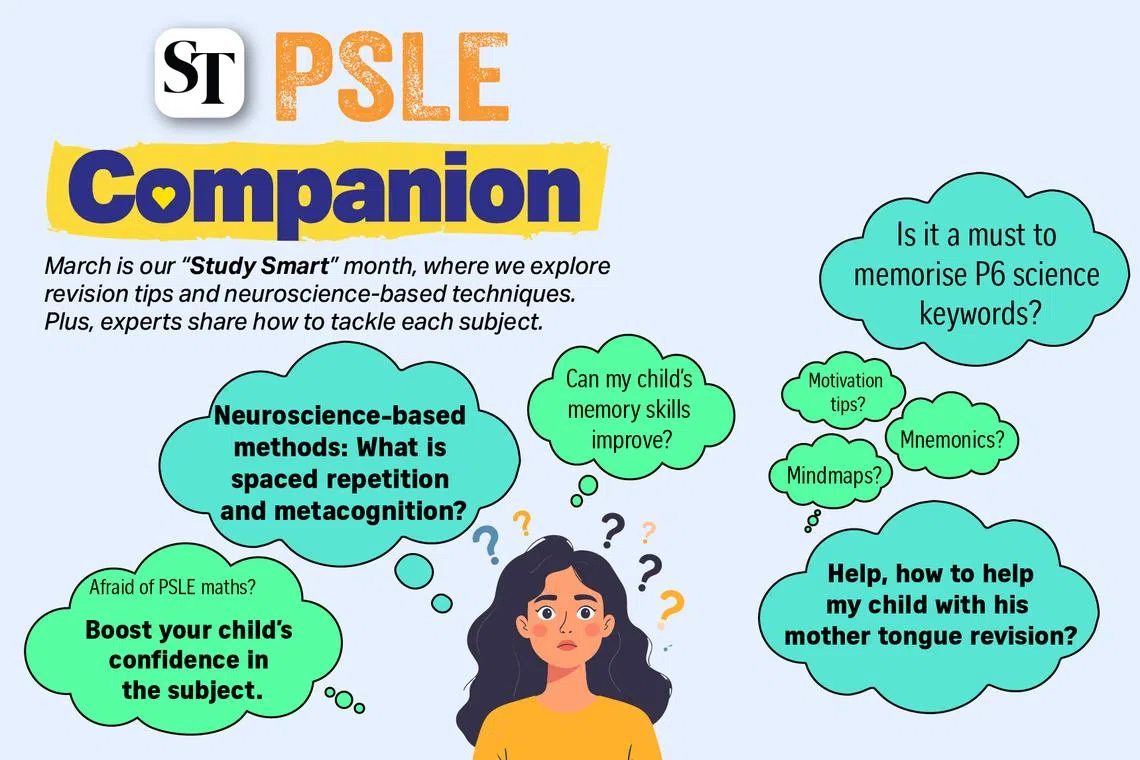
This is something that the PSLE Companion team will cover in March, which The Straits Times is dubbing the “Study Smart” month.
Memory and recall can be improved by using specific learning strategies. I am sure you have heard of some of them, such as using mind maps and mnemonics.
But not many of you would have heard of some of the neuroscience-based revision methods that we will be covering this month, such as spaced repetition and metacognition.
In our articles, we will not only explain what these methods are, but also show how they can be used for PSLE revision.
Parents should especially look out for a video podcast that will be released in March, where I will be interviewing an expert on these study methods. We will give concrete examples on how parents can guide their children in using these methods.
We will also be discussing if study methods such as using flashcards or teaching a topic to a classmate helps.
Through the month, we will be interviewing several subject experts to explain how to tackle different PSLE subjects.
This week, we have an article on science revision.
We often have parents asking about the importance of memorising keywords. But experts explain that the focus of learning science is about developing the ability to inquire, understand and explain concepts, and not on giving standard answers or reproducing keywords.
Experts say students should be focused on gaining a good understanding of the concepts.
Later in the month, we will have articles on how best to prepare for mathematics and the mother tongue exams.
The mathematics exams have been a source of angst over the years, with parents complaining about their difficulty. But experts say the majority of questions are accessible to most pupils, with a small number of questions allowing stronger pupils to demonstrate their mastery of the subject.
As Singapore mathematics expert Yeap Ban Har has said before, the best approach is to help students be better problem solvers as opposed to focusing on teaching them particular problem types.
Research shows that simply putting in more hours revising does not guarantee results. Instead, your children should be using strategies that maximise learning efficiency. We will show you how.
What will also help is hearing from experts such as Dr Yeap first-hand. So, if you haven’t already signed up for the PSLE Prep forum on April 4, I would urge you to subscribe to the PSLE Companion and then register for the forum from March 6 before places run out.
-
Subscribe to the
ST PSLE Companion package
($29.90 per month, over 24 months) for access to events, exclusive articles and resources.