
SINGAPORE – The move to raise the Republic’s solar deployment target from 2 gigawatt-peak (GWp) to 3 GWp by 2030 reflects the maturation of Singapore’s solar industry and could boost the nation’s resilience to energy import disruptions, experts said.
Dr Thomas Reindl, deputy chief executive at the Solar Energy Research Institute of Singapore (Seris), said maximising solar deployment here not only helps to decarbonise the nation’s power sector, but also has an economic and geopolitical component.
He added: “For every kilowatt-hour generated locally, we don’t need to import fuel from overseas, and we also don’t need to ‘ask anyone’ or depend on contractual parties, such as for the importing of electricity.”
Dr Reindl was among the experts responding to The Straits Times’ queries on the significance of Singapore’s move to increase its solar deployment target, first announced by Prime Minister Lawrence Wong in his
Budget 2026 speech
on Feb 12.
The nation’s earlier solar deployment target, of reaching 2 GWp by 2030, was met in 2025.
GWp measures the maximum power that solar panel systems in Singapore can produce together under standard test conditions. However, the average amount of electricity generated from solar energy at any given time is lower, for reasons including that electricity is not generated at night.
Solar is currently the main source of renewable energy that can be harnessed domestically, although its potential remains small relative to the nation’s total energy needs.
The new target of 3 GWp can meet around 4 per cent of the country’s total electricity demand in 2030.
According to a 2020 Seris report, Singapore’s solar deployment potential could reach 8.6 GWp by 2050. This would account for about 10 per cent of the projected demand then. Dr Reindl said the estimation was made by analysing the solar potential of every single building and aggregating it on a citywide scale. This was also done for other surfaces – such as water reservoirs for their floating solar potential, he added.
Singapore is also exploring other low-carbon energy sources, such as hydrogen and geothermal energy, to help the country meet its energy needs in a secure, affordable and climate-friendly way.
For now, Singapore relies on imported natural gas for over 95 per cent of its electricity.
Analysts have warned that the conflict in the Middle East could nudge up oil and gas prices because of supply chain disruptions, leading to concerns about a global energy crisis and electricity price spikes.
Giving more details on how the country plans to reach its new target, the Energy Market Authority (EMA) said on March 2 that the Government will deploy solar panels across more viable surfaces.
This includes tapping all feasible rooftops, land and water spaces, as well as exploring more innovative solar deployments such as overhang solar systems that could serve as shelters, canopies at open-air carparks, and other suitable areas, said EMA.
Solar canopies are outdoor, roof-like structures designed to hold solar panels, while providing shelter and shade.
At present, rooftop solar is estimated to make up more than 80 per cent of the total installed capacity, EMA said. This has mainly been driven by government-led programmes, as well as the increasing cost-competitiveness of solar installations.
NUS Energy Studies Institute research fellow Sita Rahmani said solar energy is the “most practical and immediate option” for Singapore to decarbonise locally. She noted that other potential sources of energy, like geothermal, can be costly.
“Maximising solar energy deployment is both a strategic and necessary approach to increasing the share of locally sourced renewable energy,” she said, adding that solar technology is more mature and can be deployed rapidly.
Dr Kathiresan Ramprakash, programme director at the Energy Research Institute @ NTU, said the country reaching its initial solar goal ahead of schedule shows that its solar ecosystem has matured faster than expected.
However, Dr Ramprakash noted that Singapore’s solar capacity comes from the aggregation of “thousands of smaller distributed solar photovoltaic systems” across the island. This differs from other countries, where a few large utility-scale projects contribute an equivalent capacity to the grid, he said.
With plans to deploy solar panels across more viable surfaces, he said Singapore will need increasingly flexible grid operations and appropriate market incentives to manage the intermittency of solar generation while maintaining grid stability.
Intermittency of solar energy refers to fluctuations in power production, caused by factors such as cloud cover.
Experts say that for Singapore to meet its new target, large-scale deployment of solar panels on buildings and reservoirs is likely to continue. A number of floating solar systems have already been rolled out or are in the works here. These include installations at Pandan, Lower Seletar, Kranji, Bedok and Tengeh reservoirs.
But, given the space constraints here, Singapore has to think “out of the box” and consider innovative ways to tap sunshine, said Dr Reindl. For example, Singapore can consider installing solar panels atop existing infrastructure like carparks and flood canals, he added.
There is already some movement on this front, with industrial developer JTC in December 2025 launching a tender to build Singapore’s first overhang solar system at an industrial building in Woodlands.
The pilot tests the viability of solar systems on overhang structures constructed across void spaces between multi-storey industrial buildings, to serve as an alternative to conventional land-based or rooftop installations, JTC said then.
Large solar canopies that can be erected over roads, highways or even ports are another potential solution.
The authorities are also
exploring the possibility
of building solar canopies at Jurong and Tuas ports, according to the Maritime and Port Authority of Singapore in 2024.
NTU’s Dr Ramprakash said dead sea spaces – maritime waters that are not usable for other purposes – near the shore are also potential sites for substantial solar deployment.
Singapore reached its 2030 solar deployment target of 2 GWp ahead of schedule, and will raise the target to 3 GWp by 2030. Here are some places where solar panels are found.
Found on the roofs of some HDB blocks, the solar panels were installed under the Government’s SolarNova programme, led by the Economic Development Board and HDB.
The solar panels generate electricity that can be used to power lifts, corridor and staircase lighting, and water pumps.
As at December 2025, HDB has installed solar panels on around 5,300 blocks, which is about half of all HDB blocks.
Singapore has installed floating solar farms at some reservoirs, including Tengeh Reservoir.
The solar farm to be
installed at Lower Seletar Reservoir
will occupy an area larger than Gardens by the Bay, with construction slated to begin in 2027. When completed, it will generate at least 130 MWp of electricity, contributing 4.3 per cent of Singapore’s solar capacity target of 3 GWp by 2030.
Sembcorp in September 2025 won a bid to build a floating solar farm on Pandan Reservoir.
The Ministry of Defence recently
launched its first solar farm
at Sembawang Air Base, which will generate 18 MWp of energy by end-2026. This is equivalent to powering 4,700 four-room HDB flats annually.
Home to more than 100 global energy and chemical companies, the industrial island has deployed solar panels as it revs up its clean ambitions.
As at December 2025, JTC has deployed more than 300,000 solar panels on Jurong Island, generating 153 MWp of solar capacity. This is equivalent to powering more than 35,000 units of four-room HDB flats a year.
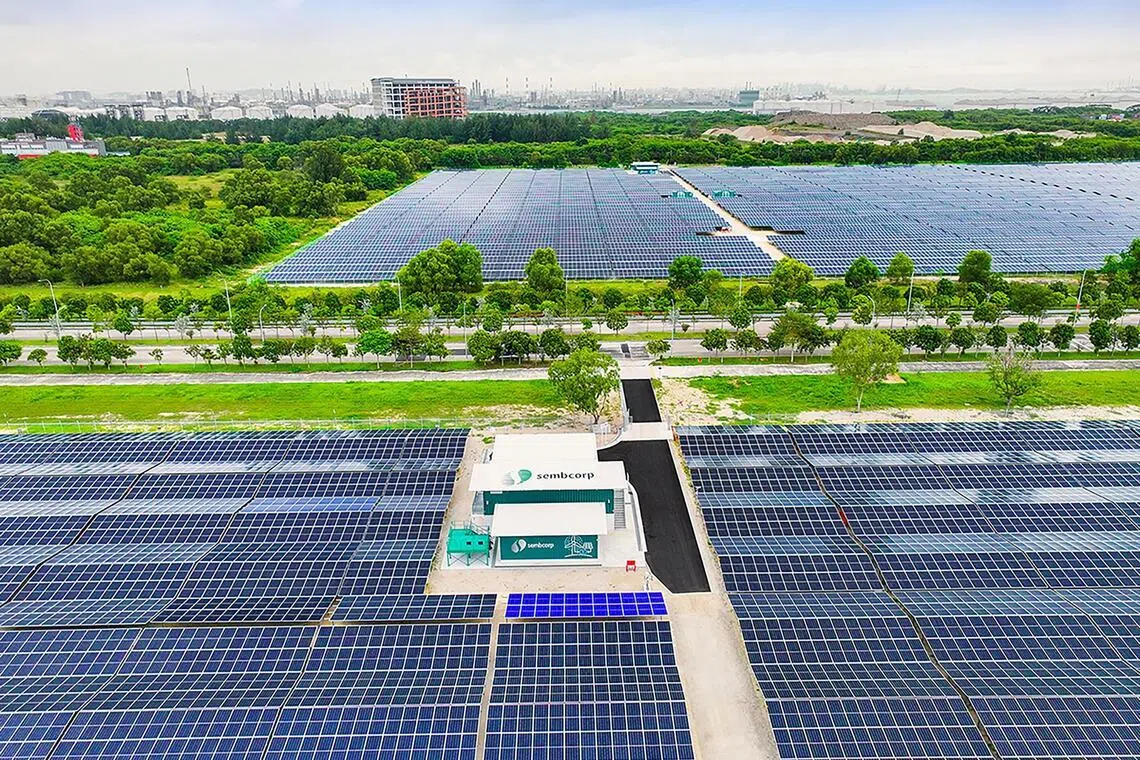
One example is the Sembcorp Jurong Island solar farm, which has a total installed capacity of 118 MWp – enough to power more than 33,200 four-room HDB flats a year.