
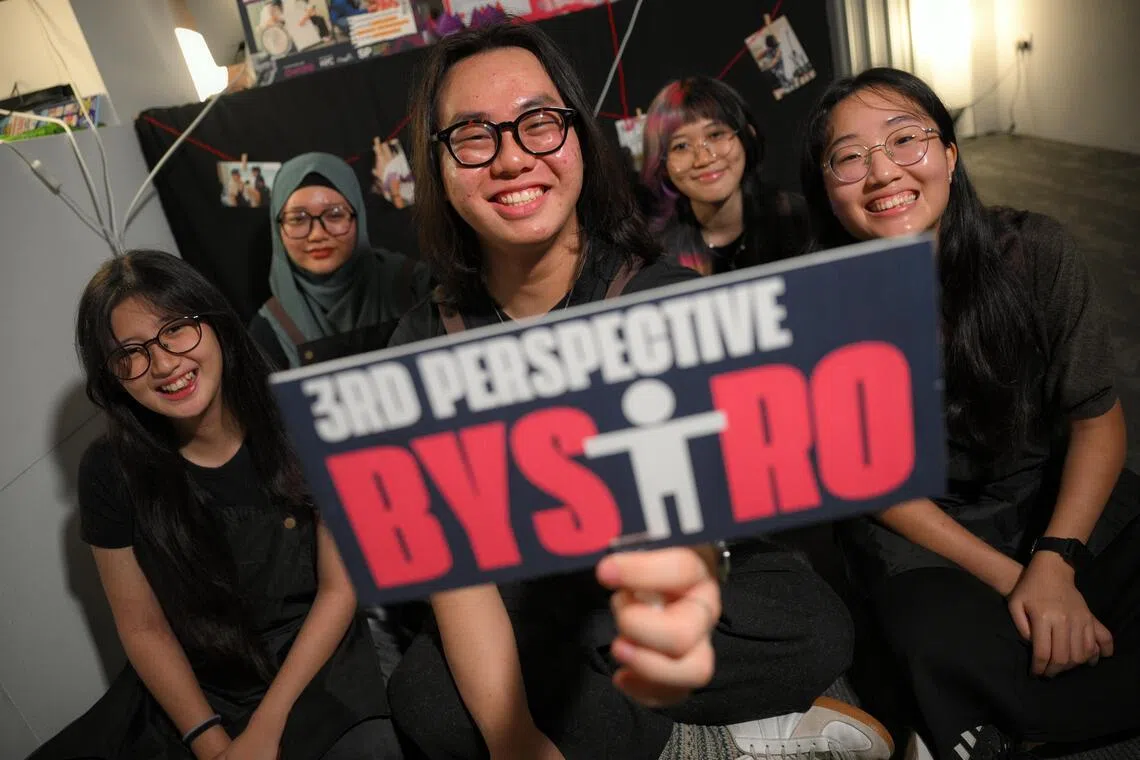
Donning aprons with Hwachae (Korean fruit punch) drinks in hand, they were not your typical baristas. These 20-year-old Singapore Polytechnic students served not just drinks, but also knowledge about abuse, encouraging young people to be active bystanders and willing to intervene when they witness a victim of abuse.
The team of five final-year students from the Media, Arts and Design (MAD) School (with a specialisation in Creative Community Engagement with Psychology) were Mr Stephen Teo Shao Hong, Miss Ho Yue Ling, Miss Meredith Tan Yenn Xi, Miss Dian Azura Riduan and Miss Wen Qing.
The name of their project, “3rd Perspective Bystro”, was taken from the idea of a bystander, or a third party, in a situation of violence, while “bystro” was a play on the words “bystander” and “bistro”.
The project adopted a cafe-style concept, as “a lot of young people go to cafes, and in a cafe, young people usually have conversations”, said Miss Ho.
“We want to re-enact that part, to have conversations in our exhibits too”, she added.
They hope to encourage this through their interactive exhibits and workshops, aside from selling the trendy Hwachae drinks for $4 a cup, raising more than $200 for Association of Women for Action and Research (AWARE) Singapore.
One of the exhibits, titled “A Normal Conversation”, featured a clay figure of a girl being heckled by a group of boys. Participants were encouraged to speak to facilitators on hand, reflecting on and understanding what happened.
They were also presented with Reddit posts inspired by real-life scenarios describing examples of abuse, and encouraged to offer advice and reassurance to these victims.
As part of the After Hours Workshop, participants were also urged to put themselves in the victims’ shoes by engaging in an activity which helped them unpack the victims’ experience of abuse.
3rd Perspective Bystro was done in collaboration with AWARE to increase awareness of hidden forms of abuse, and to empower youth between the ages of 18 and 25 to become active bystanders. It was funded by the National Youth Council (NYC).
The project was exhibited as part of the MAD Graduation Experience from March 11 to March 12 at the Singapore Polytechnic Graduation Showcase.
However, work on it started months before.
In January this year, when Mr Teo had an internship stint – as part of the MAD’s graduation requirement – with AWARE, he road-tested the role-playing activities of the project in a workshop with the National University of Singapore students.
During the research process, the 3rd Perspective Bystro team found it challenging to define what was abusive behaviour, due to its possible range, both physical and non-physical. Eventually, the team decided to focus on invisible abuse, which comprises harassment, sexual harassment, microaggression, emotional abuse, stalking, coercion and gaslighting.
Mr Teo felt that these insidious forms of abuse “have a lot of impact on people, but people don’t recognise them as problems”.
He said that gaslighting, in particular, is one of the most overlooked types of abuse. This involves psychological control of the victims, as they are systemically fed false information that leads them to question what they know to be true. Often, victims are led to believe that they are imagining things, and that their opinions are exaggerated.
For instance, when a child believes that a parent is being abusive, the parent could psychologically manipulate the child into thinking that he is a difficult child, and hence needs strict discipline, even if it is not the case.
Mr Teo added: “With the rise of social media, gaslighting has become normalised. But let’s not stray away from the fact that gaslighting is actually a form of violence.”
Ms Izzaty Ishak, senior executive of Support, Partner and Act Through Community Engagement (SPACE) – which is AWARE Singapore’s dedicated department for community and volunteer engagement – said: “The team brought an invaluable sense of innovation and energy to our cause, one of which was by translating the goal of eradicating gender-based violence into a language that resonates with the student community.”
The exhibition wants to encourage people to practise the 5D framework when dealing with abuse. The 5Ds are:
1. Direct – Speak up firmly when it is safe to do so;
2. Document – Safely documenting the incident;
3. Delay – Check in with the recipient of harassment afterwards;
4. Distract – Take an indirect approach to de-escalate the situation;
5. Delegate – Get help from a trusted adult.
For more information, check out @thirdperspectivebystro_cafe and @awaresingapore on Instagram.