
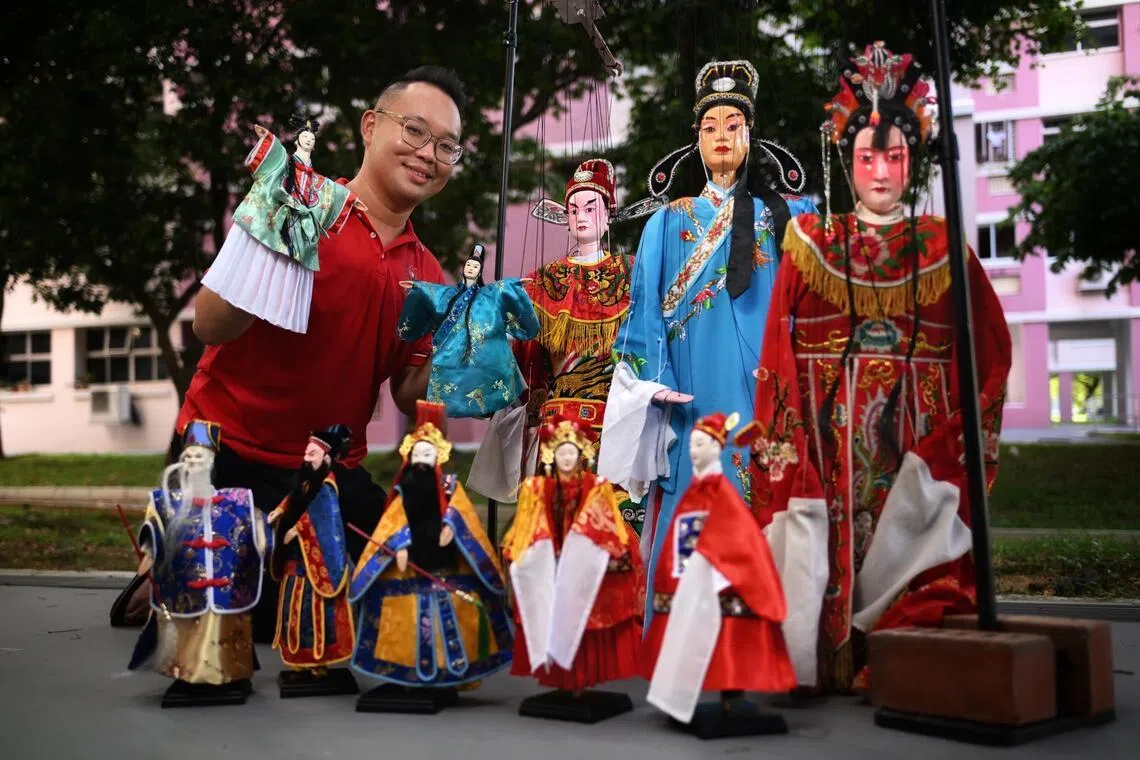
SINGAPORE – Mr Adrian Ong first fell in love with Chinese opera after accompanying his grandmother to watch live performances as a four-year-old.
The music was the main draw for him.
“Despite the different moments of joy, sorrow, separation and reunion, the music, especially the parts played on the electronic keyboard, had a very distinctive and expressive quality,” the 34-year-old recalled.
Mr Ong’s early interest in Chinese opera led him to pick up Hokkien glove and string puppetry in his late teens.
He performed with a clutch of troupes over the years, before starting his own Chinese puppetry troupe in December 2025.
Named Tian Ge Sia, his troupe has around six members: two musicians and four singers and puppeteers. He also writes his own scripts for the troupe and fills in whatever role that is vacant.
Unlike the troupes he had been in that had been very demanding, he welcomes anyone who is interested in the art, regardless of their capabilities.
“I don’t want to put them down… because I was once on the receiving end,” said Mr Ong, who is an after school care teacher.
“I was being told, eh, how come you don’t know how to play? It’s hurtful, so I don’t want history to repeat itself.”
Instead, he encourages newcomers to take on what they are capable of.
“For example, some of them can drum but cannot speak the dialect properly. So I would say, never mind, you do the drumming part,” he explained. “For those who know how to speak some Hokkien, I would say, okay, you help me to do some dialogue.”
Mr Ong is one of the six recipients of the inaugural Outstanding Youth in Intangible Cultural Heritage (ICH) Award, which was given out by Acting Minister for Culture, Community and Youth David Neo at the award ceremony on March 18.
The award, by National Heritage Board, recognises individuals aged 35 years old and below who are not only exceptional in their craft, but also serve as positive influences and leaders through regular engagement with the wider community.
Besides receiving a trophy and a certificate, the recipients may each tap a $20,000 grant within the next three years for their growth as ICH practitioners and emerging leaders in their respective fields.
First announced in 2025, the award was launched as a way of investing in the continuity and transmission of cultural heritage by recognising youth practitioners.
“Our intangible cultural heritage is formed by the practices, expressions, knowledge and skills that our communities recognise as part of our heritage. This is the living part of our culture that gets passed on from generation to generation,” said Mr Neo in his opening address at the inaugural award ceremony on March 18.
“Singapore’s multicultural tapestry is the foundation of our national strength and identity.”
MCCY will continue to focus on the deepening and passing on of traditional arts and heritage to younger generations, and supporting local artists and practitioners in developing Singapore’s multicultural arts and heritage, he added.

Acting Minister for Culture, Community and Youth David Neo delivering his speech at the inaugural Outstanding Youth in Intangible Cultural Heritage award ceremony on March 18.
ST PHOTO: ARIFFIN JAMAR
Creative producer, arts educator and traditional Indian dancer Banupriya Ponnarasu said her journey was heavily inspired by her late teacher Mrs Neila Sathyalingam, a Cultural Medallion recipient.
The 35-year-old said her teacher encouraged her to explore dance beyond the Indian culture.
Ms Ponnarasu recalled once donning the same elaborate headwear and water sleeves as the other performers for a Chinese dance item.
“I was the only Indian girl in the line, but it didn’t feel foreign or alien because everybody made it feel like we were all one people, just doing different things in the same way,” she said.
Ms Ponnarasu went on to start Mandala Arts, a dance company that teaches Bharatanatyam, a traditional dance form, to learners of all ages with a learning-driven pedagogy rather than a performance-driven one.

Creative producer, arts educator and traditional Indian dancer Banupriya Ponnarasu said her journey was heavily inspired by her late teacher Mrs Neila Sathyalingam, a Cultural Medallion recipient.
ST PHOTO: GIN TAY
She wanted the academy to provide dancers a space to escape from various pressures, instead of allowing the arts to be a source of stress.
Ms Ponnarasu also runs the Scarlet Mela Festival of the Arts (SMFA), a biennial eight-week-long programme that provides emerging youth artists, across ethnic backgrounds, an avenue to transform their practices.
Traditional Malay dancer Muhammad Al-Hafiz Hosni, who took part in SMFA, choreographed a piece incorporating military drills to explore themes of conformity and social structure.
Ms Ponnarasu hopes to start a residency to allow dancers a space to learn and embody not only Indian, but also Malay and Chinese dance forms, connecting the three cultures to discover a Singaporean way of dance.
Ms Syafiqah ‘Adha Sallehin’s world was transformed when she first encountered Malay Asli music.
After playing the accordion and keyboards for Orkestra Melayu Singapura from 2007 to 2008, the classically trained pianist also picked up the angklung, gong and kompang.
Ms Sallehin progressed to take on music directing for Gendang Akustika, a Malay folk music ensemble in Singapore, which she curates programmes for.
“I see the importance of leading and sort of trailblazing and starting things, thinking out of the box and not just presenting normal performances,” she said.

Ms Syafiqah ‘Adha Sallehin’s world was transformed when she first encountered Malay Asli music.
ST PHOTO: KEVIN LIM
The group submitted a documentary about Pasir Ris for the National Arts Council’s Arts in Your Neighbourhood project in 2021.
Ms Sallehin’s original composition for the documentary was also meant to contribute to the local Malay Asli music repertoire.
“The song is called Pasir Ris because it’s a continuation of the tradition of how traditional Malay music was about places,” she explained. “From Malaysia, we have Pasir Roboh or Tanjong Puteri – songs about places. So why don’t we have songs about places in Singapore too?”
She wanted to show that this tradition is still living and continuing in Singapore.
She added: We’d also like to have music that is also from Singaporeans about Singapore.
The three other winners of the Outstanding Youth in ICH Award include rattan artist and craftsperson Ng Si Ying, classical Indian music bamboo flautist Niranjan Pandian, and practitioner of dikir barat and Malay poetic forms Muhammad Ilyia Kamsani.
NHB’s heritage policy and research director Melissa Tan said, “The path of our local cultural heritage practitioners is not easy. Some have faced resource constraints, while others have had to constantly adapt to keep their practice relevant and meaningful to their audiences and peers.”
“We want to encourage all youths, who are surmounting the odds to practise and pass on our living heritage, that their efforts are seen and appreciated.”