
Growing up, Temasek Polytechnic (TP) student Karina Xyza Selvaraju always knew sustainability to be about the three Rs – Reduce, Reuse and Recycle.
But following her internship at an environmental social enterprise teaching environmental issues to preschoolers, she realised there were two more to the list: Refuse and Repurpose.
This sparked a growing interest in her for sustainability. Said the 22-year-old Diploma in Communication Design student: “I feel like I wish I had the opportunity to learn of these issues when I was younger.”
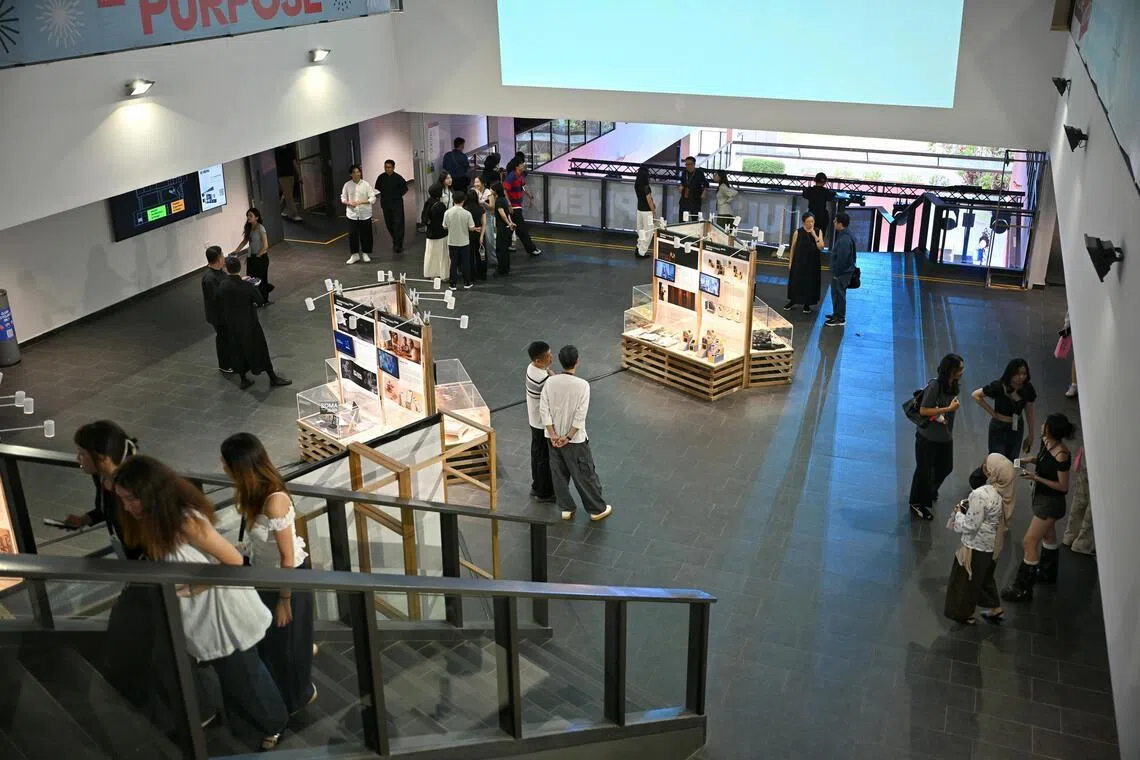
For her Final Year Project, Ms Selvaraju hence designed Myna Changes: a three-part book series and game set to educate preschoolers, specifically five to six year-olds, on environmental sustainability. Her project was one of over 330 graduating projects featured at the TP Design Show 2026 from March 12 to 17 at Temasek Polytechnic.
The title Myna Changes is a play on the word “minor” and the common Crested Myna bird found in Singapore.
“As the books are set in a Singapore context and aimed at young children, the name reflects the idea of encouraging them to adopt small, meaningful green habits in their everyday lives,” said Ms Selvaraju.
The series depicts everyday experiences, such as grocery shopping at supermarkets, and draws environmental lessons from them.

Temasek Polytechnic student Karina Xyza Selvaraju’s project, Myna Changes, is an eco-educational book series and game to educate preschoolers on environmental sustainability.
ST PHOTO: ARIFFIN JAMAR
The books, consisting of short texts and illustrations, are fully hand-drawn by her – a time-consuming process.
“I think every day in school from nine to six, it was just me drawing and redrawing sometimes, because especially when it comes to storytelling, it’s very hard to express what you want to convey (through illustrations),” she said.
To ensure that preschoolers would understand her books, Ms Selvaraju researched other children’s books to find the appropriate language.
Besides the books, Myna Changes also comes with a cooking-style board game based on the books for up to six players, to put together different sustainable ingredients and present a final dish.
The board game features over 20 interactive hand-drawn and laminated pieces. This helps preschoolers who tend to be fidgety and have short attention spans learn better, she added.
Ms Selvaraju hopes that these books can be used in preschool classrooms or enterprises like her internship company to educate children.
“I feel like a lot of the things we carry on today were things we learned from young,” she said. “Teaching them these (environmental concepts) now will help them obtain the habits in the long run.”
Meanwhile, her schoolmate Melinda Mazlan always knew she wanted to base her Final Year Project on the topic of human connection.
“As I was at home ideating and sketching, I looked around my room and realised it is filled with memories of people who make me who I am,” the 20-year-old Diploma in Apparel Design and Management student said. She hence got inspired by the items she collected, including photobooth prints and other knick-knacks.
During her 16-week internship in a fashion company, Ms Melinda also realised the extent to which fabric scraps were thrown away.
“In manufacturing, typically about 20 per cent of fabric is wasted during the cutting phase,” she said. “I did a lot of fabric sourcing and manufacturing, and I realised so much selvage is being wasted in the fabric world.”

Ms Melinda Mazlan with her project, Tether, a collection of fashion pieces that explores the human desire to collect, at Temasek Polytechnic on March 12.
ST PHOTO: ARIFFIN JAMAR
Selvage refers to the edge of a piece of fabric which prevents it from fraying or unraveling.
This convinced her to embark on her project with a mindset of being sustainable in terms of how she approached her fashion designs.
Tying these two concepts together, Ms Melinda eventually came up with Tether, a fashion collection of 12 garment pieces which explores the human desire to collect objects as physical reminders of connection and belonging, with each piece designed sustainably.
Like Myna Changes, Tether was also showcased at the TP Design Show 2026.
One of the focal pieces in Tether is a top inspired by a locket she keeps, which holds a special significance to her as it is a matching piece which she bought together with her family members.
In her pieces, elements like “weaving methods and textures mimic the way we link relationships with the items (we collect) as well,” she said.
Ms Melinda also used sustainable methods to reduce fabric waste in creating her pieces.
She experimented with creative pattern cutting, like subtraction cutting – directly cutting out a specific pattern rather than stitching pieces together – which allowed her to reduce the amount of fabric waste from her pieces. She also integrated loose scraps back into her pieces as patterned trims.
Ms Melinda hopes to eventually take Tether beyond the school setting and turn it into a business, such as by joining Temasek Launchpad, the polytechnic’s incubation programme for budding entrepreneurs.
As a Gen Z herself, she designed Tether to incorporate personality without compromising on its environmental impact.
Said Ms Melinda: “I wanted to sort of merge sustainability with emotional durability, which I feel encapsulates Gen Zs as my target audience to not see sustainability as something so separate.”