
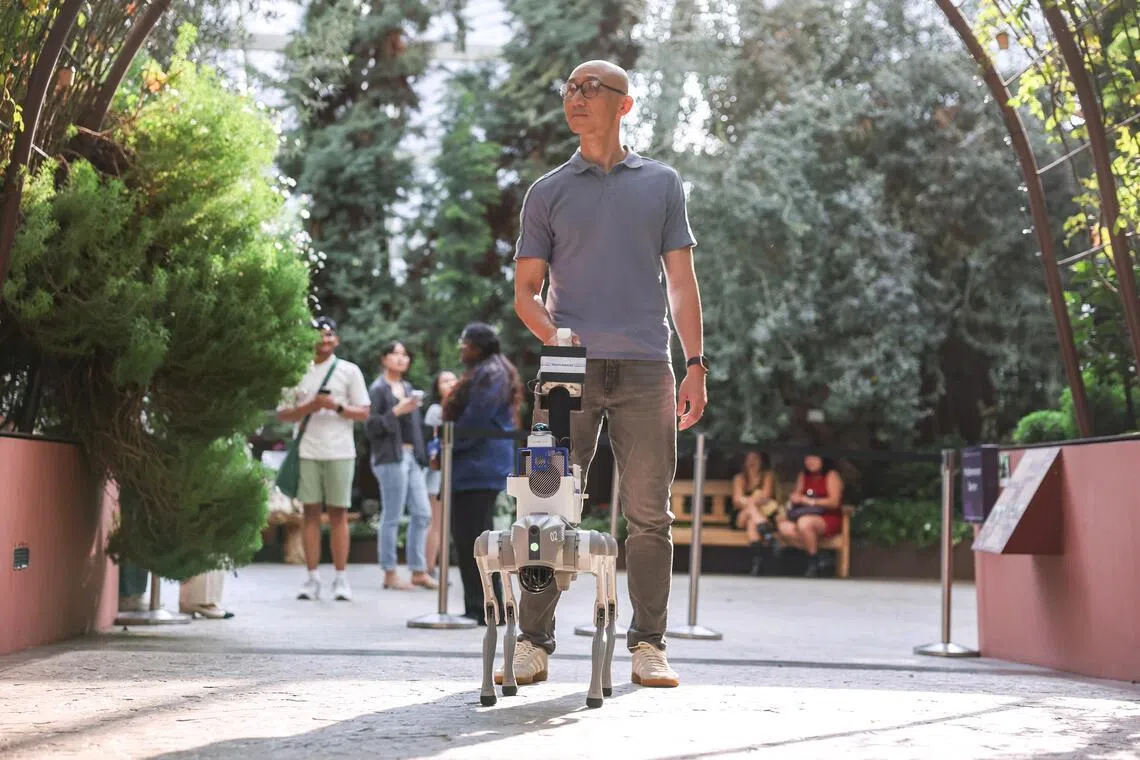
SINGAPORE – A free robot guide dog service will soon be available for individuals with visual impairment visiting Gardens by the Bay’s Flower Dome, as part of the attraction’s efforts to improve accessibility.
A wearable AI-powered headset is also in the works to help them identify their surroundings in the dome, along with an online sensory map of the park that visitors with autism and their caregivers can use to plan ahead.
Adding to these efforts, Gardens by the Bay will serve as a testbed for local companies to refine accessibility solutions for Singapore’s public spaces, said National Development Minister Chee Hong Tat on March 22.
“These new technologies can empower visitors to experience its spaces with greater autonomy and confidence,” said Mr Chee, speaking at an appreciation dinner for over 300 beneficiaries, volunteers, donors and partners of Gardens by the Bay’s Gift of Gardens community outreach initiative.
The robot guide dog, which has a handle, was developed by local company RoamAssist, and will be available by the third quarter of 2026.
Programmed with the layout of Flower Dome, it will guide visitors to key plant highlights and provide audio descriptions and instructions on how to use a tactile guidebook to understand the plant. It can also sense obstructions in the path ahead and pause or lead the visitor on alternative paths.
Development and testing for the AI-powered headset by local start-up AiSee will begin in the first quarter of 2027.
When prompted by a voice cue, the headset will capture an image of a plant in the Flower Dome, use cloud-based AI to match and identify it, and then relay the info back to the user via audio.
These new technologies build on sensory tours piloted by Gardens by the Bay since 2024, which feature tactile guidebooks, the use of descriptive language by trained guides and real plant samples and 3D models.
More than 800 people have experienced these tours and eight underwent training to become paid docents for the tours, said Gardens by the Bay in a media release.
One of the docents, Ms Liza Rosli, led Mr Chee as well as the event’s guest-of-honour President Tharman Shanmugaratnam, who is also the Gift of Gardens patron, on a tour of the Flower Dome with the robot guide dog.

Ms Liza Rosli (in purple), a visually impaired docent, demonstrating the robotic guide dog to President Tharman Shanmugaratnam and Minister for National Development Chee Hong Tat.
ST PHOTO: BRIAN TEO
“The objective is to eventually allow persons with visual impairment to enjoy Flower Dome independently at their own pace – the robotic guide dog will help them navigate safely, while AiSee can answer their questions the way a docent would,” added Gardens by the Bay.
Mr Ong Boon Keat, 45, who is blind, got to test out the robot guide dog on March 22. “In the past, without all these gadgets, I had to rely on family or a volunteer guide through the whole experience,” he said.

Mr Ong Boon Keat (centre) uses the tactile booklet with the help of Mr Gerald Teo (right), 49, deputy director of programming (membership and volunteers) at Gardens by the Bay, at the flower dome.
ST PHOTO: BRIAN TEO
“But with this, (visually impaired people) can enjoy the tour on our own… the dog can not only lead me to the garden that I want, but it can also narrate and describe the plant to me,” added Mr Ong. He visits Gardens by the Bay several times a year with his family for seasonal exhibits such as the sakura and rose displays.
Mr Ong, a group personal assistant in financial advisory firm, also hopes the technology could be applied more widely in daily use, such as walking to the gym or commuting to the office.
Another accessibility initiative, the online sensory map, will be rolled out from June this year. The map, co-developed with St. Andrew’s Autism Centre, identifies level of sensory stress and environmental triggers in various parts of the Gardens, like noise, light and smell at different times of the day.
Mr Chee noted that such efforts also support the Republic’s Enabling Masterplan 2030 – a national road map first announced by a 27-member committee in 2022, to support persons with disabilities and enable them to contribute to society.
The development of both the robot guide dog and AiSee is supported by the Enabling Lives Initiative Grant, funded by Tote Board and managed by national disability agency SG Enable.
Mr Chee highlighted that since 2025, more than 1,000 youth have volunteered for Gardens by the Bay’s programmes, such as sensory tours for persons with visual impairment and befriending activities.
In 2025, the attraction partnered with Youth Corps Singapore to engage 3,000 youth volunteers by 2028.
“As a People’s Garden, Gardens by the Bay is also working towards involving more Singaporeans, especially our youths, in its programmes and operations, and to cultivate the spirit of volunteerism,” he said.
Gardens by the Bay’s accessibility improvements come as the attraction is due to expand with the 5ha Wetlands by the Bay, slated to open in stages from end-2028.
Some 16 million people visited Gardens by the Bay in 2025.
“As a People’s Garden, we believe nature should be accessible to all,” said Gardens by the Bay chief executive Felix Loh.
“By leveraging technologies such as AI to support greater independence for persons with disabilities, we hope to create a more inclusive society where everyone feels welcomed and empowered.”