
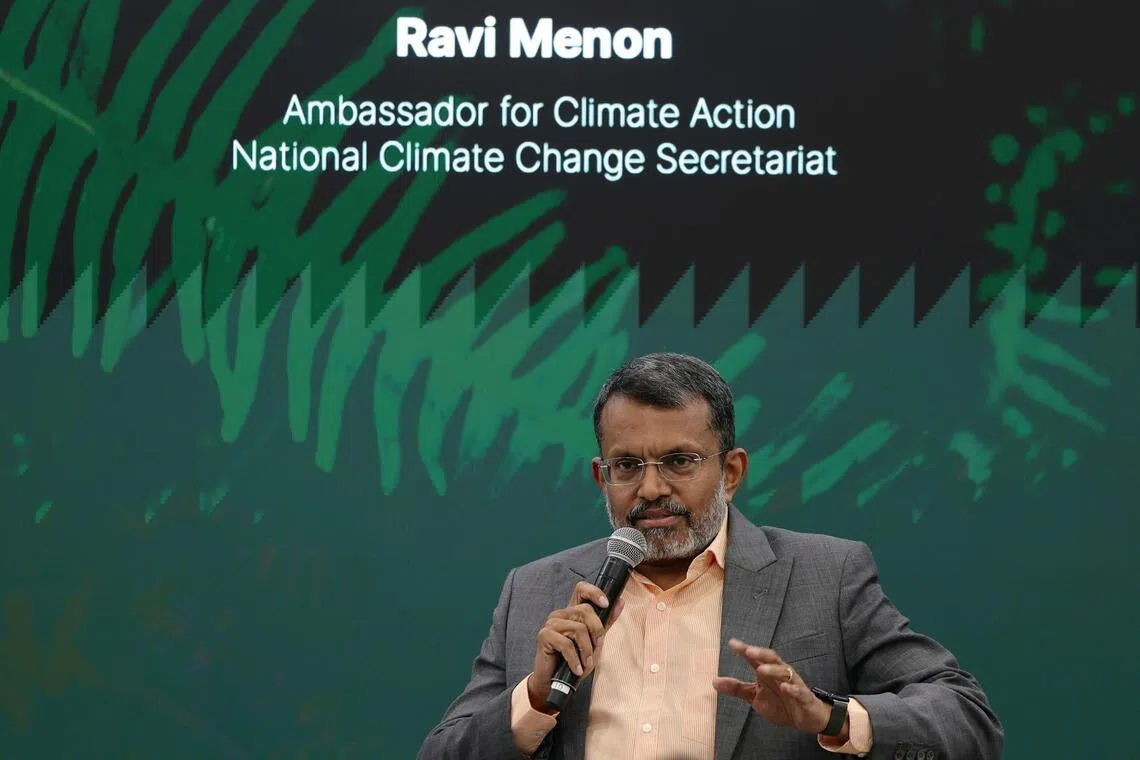
SINGAPORE – The current geopolitical situation does not weaken the case for climate action but strengthens it, said Singapore’s Ambassador for Climate Action Ravi Menon on April 6.
Energy security and environmental sustainability are becoming mutually reinforcing objectives, he said at a dialogue organised by the Singapore Business Federation (SBF).
A large share of oil and gas production is located in a small number of regions, noted the former chief of Singapore’s central bank. Much of the cargo also moves through a few critical choke points, he added, noting that this was a concentration of risks on two fronts.
Diversifying oil and gas sources or switching to coal-fired energy are effective short-term responses. But Mr Menon added that increasing energy efficiency and switching to renewables are the durable, long-term solutions to reducing the inherent vulnerability of oil and gas dependence globally.
The ongoing conflict in the Middle East has led to the blockage of the Strait of Hormuz – which accounts for about a fifth of global crude oil flows – and oil prices have spiked since. That has caused trickle down impacts on energy prices, food and fuel.
At the same time, climate change impacts such as flooding are affecting business bottom lines. From floods disrupting manufacturing hubs to droughts affecting agricultural output, businesses are facing climate-related risks and have to plan for operating in a climate-impaired world, he said.
Transition planning is planning for business resilience in a climate-impaired world, Mr Menon said. Those who start to adapt early will reap the most advantages, he added.
During a fireside chat with data and technology firm ESGpedia’s founder Benjamin Soh at the event, he cited how Spain was experiencing some of the lowest gasoline prices across Europe.
Mr Menon said this was because of the investments it made in renewable energy, especially solar power, in the past few years. Companies and countries that prepare five, ten years in advance are now in better place, he said.
To help businesses start moving early on this front, the Singapore government will be launching with the SBF a new Council for a Competitive Climate Transition, or C3T.
It will be co-chaired by Mr Menon and SBF’s chief executive Kok Ping Soon, and invites to business representatives across various sectors to join the council have been sent out.
Some initiatives the council will look to implement include sharing relevant climate-related data with various sectors, said Mr Kok.
This includes sharing information on how sea-level rise could affect the marine industry, or helping construction firms understand how growing numbers of hot days could impact their businesses.
Said Mr Kok: “What does heat resilience mean? (Rising temperatures) will affect worker safety. It will affect your productivity, and it’s going to affect your project timeline, right? So what are you going to do about it if Singapore gets hotter and hotter?”
“Treating heat risk is no different from how you should consider dealing with manpower shortages in Singapore or supply chain disruption. So it’s really making climate risk a business continuity risk,” he said.
Firms that delay action will eventually face rising costs, said Mr Menon, adding that there is fair and competitive advantage in investing early.
On tracking the progress of the council, Mr Menon said that success is when every business has a credible and viable transition plan in terms of how they’re going to be managing their climate-related risks, and transitioning their business to become more competitive in a carbon-constrained world.
The launch of the new council comes as Singapore designated 2026 as its Year of Climate Adaptation, to focus attention on the need for people and businesses here to start preparing for climate change impacts.
Speaking at the event, Minister for Sustainability and the Environment Grace Fu emphasised that the private sector will need to include climate adaptation as part of their business continuity plans.
“The government can only do this much. We can make sure that there’s some basic climatic infrastructure that we will put in place… but we can’t have your business continuity plan done for you.. you have to evaluate this for yourselves,” she said.

Minister for Sustainability and the Environment Grace Fu speaking at the post-COP30 Dialogue on April 6.
ST PHOTO: KEVIN LIM
Ms Fu also urged companies to start planning their adaptation strategies which may span many years or may need to be developed sooner than expected.
“We don’t want to be the frogs in boiling water. We want to be able to jump out when we sense the water is getting hotter, so that we will not be boiled over,” she added.