
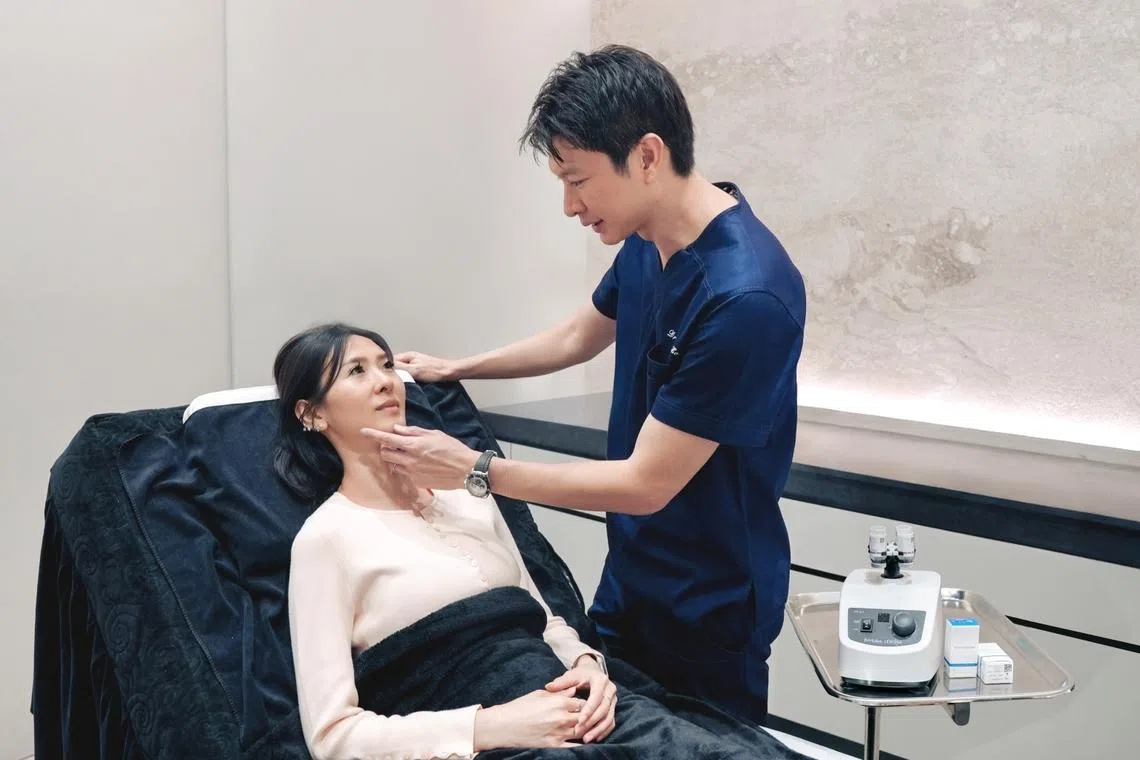
For many people, acne does not end when the breakouts stop. Damage from the inflammation can leave behind structural changes long after active breakouts have cleared.
Dr Gerard Ee, medical director of The Clifford Clinic, explains: “Acne scars develop when inflammation damages the deeper layers of the skin. This injury disrupts the underlying tissue and creates fibrous bands that tether the skin down, leading to depressed or sunken scars.
“The type of acne scar also varies. During the healing process, collagen, which provides structural support to the skin, may be rebuilt in an uneven manner. ”
Ice pick scars are narrow, deep and look like tiny punctures, so they are usually the hardest to improve with surface treatments alone, explains Dr Ee. Boxcar scars are broader with more defined edges like a small crater, while rolling scars appear as wider, softer depressions, caused by fibrous bands that pull the skin downward.
In reality, many patients have a combination of all three scar types at the same time, says Dr Ee. Because of this, treating acne scars often requires more than one approach.
“Different scar types sit at different depths and behave differently. That is why a single treatment rarely works for every patient,” he adds.
One method to address acne scars is Juve Scars, which aims to stimulate collagen production within the skin.
The treatment involves placing small amounts of an injectable into specific scarred areas to encourage gradual repair from within. Best suited for rolling and boxcar scars, it helps scars become shallower over time while improving overall skin surface.
Dr Ee explains: “It is a biostimulator rather than a classic filler and contains hyaluronic acid to help with hydration, and polylactic acid to encourage the skin to make more collagen.
He says the Juve Scars treatment is done with topical anaesthesia and involves minimal downtime. Mild swelling, tiny bumps, redness or bruising may occur at the injection points, but most people can return to their normal activities by the next day.

At The Clifford Clinic, a holistic approach to scar care combines a range of treatment options tailored to individual skin needs.
PHOTO: THE CLIFFORD CLINIC
Dr Ee notes that many patients may see improvement after just one session, but a course of two or three sessions, spaced about one month apart, is usually recommended.
Another treatment often used alongside the Juve Scars treatment is INFINI – a microneedle fractional radiofrequency (RF) procedure that delivers energy deeper into the skin.
The treatment works by allowing the needles and heat to bypass the skin surface and create controlled injury in the deep dermis, which triggers wound healing and new collagen formation.
As new collagen forms and scar bands are remodelled, the base of the scar gets more support from below, so the scar depression appears softer and the skin surface smoother.
Explains Dr Ee: “Many acne scars are anchored deeper than people think. If a treatment reaches only the upper layers, it may improve texture but not fully address the deeper scar support problem. INFINI can reach up to 3.5mm, so it can treat the layer where deeper scar tissue and collagen loss sit.”
By comparison, conventional laser and RF treatments typically reach a maximum depth of 1.5mm.
He notes that patients can expect some discomfort during treatment, so numbing cream is applied. Common short-term effects include redness, swelling, tenderness and occasionally, temporary faint patterned marks on the skin.
Visible improvement may be seen after one or two treatments, with sessions often spaced a few months apart to allow collagen remodelling to take place fully between treatments, he says.
Another option for acne scar management is the ECM Skin Booster, a treatment that focuses on improving the skin’s overall quality through skin repair rather than directly filling scars.
“The ECM or extracellular matrix is a support system around skin cells, where collagen, hydration and repair all happen. When it’s healthier, the skin can renew itself more effectively – improving texture, strength and resilience over time, rather than creating an instant filling effect,” Dr Ee says.
He adds that the ECM Skin Booster can be useful for those whose skin is rough, tired, porous or slightly lax, as improved skin quality can make scars appear softer and less obvious under light.
“The result is subtle and natural looking, but the limitation is that it is not the right tool for sharply defined deep scars that need greater remodelling and stronger treatments that penetrate deeper into the skin.”

Suitable for rough, tired or slightly lax skin, ECM Skin Boosters can improve overall skin quality, helping scars appear softer and less visible.
PHOTO: THE CLIFFORD CLINIC
After the treatment, patients may experience mild redness, swelling, tenderness or occasional bruising. Some may also notice tiny bumps at the injection site, which typically temporarily settle as the skin recovers and the product integrates.
Dr Ee says that many patients start with one or two sessions, often spaced about two months apart. While hydration and radiance may improve earlier, changes in firmness and texture tend to develop more gradually.
The ECM Skin Booster, Juve Scars and INFINI are not suitable for individuals who are pregnant or breastfeeding, have active acne breakouts or infections in the treatment area, or have medical conditions such as impaired wound healing or significant hypersensitivity.
In most cases, these treatments are performed in staggered sessions rather than a single session, says Dr Ee.
“Acne scar treatment works best when each session is sequenced so the skin has time to remodel properly, and also to reduce unnecessary inflammation and lower complication risk,” he explains.
“There is no single best treatment for every patient because acne scars are not one condition. The right answer depends on scar mapping during consultation – these and other complementary procedures work together by treating different parts of the scar problem.”
To find out which treatment is right for you, book a consultation at The Clifford Clinic.
