
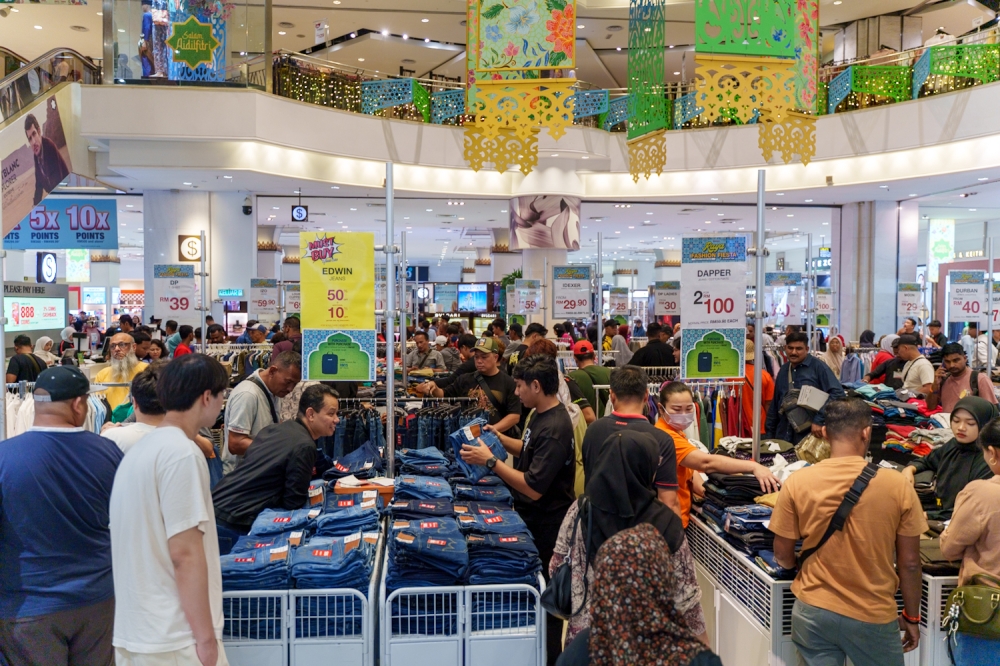
KUALA LUMPUR, April 10 — Will you always choose the cheapest brand when you are shopping, if your wallet or purse feels a bit thin now?
Research firm Rakuten Insight’s latest survey this month shows that Malaysians would not necessarily go for what is cheapest, and that they also want a good quality product when choosing a brand.
Rakuten Insight Malaysia’s commercial research lead, Min Yao Kong, told Malay Mail that price is a dominant factor, but not the overwhelming reason why Malaysians would choose a certain brand when finances are tight.
“53.4 per cent cite lowest price as a driver. That means nearly half don’t. Under genuine financial stress, you’d expect that number to be higher.
“What it suggests is that price is necessary but not sufficient — people want cheap, but not at the cost of quality or reliability,” he said.
“The ‘durable long-term value’ result at 26.6 per cent actually reinforces this: waste anxiety is real. Buying the wrong cheap thing is an expensive mistake,” he added
‘Buatan Malaysia’ something Malaysians want in a financial squeeze
In Rakuten Insight Malaysia’s Malaysia Cost Pressure Pulse (MCPP) April survey, 1,052 Malaysian adults were asked to choose what they consider when deciding on a brand, with the top five factors being: lowest price (53 per cent); promotions/ cashback (39 per cent); durable, long-term value (27 per cent); trusted quality (won’t risk wasting money) (26 per cent); and preference for local-made (18 per cent).
This is followed by loyalty points (14 per cent); ethical or halal considerations (13 per cent); flexible payments (12 per cent), while 12 per cent chose the new option of “not an imported product” as it would be less affected by currency or shipping cost changes.
As for the other factors, 11 per cent in the April survey cited convenience and speed, 10 per cent chose the new option of “familiar brand I’ve always used”, and six per cent considered customer service and easy returns.
‘Jom Beli Lokal’ no longer just a feeling, but a factor when deciding on purchases
Kong said the 11.5 per cent figure for “not an imported product” is bigger than it looks, as Malaysians are placing more importance on this compared to buying what is fastest and most convenient.
“It immediately ranked above convenience and speed in a market where platforms have spent billions competing on exactly that,” he told Malay Mail.
Combining this with another finding in the same survey where 19.9 per cent are actively switching to Malaysian-made products, Kong said: “This is the same signal appearing twice”.
“The ‘buy local’ behaviour has crossed from sentiment into an actual purchase criterion,” he said.
The tired of making choices factor
Kong said a “quietly interesting finding” is the fact that 10 per cent of Malaysians polled say they stick with familiar brands because switching feels like too much effort.
“After months of price-hunting, a meaningful slice of consumers has decision fatigue,” he said, noting that brands that Malaysians are choosing to continue buying would be seeing results now from their brand loyalty efforts.
“For incumbent brands, that’s a window — loyalty programmes and habit-based retention have real ROI right now in a way they might not during normal conditions,” he said, referring to the return on investment (ROI) that brands could benefit from.
Amid rising global costs due to the US-Iran war’s impact, Rakuten Insight’s same April survey respondents have also been increasingly worried over their household finances and living costs within the next three months.
Here’s a quick look at what Malaysians polled are saying they plan to do in the next four weeks: 31 per cent will likely switch to cheaper brands or store brands (store brands refer to products made for a supermarket that is selling it, for example), while 19.9 per cent are likely to switch to Malaysian-made products.