
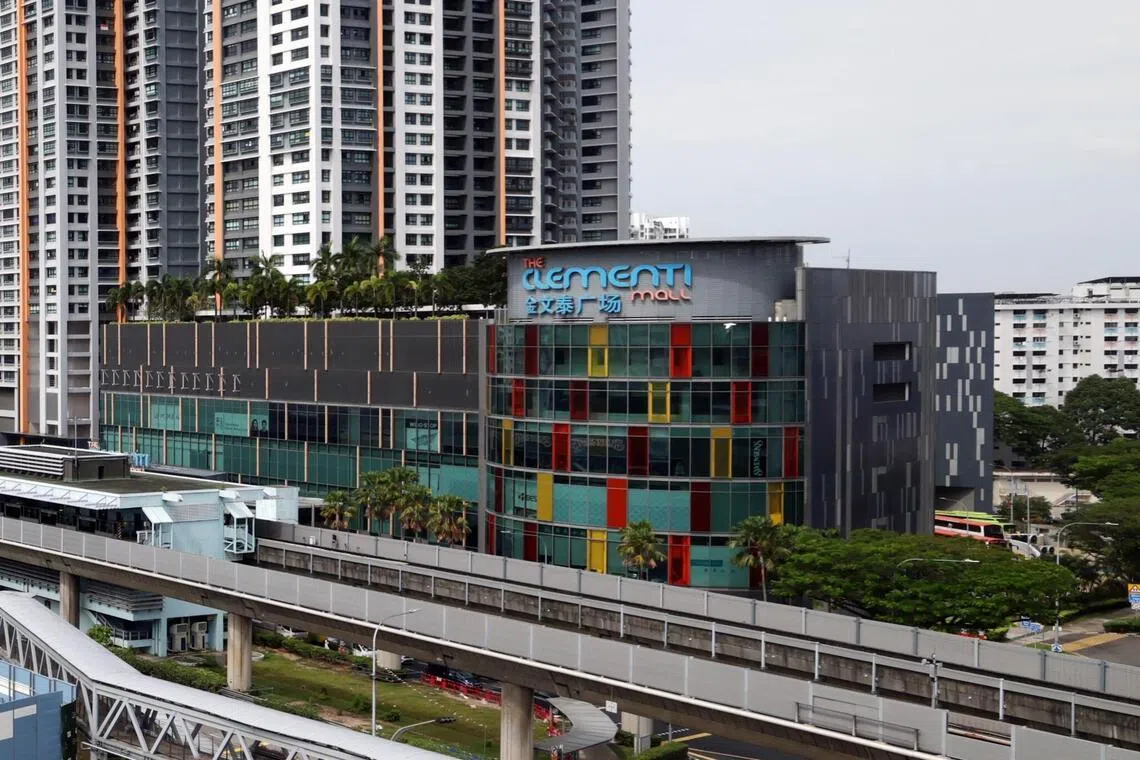
SINGAPORE – A home-grown bakery that has been selling its cakes, confections and cookies at The Clementi Mall for the last nine years might soon close when its lease runs out in end-2026.
The bakery’s owner is concerned that the heartland mall’s new owner, property firm Elegant Group, will ask for higher rent that he will not be able to afford.
When he recently negotiated the renewal of his lease, the mall’s new owner asked for more than $10,000 – a 55 per cent fee hike.
The bakery owner, who asked not to be identified out of concern that it might jeopardise future rental negotiations, managed to get this down to a roughly 25 per cent increase, but was offered only a six-month lease extension.
This expires at the end of 2026.
“Before Elegant Group took over as landlord, rental increases did happen, but they were generally at a reasonable and manageable rate, between 5 per cent and 10 per cent,” said the owner.
Elegant Group, linked to Guangzhou-based conglomerate Grantral Group, has been acquiring retail malls here. The Clementi Mall is its sixth acquisition, adding to a portfolio which includes adjacent Grantral Mall @ Clementi.
This example illustrates how a recent influx of foreign investors and businesses is changing Singapore’s retail landscape, with local businesses concerned that they will be pressured by rising rents.
Mr David Hoe, the area’s MP, raised these concerns in Parliament. In January, he asked the Government whether it has assessed the impact of the sale of The Clementi Mall on the diversity of the area’s commercial offerings.
Mr Hoe told The Straits Times that his residents who visit the mall for daily needs are worried about local brands being displaced.
He pointed out that this might affect Muslim residents’ dining options in the future and said Singapore needs to develop a guiding framework to shape outcomes when local malls are acquired, so that they continue to cater to the diverse needs of Singapore’s multiracial society.
Without such a framework to check market forces, this could be challenging, said Mr Hoe.
These concerns have arisen because of how Grantral Mall @ Clementi has changed since Elegant Group’s purchase of the mall in 2016.
Mr Mohamed Jameel, who runs a money changer in Grantral Mall @ Clementi, said more mainland Chinese stores, including eateries and a supermarket, have entered the mall in recent years.
In 2025, his shop was asked to move to a new unit. The third-generation owner of HRBS Money Changer, a tenant of 15 years, said the landlord then allocated the previous space to an existing Chinese food and beverage tenant.

More mainland Chinese stores, including eateries and a supermarket, have opened at Grantral Mall @ Clementi since property firm Elegant Group acquired the mall in 2016, say shopkeepers.
ST PHOTO: AZMI ATHNI
While Mr Mohamed’s outlet has been spared major rental hikes, the plight of some neighbourhood tenants like the bakery owner in The Clementi Mall makes him anxious.
“We heard rental has increased on that side for both old and new tenants. We’re worried it will happen here too because it’s under the same group,” said Mr Mohamed, 51.
According to Realis data, median rents for retail units in Commonwealth Avenue West, where The Clementi Mall and Grantral Mall @ Clementi are located, rose by 29 per cent from 2022 to 2025, compared with 14 per cent islandwide.
The steeper spike in Clementi’s retail rents is driven in part by a surge of mainland Chinese businesses in the area, said Mr Alan Cheong, executive director of research and consultancy at Savills Singapore.
He added that these stores – primarily F&B outlets – are drawn to the area because of its high concentration of Chinese nationals, who are mostly students or graduates of local universities in the west.
Mr Ng Pit Hann, owner of 2020 Vision Optometrists, said about half of the customers at his Grantral Mall @ Clementi store are Chinese nationals, compared with just 10 per cent at his other heartland outlets.
“It might be a good thing that the Chinese shops come in, as they may bring more customers to the malls. Anyway, for spectacles shops like us, (the landlord) might not charge very high rents because they might want to keep at least one such store,” the 46-year-old said.
Clementi residents said they are concerned that Elegant Group’s recent takeover of The Clementi Mall could lead to changes to their shopping and dining options, such as a decline in halal shops.
Several residents said that as it stands, halal food options in the area are limited, especially after a halal-certified foodcourt in The Clementi Mall closed in 2025.
“The tenant mix in Grantral Mall is not that diverse… We’re concerned The Clementi Mall will end up the same,” said financial adviser Karen Ang, 47.
Retiree Bala Vellu, 80, visits Clementi several times a week because he enjoys the variety offered by the area’s HDB shops and The Clementi Mall, and hopes foreign brands do not take the place of local shops.
“Even though I like the Chinese food, there’s no point having so much of one kind of thing in a place. You don’t want to be eating the same flavours all the time,” he said.

Both Grantral Mall @ Clementi (left) and The Clementi Mall are now owned by Elegant Group, which is linked to Guangzhou-based conglomerate Grantral Group.
ST PHOTO: AZMI ATHNI
Asked about these concerns, Elegant Group said it intends for both its Clementi malls to complement each other to serve the daily needs of residents and visitors to the area, including students.
The group’s spokesperson added that owning both malls allows the group to optimise tenant mix across the precinct, reduce internal competition, and negotiate better with anchor tenants.
For instance, the firm plans to introduce more brands to attract younger shoppers from the new flats and condominiums being built in Clementi, said the spokesperson.
The firm, which also has in its portfolio the Kinex mall in Paya Lebar and Tanjong Katong Complex, said it will curate the offerings of its malls to suit the needs of the surrounding community.
“We monitor closely our tenants’ performance and observe for any shifts in consumer preferences, and retail or lifestyle trends. We will proactively adjust the tenant mix as and when required,” said the spokesperson.
In end-January, CapitaLand Investment (CLI) said it would take a minority stake in The Clementi Mall and provide it with real estate advisory services. This came several weeks after concerns were raised in Parliament about the diversity of tenants and consumer choice in heartland malls.
Welcoming the move, Mr Hoe told ST he believes CLI’s involvement will help The Clementi Mall better cater to the needs of residents with a varied tenant mix, given the group’s experience in running heartland malls.
But local businesses said more intentional support is needed for them to thrive.
The Clementi Mall bakery owner said it has become increasingly difficult for home-grown brands to survive, citing the cost of rent, manpower and utilities.
“For local businesses to continue contributing to the mall’s character and community, there needs to be more stability, fairness, and support from landlords.”
Several foreign businesses said they chose to expand in Singapore because its majority Chinese population has similar consumer preferences to mainland China, making it a gateway towards further overseas expansion.
Singaporean realtor Aric Lim, who specialises in mainland Chinese clients, said Singapore is also an appealing location because it is a financial safe haven with a very stable market.
“We have relatively low taxes compared with many other countries. We also have no inheritance or capital gains tax,” he said, adding that Singapore has various incentives to attract foreign investors.
The Huttons Asia group district director said many of his clients first set up family offices in Singapore, moving funds and assets here before setting up businesses to integrate into society.
While rents across Singapore are increasing, Mr Lim said numbers are rising faster in areas where wealthier foreign brands are moving in, putting local businesses at risk of being priced out.
On top of high rents, some landlords require tenants to fork out several months’ worth of rental deposits upfront.
“Local businesses that are well-established brands might be able to do that, but for the rest, like a small business outfit, it would be very hard,” said Mr Lim.
The arrival of foreign brands has sharpened competition in what is already a challenging retail landscape.
Mr Jaden Wu, director and co-owner of restaurant chain Yuen Kee Dumpling, said he aims to open 80 stores in Singapore within three years.
The Guangzhou-based brand currently operates 27 outlets here, since entering the Singapore market 1½ years ago.
One of Mr Wu’s most popular outlets is a restaurant in the HDB area a few blocks from Grantral Mall @ Clementi.
“Our core corporate mission is to bring Chinese dumpling culture to the whole world,” he said.
“We want to embed ourselves and hope to become like local brands that Singaporeans love to eat, so that when they think of eating dumplings, they think of Yuen Kee.”

Yuen Kee Dumpling, which has opened 27 outlets here in the span of 1½ years, recently launched a new outlet in a Housing Board shop unit at Marine Parade in March.
ST PHOTO: LIM YAOHUI
Yuen Kee recently opened one of its latest outlets – a two-storey Housing Board shop unit in Marine Parade – on March 25.
The brand has signed a 10-year lease there at $18,000 a month, Mr Wu said, adding that the rent was affordable given the area’s high foot traffic.
Another Chinese business owner said Chinese brands that come to Singapore are battle-hardened – they have survived the tough competition back home and have come here with tested business models.
Health snack store Eighteen Plum’s co-director Tina Ye said: “We want to beat our main competitors here too and cement our presence.”
The brand, which runs 300 stores in China, opened eight here in a year, and wants to have 25 to 30 Singapore outlets by 2030.
The store’s other co-director, Ms Sammi Wang, told ST that since opening its maiden store in Plaza Singapura, all her other outlets were launched in response to invitations by different mall operators.
Both Yuen Kee and Eighteen Plum said Singaporeans have, over time, developed a taste for their food after they made adjustments for local palates.
Yuen Kee’s Mr Wu said Singaporeans now make up 70 per cent of his customer base, compared with 30 per cent when it first opened.
Singapore is the Guangzhou-based chain’s first stop in South-east Asia, and Mr Wu said the brand spent a month studying and adapting its products to Singaporean taste buds to achieve this outcome.
Ms Wang from Eighteen Plum made similar adjustments.
When asked about concerns of dwindling non-Chinese options, Ms Wang said that while her chain is not halal-certified, its products do not contain pork or lard and at least 30 per cent of her customers are Malay and Indian.

Health snack store Eighteen Plum has opened eight outlets here in a year, including one at imall, a new shopping complex in Marine Parade that opened in May 2025.
ST PHOTO: LIM YAOHUI
Some of these business owners also have personal reasons for making investments in Singapore.
Yuen Kee’s Mr Wu and Eighteen Plum’s Ms Wang, who both came to Singapore in 2024, said they plan to apply to be permanent residents (PRs).
In the long run, Ms Wang hopes to live in Singapore with her husband – a PR who has worked here as an engineer for two decades.
Ms Ye, Eighteen Plum’s co-director who has been a resident here for 17 years and has acquired Singapore citizenship, said: “Singapore’s laws are fair and people are very friendly to foreigners.
“I feel a sense of belonging here and want to contribute to the economy and society.”