
SINGAPORE – One of the first few priorities of a new committee to strengthen the Singapore Indian community is to use religion to help reduce reoffending among Indian inmates.
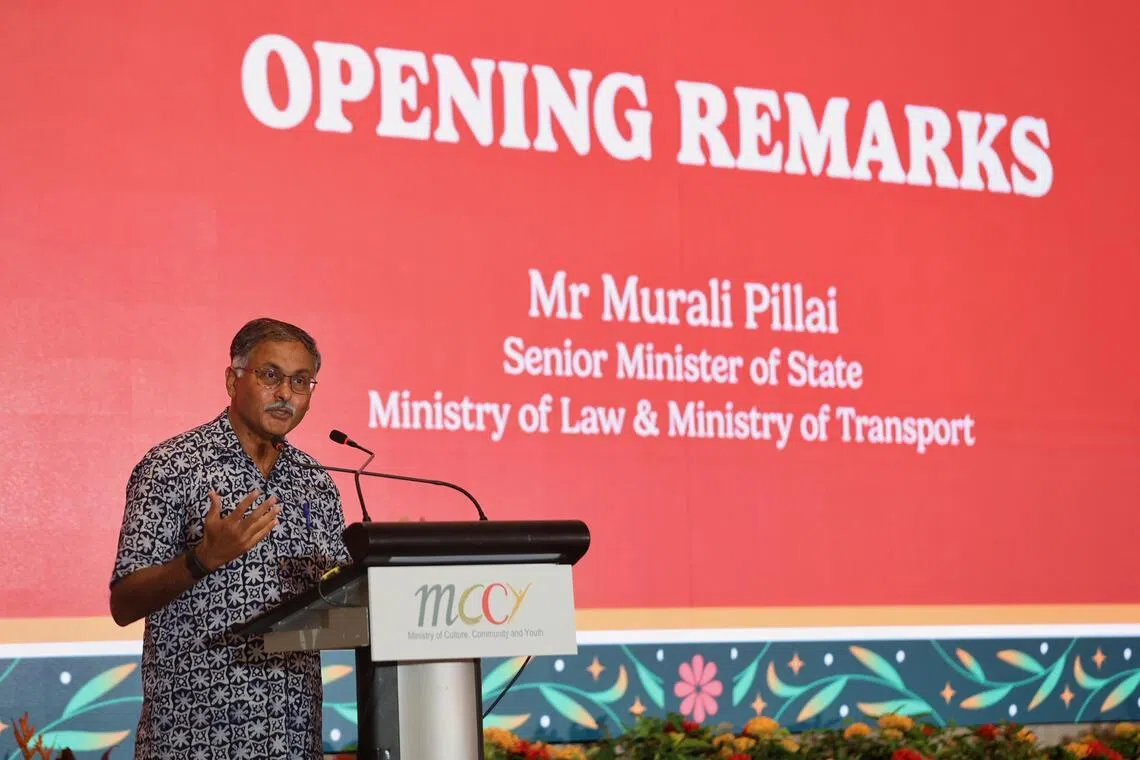
Nearly 50 Indian religious organisations across Singapore’s major faiths have joined the effort, with more volunteers stepping forward to help inmates, said Senior Minister of State for Law and Transport Murali Pillai on April 25.
The work is not just helping inmates individually but also their families, he said. “We have a chance to break the cycle of intergenerational offending,” said Mr Murali, who as co-chair of the Indian Engagement and Development Committee (INEI) has focused on religious and socio-economic initiatives.
Organisations like Singapore Indian Chamber of Commerce and Industry, Singapore Indian Development Association and Narpani Pearavai have also come on board to support vulnerable Indian families by referring them to help and offering children internships, for instance.
These initiatives fall under the work of INEI, which was announced during the debate on the Ministry of Culture, Community and Youth’s budget on March 5.
Speaking at the inaugural INEI forum at the Grand Copthorne Waterfront Hotel on April 25, Mr Murali outlined its objectives: to better support the vulnerable and disadvantaged within the Indian community; strengthen the Singapore Indian identity; and develop a pipeline of young Indian leaders.
“Inei” means to come together or be connected in Tamil.
He told the 600 participants from more than 330 organisations at the forum that Narpani Pearavai, the coordinating body for the Indian Activity Executive Committees (IAECs), will be on the lookout for Indian families in distress and make referrals to SINDA Family Service Centre or their grassroots adviser.
This follows a survey of the 100 IAECs across Singapore that found demand for such support.
INEI was first proposed by Coordinating Minister for National Security and Minister for Home Affairs K Shanmugam as a way to coordinate efforts to build a cohesive Singapore Indian community and take the community forward.

Home Affairs Minister K. Shanmugam placing a sticker on the Indian Engagement and Development Initiative Forum Mural on April 25.
ST PHOTO: JASEL POH
Mr Murali said the committee will address current structural challenges such as fragmentation, limited youth engagements and the lack of broader coordination efforts.
Its coordinating committee will be made up of mostly young Indian leaders with a few seniors.
Mr Murali also announced that Minister of State for Culture, Community and Youth Dinesh Vasu Dash will chair the INEI and oversee its efforts, with MCCY supporting the work.
“As for myself, I decided that I can contribute better in an advisorial role,” said Mr Murali, who added that he will help to develop young leaders.
Senior community leaders will support the committee, whose members will lead the work across four areas: religion, socioeconomic issues; culture, youth and sports; and language, heritage and the arts.
Focus group discussions were held between August 2025 and February 2026 to gather views on the community’s needs.
Participants said that while the Indian community in Singapore is diverse, there is scope to build a stronger shared identity.
They also highlighted the need to improve access to support for vulnerable groups. While many programmes already exist, support should be brought closer to people, with stronger outreach, better matching of volunteers to needs, and more accessible, meaningful participation.

Minister of State, Ministry of Culture, Community and Youth Dinesh Vasu Dash (right) will be leading the coordinating committee of the Indian Engagement and Development Initiative.
ST PHOTO: JASEL POH
Lawyer Ramesh Selvaraj, 47, said: “The use of religion to reduce the number of times Indian inmates reoffend is a good way of helping to plug gaps. Some of these inmates may not have familial support, but through religious teaching, they may be able to integrate better into the community.”
Participants also felt there could be more structured pathways for youth development and programmes that better reflect the interests and preferences of younger Singapore Indians.
Ms Simarna Singh, 29, who works in the pharmaceutical industry, told ST that it is important to have a platform for youth across different Indian cultures to grow together and develop leadership skills.
“Some may have challenges financially or socio-economically, but there are talented youth who can contribute. I feel they should not be left out,” she said.