
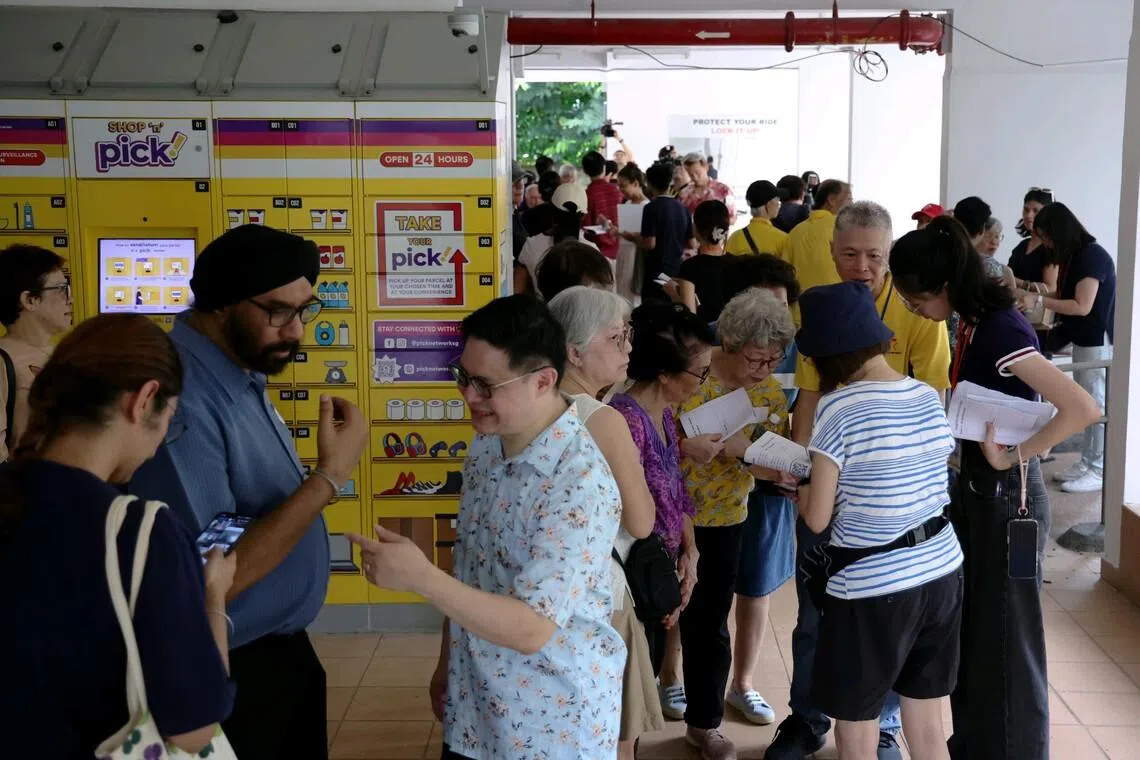
SINGAPORE – Dog runs, pickleball courts, water coolers, and toilets at a void deck are among more than 120 items on Spottiswoode residents’ wish list, which was shared on April 26 at the launch of a participatory budgeting trial.
This is the first time a participatory budgeting trial is being rolled out in Singapore, said Tanjong Pagar MP Foo Cexiang.
It gives residents more say in how funds are allocated, from proposing ideas to deciding on neighbourhood improvements.
Unlike how HDB and town councils identify proposals to improve the neighbourhood with residents’ input, the trial involves residents from the start – allowing them to suggest the improvements they hope to see and come up with a full proposal themselves.
Speaking to the media at Block 108 Spottiswoode Park Road, Mr Foo described the trial as a “very deep-level” and “precise” mode of engagement with residents, who live in 460 housing units spread across nine blocks in the estate.
He said he hopes residents can gain a greater sense of ownership over their precinct, as well as to understand the trade-offs that need to be made.
The participatory budgeting trial – a collaboration between Tanjong Pagar Town Council and the Institute of Policy Studies (IPS) – will complement the estate’s neighbourhood renewal plans, which was previously announced in June 2025.
The total budget for this participatory budgeting renewal exercise comes to $200,000 and draws from the Future Ready Society Impact Fund administered by Tote Board.
The proposals that were accepted at the launch event will be further developed at workshops before they are submitted to a workgroup – comprising representatives from IPS, HDB, Tanjong Pagar Town Council and Residents’ Network – for a feasibility review which will take place in end-May.
Next, workable proposals will be displayed in a community exhibition for residents to view. Voting will take place some time from June to July.
The projects with the most votes will be announced around late July to early August, and will be implemented by the town council from late-2026 onwards.
Asked what success would look like for the trial, Mr Foo cited tangible as well as intangible results.
High utilisation rates of the new amenities implemented would count as one sign of success, he said.

Tanjong Pagar MP Foo Cexiang (left) joining residents of Spottiswoode Park on a discovery walk to explore potential sites for renewal in the estate on April 26.
ST PHOTO: KEVIN LIM
Another would be other neighbourhoods in Singapore adopting a similar framework when working on their improvements.
Mr Foo also said he would consider that the trial has worked out well if the residents say they have felt a deeper sense of engagement and a stronger sense of ownership over the community.
Spottiswoode resident Ann Hu, 55, proposed building a pickleball court in an area next to the multi-storey carpark, a distance away from the housing blocks so that the game noises do not disturb residents.
Banking executive Christina Chu suggested constructing a dog run, weaving across various blocks in the estate, for dog owners and residents to gather.
Ms Hu added that such public spaces will benefit everyone – from the elderly to the young ones – as they can rest in these areas and mingle with each other.
Agreeing, Ms Chu said that this will be “therapeutic” for different generations to come together and for neighbourhoods to bond.
Diya Mishra, who is 10 years old, suggested the installation of a public toilet and a water cooler at the void deck of Block 104 Spottiswoode Park Road – the block closest to the estate’s playground.
Diya said she and her friends find it troublesome to go all the way back home to drink water or use the toilet: “Half the time when we’re playing at the playground, we don’t have any more water to drink.”