
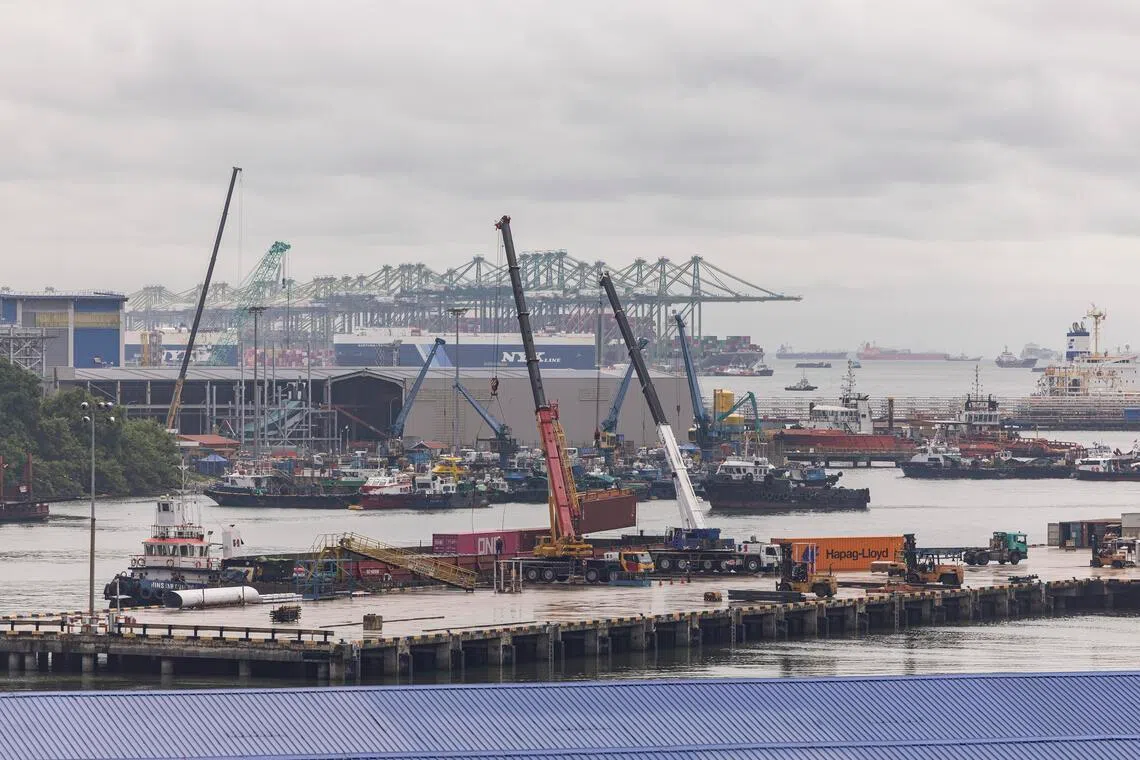
SINGAPORE – A study to protect the industry-heavy south-west of Singapore from sea-level rise is expected to start later in 2026, with consultants set to recommend if coastal barriers can be built between the mainland and Jurong Island.
The 116km coastline study from Tuas to Pasir Panjang will be national water agency PUB’s largest coastal study to date. It is expected to take six years to develop solutions to prevent coastal and inland floods, said Mr Ridzuan Ismail, director of PUB’s flood resilience planning department.
In a tender by the national water agency published in end-March, it was revealed that the Pasir Panjang Terminal area, to be vacated by the 2040s, may be redeveloped, with potential reclamation and works on the surrounding water body.
The appointed consultant will have to help PUB decide between large-scale, government-owned shields that can protect most of the coastline and localised measures managed by each coastal land owner.
Large-scale measures include coastal barriers – arm-like gates or dams designed to keep out the rising seas and storm surges, which are higher-than-usual tides caused by storms brewing offshore.
The south-west is the heart of Singapore’s industrial and shipping sector, home to Tuas Port, Jurong Industrial Estate, Jurong Fishery Port and recreation spots like West Coast Park.
Singapore’s shipping and port operations are also set to be consolidated in Tuas Port in the coming decades.
Singapore’s average sea level is projected to rise by up to 1.15m by 2100. If high tides and extreme events like storm surges occur, sea levels could rise by 5m.
Assistant Professor Yuzhu Pearl Li, chair of the climate change technical committee at the Institution of Engineers, Singapore, noted that the south-west coast is more complex than a typical urban shoreline. It combines major port activity, waterfront industries, critical infrastructure, coastal drains and waterways like the Pandan and Jurong rivers that open to the sea.
“Its risks are therefore not just from sea-level rise alone, but from the interaction of storm tide, rainfall, inland drainage backflow, ship wakes, wind waves and maritime operations,” she noted. Ship wakes refer to the V-shaped trail of waves and turbulent water that tails behind a moving vessel. Such waves have contributed to the erosion of Pulau Ubin’s northern coastline.
The consultant has to assess ship wakes and determine the combined wave effects to support the engineering design of the proposed coastal protection measures, stated the tender documents on government procurement portal GeBIZ.
PUB divides Singapore’s coastline into eight segments to study them more closely and develop tailored solutions. The stretch from Lim Chu Kang to Woodlands and Jurong Island are currently being studied, while the study for Sentosa will start later in 2026. The studies for the south-eastern coast and the stretch between Tuas Checkpoint and Lim Chu Kang were completed in 2025.
The south-eastern coast stretches from Pasir Panjang Ferry Terminal to Changi, and solutions recommended include installing arm-like coastal barriers, raising shoreline slopes and constructing bunds on Changi Beach.

An artist’s impression of a possible coastal barrier between Sentosa and Pulau Brani.
PHOTO: PUB
PUB recently completed a three-year study in March to assess the feasibility of installing coastal barriers or barrages on both sides of Jurong Island, connecting them to the mainland. This is part of the large-scale, centralised option that the consultant has to assess.
The feasibility study looked at two types of coastal barriers – arm-like storm surge barriers that remain open under normal conditions and close during storm surge events, and barrages or dam-like structures that generally remain closed but include systems that allow ships to pass through.
The storm surge barriers are similar to the ones proposed to protect the Greater Southern Waterfront area on both sides of Sentosa.
“Given the proximity of Jurong Island to the south-west coast, a centralised scheme will achieve coastal protection for the mainland and part of Jurong Island,” said Mr Ridzuan.
If this solution is eventually recommended, the design and locations of the coastal barrier will be finalised during the later engineering stage, he added.

Following up on the feasibility study, the consultant should recommend the location for the barriers while considering maritime traffic, navigational requirements and constraints such as submarine cables.
Owners of coastal land protected by the coastal barriers will generally not need to implement their own measures such as putting up seawalls or raising shoreline slopes.
The Government will own, implement and operate the coastal barriers, said Mr Ridzuan.
However, not all parts of the south-west coast and Jurong Island can be covered by such large-scale solutions. Those stretches still exposed to the sea will need to be protected by other measures like seawalls, implemented and paid for by individual land owners, with support from the Government.
In March, a Bill was passed in Parliament requiring government agencies and private companies that occupy land along Singapore’s shorelines to shield their coastal areas from rising seas, or face a fine and jail term. All coastal land owners will be eligible for a grant to help defray the costs of building their coastal measures.
Thirty per cent of Singapore’s coastline is owned by the private sector, and most of their land is found in the south-west and northern areas.
Aside from coastal barriers, the other option for the south-west coastline is to have land owners or long-term lessees put up their own measures along or behind the coastline, stated the tender documents.
Measures could include a mix of breakwaters, raised platforms, tidal gates, upgrades to pumps, flood walls, and local protection for specific assets or plots, said Prof Li.
Mr Ridzuan added: “PUB will work closely with the relevant agencies on the adaptation measures, considering companies’ business needs and the redevelopment of Pasir Panjang Terminal.”
Consultancy firms have until May 14 to apply for the tender.
The tender documents also stated that the Pasir Panjang Terminal area could be redeveloped as a “new predominantly residential neighbourhood complemented with commercial, recreational and other supporting amenities”.
“Details of the redevelopment, which may involve reclamation and development of the surrounding water body, will be provided by (PUB) after commencement of the study,” the documents said.
The consultant is tasked to assess and develop different coastal protection options, such as raising the platform level, for the long-term protection of the redeveloped Pasir Panjang Terminal area, “including any potential reclamation plan and surrounding water body” after redevelopment.
This redevelopment could be part of the transformation of the terminal for the future Greater Southern Waterfront precinct, which will stretch from Pasir Panjang to Marina East.
Responding to queries, the Urban Redevelopment Authority told ST that as part of longer-term plans for the Greater Southern Waterfront, “there is potential for the area currently occupied by Pasir Panjang Terminal to be transformed for new uses such as a vibrant waterfront neighbourhood with supporting amenities, after the port relocates to Tuas”.
The plans for the area are still under study, it added.
If land is reclaimed in the area, it would join two other reclamation projects in the southern coastline. One major project is Long Island, which involves the creation of about 800ha of new land to protect the low-lying East Coast area from rising sea levels.
Separately, about 213ha of land, or around half the size of Marina Bay, is expected to be reclaimed at the Keppel and Tanjong Pagar terminals for the future precinct after they relocate to Tuas around 2027.
Works could be expected in the water body next to the Pasir Panjang Terminal, near where the eastern coastal barrier could be deployed.
The tender documents stated that the consultant will have to assess the storage capacity of the surrounding water body and dredging requirements, as well as potential water quality changes and the estimated cost of developing it.
The tender also mentioned a water infrastructure as part of the redevelopment plan for the Pasir Panjang Terminal area. It said the consultant could also explore if the eastern barrier could integrate with waterfront recreational uses.
While the potential use of the surrounding sea area is not clear, Prof Li said that it could be for a multi-functional water body with uses such as navigation, drainage and water-level management, interim port-related use, and waterfront development in the longer term.