
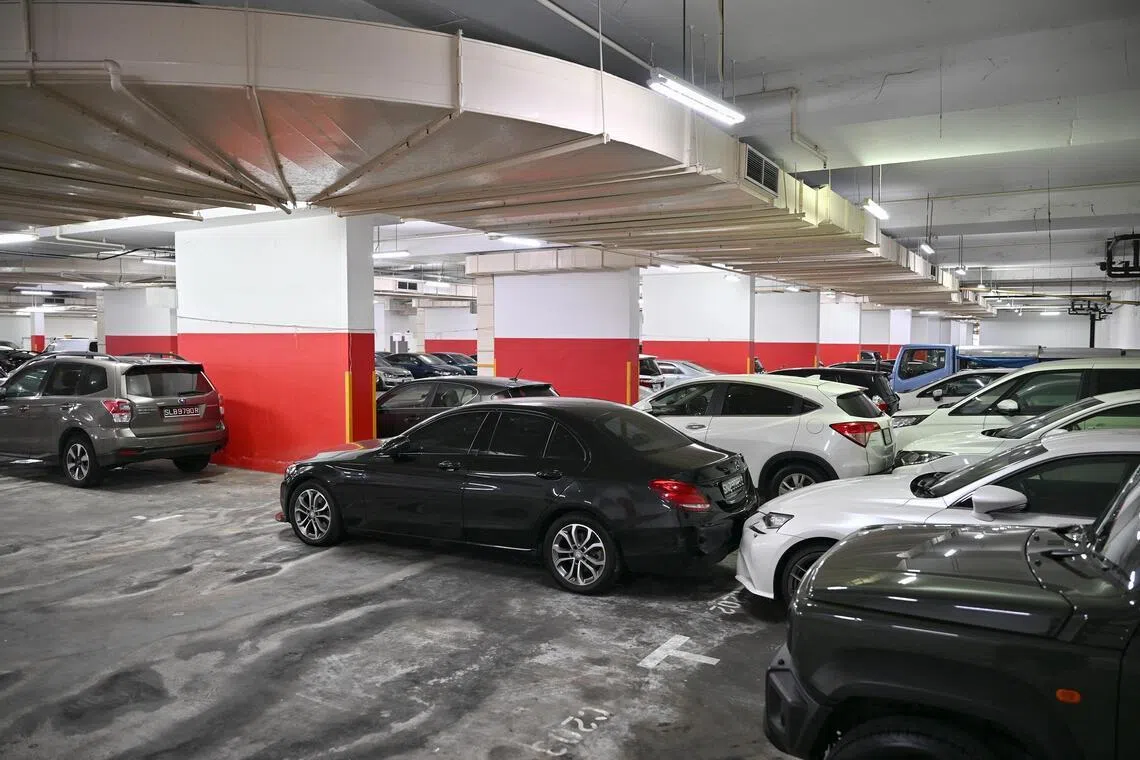
SINGAPORE – For almost a decade, a group of car dealers at WCEGA Plaza in Bukit Batok had access to a basement parking arrangement that allowed them to house more vehicles in the development’s carpark.
Located at Bukit Batok Crescent, WCEGA Plaza and Tower is a large commercial development with 913 units. Each unit is entitled to four season-parking passes, while the development has about 920 parking spaces.
About a quarter of the 492-unit WCEGA Plaza’s owners are used-car dealers whose businesses depend heavily on parking space.
Under an arrangement that dated to at least 2017, the management corporation (MCST) of WCEGA allowed the WCEGA Used Car Association (WUCA) to operate 58 basement carpark “column lots”.
This arrangement allowed up to 156 cars to be parked densely within 58 parking spaces at the basement of WCEGA Plaza. Members of the association had to pay the MCST to park there.
The arrangement was meant to help manage parking demand but later escalated into a legal dispute between a car dealer, Edmund Motor, and the MCST. WUCA was named as the second defendant in the lawsuit.
The case went beyond parking and ended with a High Court ruling on how voting power is exercised in strata-titled developments.
In a lawsuit filed in June 2025, Edmund Motor, which sells used and new cars, claimed the MCST had given WUCA and its members exclusive use of the basement parking spaces, which are common property, shutting out non-members.
Edmund Motor was a WUCA member from late 2016 to Oct 29, 2024. After its exit from the association, Edmund Motor was no longer able to make use of the parking arrangement.
The claimant argued that the arrangement was in breach of the Building (Strata Management) Act (BSMA), which requires a 90 per cent resolution to be passed if the MCST is to grant exclusive use of common property to a group of subsidiary proprietors, or unit owners, for more than three years.
Represented by lawyers Lin Shumin and Arushee Bhatnagar of Drew and Napier, Edmund Motor asked for a court declaration that the parking arrangement was invalid. It also sought to claim damages amounting to $8,185 for the rental of parking spaces outside WCEGA and for towing its vehicles to its other outlets in Balestier Point.
While the proceedings were ongoing, the MCST passed a special resolution at a Sept 5, 2025, annual general meeting (AGM), to allow the leasing of the basement parking spaces to WUCA.
Edmund Motor also alleged that the MCST had allowed certain individuals to represent more than 2 per cent of the total units in the development at the AGM, in breach of the BSMA. It asked the court to restrain the MCST from allowing unit owners to obtain letters of authorisation in breach of the 2 per cent proxy rule.
In its defence, the MCST, represented by lawyers Daniel Chen and Enzel Tan of Lee & Lee, argued there was no exclusive use by WUCA, as it operated or managed only the designated parking spaces and coordinated the movement of individual subsidiary proprietors’ vehicles.
Allowing WUCA to operate or manage the parking spaces fell within its duties and power, said Mr Chen.
Mr Chen also argued that the arrangement was not a lease as there had not been any rental paid by WUCA to the MCST, and the parking charges were paid to the MCST.
He also argued that the arrangement was superseded by the 2025 special resolution. As such, the validity of the arrangement was inconsequential and there was no real controversy for the court to resolve.
In her grounds of decision dated Nov 26, 2025, District Judge Sia Aik Kor noted that there was exclusive use, or at least special privileges, granted to WUCA members. However, she dismissed Edmund Motor’s request for an injunction as that part of the claim had been superseded by the 2025 special resolution.
The judge also dismissed Edmund Motor’s claim for damages, citing lack of evidence as to how the 58 column lots would have been allocated in the absence of the arrangement with WUCA.
“Given that there were a total of 3,652 vehicles, which had been assigned the season parking passes… the fact that the claimant had to look for parking spaces outside the development upon ceasing to enjoy the benefits under the arrangement suggests that there was difficulty in securing parking spaces within the development in the absence of the arrangement,” the judge noted.

Edmund Motor was a WCEGA Used Car Association member from late 2016 to Oct 29, 2024. After its exit from the association, Edmund Motor was no longer able to make use of the parking arrangement.
ST PHOTO: ARIFFIN JAMAR
The parking dispute, however, led to a second issue on how voting power is exercised at general meetings of strata-titled developments.
Edmund Motor argued that the MCST had allowed certain individuals to represent more than 2 per cent of the total units in the development through letters of authorisation from companies that owned units, when the law limits how many proxy votes one person can hold.
A proxy is a person who has been authorised by a unit owner to represent him or her at a general meeting. Currently, an appointed proxy can represent a maximum of only two lots or 2 per cent of the total number of lots in the development, whichever is higher.
The rule was introduced to stop individuals from collecting large numbers of proxy votes and dominating meetings.
Edmund Motor argued that the same cap should apply when companies appoint representatives through letters of authorisation. Otherwise, it said, the proxy cap could be bypassed.
The argument was accepted by the Magistrate’s Court.
On appeal, the High Court disagreed and reversed the Magistrate’s Court decision.
The High Court held that the law distinguishes between proxies and company representatives, and that the 2 per cent cap applies only to proxies.
A company-appointed representative, the court said, exercises the voting rights of the company itself, rather than acting on behalf of multiple owners.

WCEGA Plaza and Tower is a large commercial development with 913 units. Each unit is entitled to four season-parking passes, while the development has about 920 parking spaces.
ST PHOTO: ARIFFIN JAMAR
The ruling means that corporate owners, which may hold multiple units within a development, can appoint a single representative to vote across all their lots without being subject to the proxy cap.
The Ministry of National Development said on March 4 that the BSMA is undergoing a comprehensive review, and measures are being proposed to deal with small groups of owners who hold large numbers of proxy votes, controlling decisions in ways that do not reflect the broader interest of owners.
When contacted, Mr Edmund Loo, who runs Edmund Motor, said: “It is a loophole for companies to exploit and control decisions at annual general meetings if the 2 per cent proxy cap does not apply to letters of authorisation.”
Ms Catherine Kweh, chairperson of WCEGA management council, said: “The MCST has always understood from looking at the legislation that the 2 per cent rule applies only to proxies, and the High Court ruling confirms that understanding. MCST’s management of the basement parking spaces will continue in the same manner.”
Mr Chen said both the High Court’s and the Magistrate’s Court’s decisions were the first to deal with the application of the 2 per cent proxy rule since it came into effect on Feb 1, 2019. The decisions provided clarity on the distinction between company representatives and proxies appointed under the BSMA, he said.
“In practice, this makes clear that there is no limit on the number of companies an individual can represent at general meetings,” he added.