
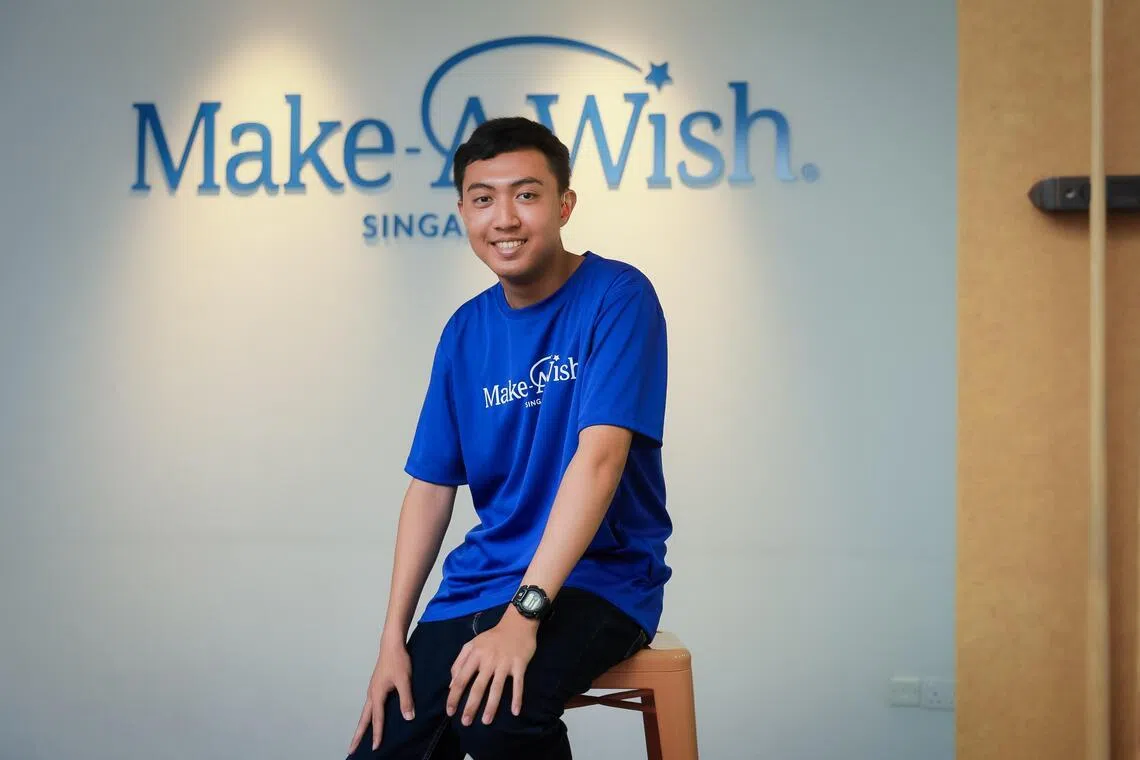
SINGAPORE – For 18-year-old tech enthusiast Isaac Ng, speaking with the engineers who keep Google Maps running and taking photos with a Google Street View car during a visit to the Google Singapore office was a dream come true.
The visit on Feb 25, arranged by Make-A-Wish Singapore, reflected his interest in – and reliance on – technology to help him navigate life and health challenges.
At just five months old, Isaac was diagnosed with meningoencephalitis, a life-threatening condition that involves inflammation of the brain and its protective membranes. Although he recovered from it, he was left with permanent hearing loss and uses hearing aids.
As the condition also resulted in speech delay, he underwent speech therapy and auditory-verbal therapy lessons.
Although Isaac attended a mainstream primary school, he did not start speaking in full sentences until he was 10 years old. Before that, he communicated with others primarily through sending text messages.
“It was difficult to talk to people because I wasn’t able to communicate very well back then, as I could communicate only with simple words and, at best, a short sentence,” he told The Straits Times.
“To overcome this, I used my phone to message and process my thoughts more easily, without having to directly engage with the person face to face.”
When he had to communicate in person, he used simple words and gestures.
When Isaac progressed to secondary school, he faced another health challenge – a mysterious pain in his wrists.
“Initially, I thought that it was a hairline fracture, or a hand cramp, as I had been playing basketball with friends,” he recalled.
After several visits to the hospital, he was referred to a specialist.
At 13, he was diagnosed with polyarticular juvenile idiopathic arthritis, a chronic condition where the joints are inflamed. The condition affected both his wrists, which made it hard for him to perform simple daily tasks.
“It’s quite painful – I can’t write properly, and there are times when I can’t sleep at night,” he said.
Apart from the pain, Isaac also suffers from perpetual fever.
“He will wake up sweating every other night, and the bedsheet will be wet due to the fever,” said his mother, who wanted to be known only as Ms Isabel. She declined to reveal more about the family, citing privacy concerns.
Isaac has been managing his condition with regular biologic injections that help mitigate the pain and inflammation. The frequency of the jab depends on the severity of the inflammation. Currently, he injects himself with the biologic treatment once every seven days.
However, the treatment comes with risks. It suppresses Isaac’s immune system and makes him highly susceptible to common illnesses and infections. For instance, he takes a long time to recover from a small cold, and if he has diarrhoea, he has to go to the hospital immediately.
“It’s tough because you have to deal with it as part of life, and you know that there’s no cure,” he said.
Despite his challenges, Isaac keeps up with his studies and is now a second-year student pursuing a diploma in information technology at Ngee Ann Polytechnic.
“My current poly education is not affected at all since I have learnt how to manage in the last 10 years from primary school till now,” he said.
He usually sits in front of the class and follows up with teachers if he has any questions. He receives extra time during examinations because of his condition.
Through the National University Hospital, where he goes for regular check-ups, Mr Ng was referred to Make-A-Wish Singapore, which grants more than 100 wishes a year to children and teenagers with serious, life-threatening medical conditions.
Recipients, who are aged three to 18, have their wishes fulfilled by volunteers known as “wish granters”, who take care of logistics and coordination work.
On his wish to visit Google Singapore, Isaac said: “I wanted to know how Google puts its technology together, and how the product actually comes about. After all, we have been frequent users of this technology.”
He used Google Maps to navigate when he was on holiday in Europe with his mother recently.
The visit to Google has further reinforced his interest in working in tech, though he has yet to decide on a specific area. He plans to study an IT-related degree in university.
Isaac wants to encourage others in similar situations to never give up.
“Continue working hard and don’t ever look down on yourself, especially your disabilities. Slowly and surely, you will get there (and achieve your dreams).”