
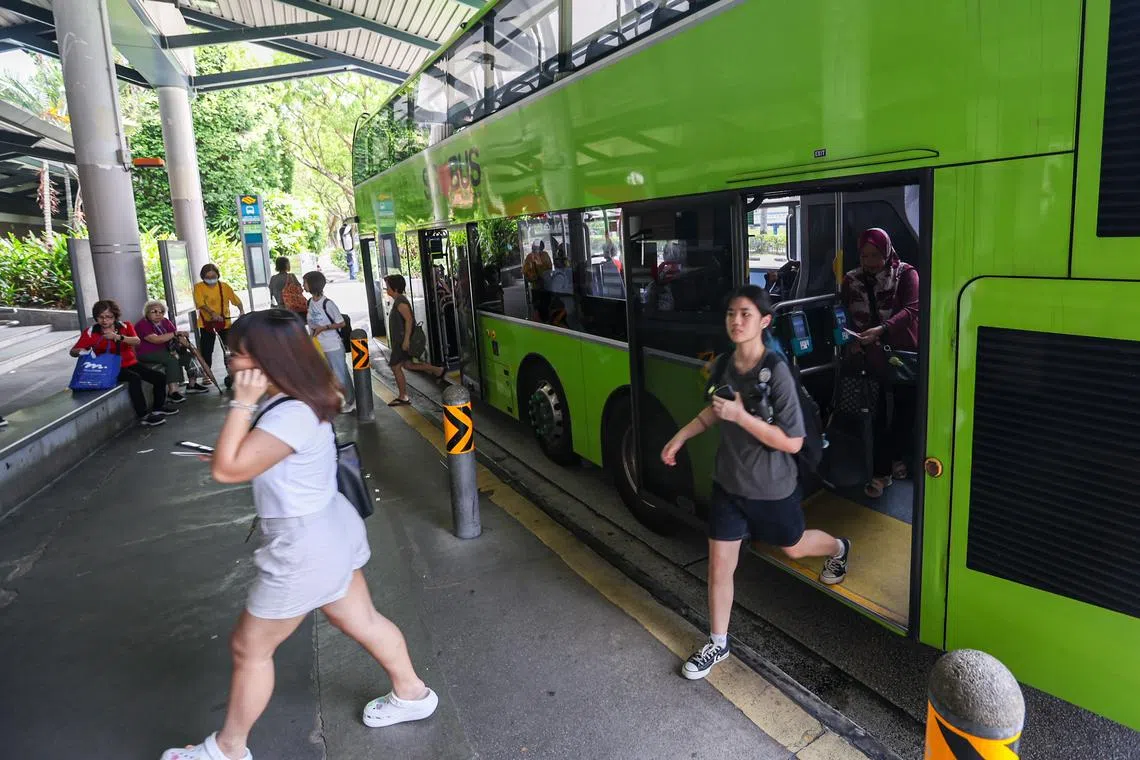
SINGAPORE – The Land Transport Authority (LTA) is carrying out modification works at some bus stops across the country to support more than 500 public buses that have three doors, for smoother boarding and alighting.
However, due to site constraints at some locations, not all bus stops can be modified, it added.
“At these bus stops, the third door may continue to remain closed, and bus captains will advise passengers to alight using the second door for safety,” said LTA on April 27 in response to queries from The Straits Times.
It did not provide the number of bus stops deemed unsafe to alight from the third door. Neither did it disclose the number of bus stops undergoing modification works.
LTA explained that at some bus stops, the third door would open directly onto the road instead of a “proper platform”.
Such bus stops, including one at East Coast Apartments in Telok Kurau Road, are shorter in length and situated between exits of a residential building.
At another stop along the same road, before Saint Patrick’s Road, passengers alighting from the third door might step on a grass patch instead of a concrete platform.
A bus stop at Sing-China Building on Piccadilly Road near Seletar West Park Connector has a different infrastructural constraint – there are metal beam barriers on both sides of the bus stop.
LTA noted that there are currently 440 single-deck and 100 double-deck three-door buses in the public bus fleet, with the first of such vehicles hitting the roads in 2017.
And from the end of 2026, another 300 three-door electric double-deckers will be progressively deployed for passenger service.
Some time in 2025, notices were put up on the third door of buses to inform passengers that this rear door may not open at certain bus stops. Discussions about this issue soon surfaced online.
Public transport users ST spoke to also pointed out other bus stops where the third door does not open:
-
The one opposite the National Library, in North Bridge Road, where the third door might open to a grass patch or a safety bollard if there is another bus ahead
-
The one located after Chun Tin Road in Bukit Batok, which is on a small platform sandwiched between the entrances of two landed properties
-
The one located after Paya Lebar Crescent, where the third door may be blocked by the pillar of an overhead bridge
Mr Mark Chua takes bus service 970 every day, and according to his observation, many three-door buses ply that route.
He often sees passengers being thrown off-guard and confused when they are unable to disembark from the third door of the bus. The content creator, who is in his 30s, added that it defeats the purpose of having a third door, since passengers may avoid moving towards the back of the bus.
But another bus passenger said he had observed multiple instances of bus drivers refusing to open the third door even when there was clearly an unobstructed platform for passengers to step onto.
This had taken place on service 106 from Orchard towards Bukit Batok, said the man, who wanted to be identified only as Mr Ng.
He said this could be due to bus drivers being accustomed to keeping the third door closed.
Noting that these three-door buses were rolled out after successful trials in 2017 and 2018, LTA said commuters welcomed the additional door as it made alighting easier and faster. It added that the additional door is useful for bus services that are in high demand, where many commuters need to get on or off the bus.
Bus operator Go-Ahead Singapore said the third door is used only at bus stops “approved” by LTA and that its bus captains are trained to operate the third door only at these stops, to ensure safe boarding and proper alignment.
Operators SBS Transit and SMRT directed ST’s queries to LTA, while Tower Transit did not respond.