
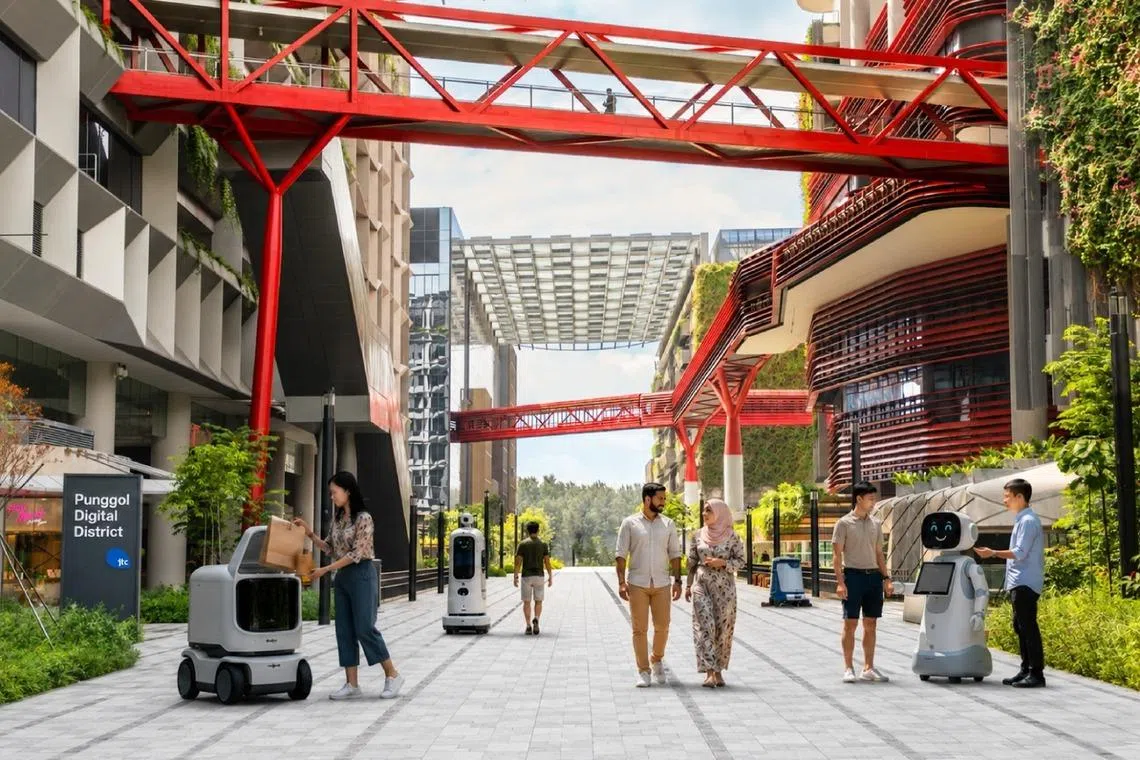
SINGAPORE – Eight firms including ride-hailing giant Grab and security services provider Certis will be leading a renewed push to deploy robots to automate cleaning, patrolling and food delivery in Singapore’s largest smart robotics test-bed, Punggol Digital District.
Large scale trials are expected to start by the end of 2026 to test artificial intelligence (AI) safety measures and shape regulations for mass adoption.
Announcing this on May 20, Minister of Digital Development and Information Josephine Teo said: “Robots can help our workers enhance service delivery to areas that are currently underserved.”
Affirming Punggol Digital District as a frontier AI test-bed, she added that the growing network of industry partners using the district’s ecosystem to test and experiments help to spread acceptance and adoption.
“We will create an integrated data platform, design renewable test scenarios and rules that enable robots to safely operate across the district.”
Mrs Teo was speaking on the first day of the the Asia Tech x Summit, which is in its sixth edition, held at Capella Singapore from May 20 to 22. It is attended by global tech industry players and policymakers.
The eight firms working with government agencies and SIT on this testbed are Grab, DHL, Certis, Quikbot, software firms FieldAI and Thoughtworks, along with robotic companies Slamtec and Unitree.
The robotic fleet will roam across public roads, office building lobbies and a university campus to create realistic environmental conditions that will allow autonomous robots and AI systems to be continuously tested and refined, said the Infocomm Media Development Authority (IMDA), urban planner and developer JTC, and Singapore Institute of Technology (SIT) in a joint statement on May 20.
“Robotics and embodied AI mark a major shift in AI development moving beyond screen-based tools to physical systems that can perceive, reason and act in the real world,” said the organisations in their joint statement. “This evolution is seen as AI’s next frontier, with the potential to transform industries and reshape daily life.”

Minister of Digital Development and Information Josephine Teo giving the opening keynote address on the first day of ATxSummit held at Capella Singapore on May 20.
ST PHOTO: BRIAN TEO
Embodied AI refers to physical systems fused with AI that allow them to interact with the physical world. They include general-purpose robots, humanoid robots, and autonomous vehicles.
For instance, robots that deliver food and parcels are expected to improve first and last-mile efficiency for delivery partners. Robots that do security patrolling and cleaning will also complement human operations by working beyond office hours, patrol hard-to-reach spaces and clean more frequently.
“In turn, this will allow workers to take on higher-value roles such as supervision, operations management, and service delivery,” said IMDA, JTC and SIT.
For a start, robotics operators are expected to work with IMDA, JTC, SIT, and appointed industry partners such as Grab and DHL to co-design testbed conditions for commercially-viable robotics services in public spaces.
Deployed robots will be required to meet safety standards and specified operational parameters, to ensure that both humans and robots co-exist safely.
To meet the objectives, businesses testing the robots will receive a precinct-level exemption under the Active Mobility Act. This blanket exemption will allow robot operators to trial different scenarios on public paths within the district without having to apply for individual exemptions from the Land Transport Authority.
Punggol Digital District, which saw its first wave of tenants set up shop in 2025, already boasts an estate-wide operating system that works with all robots for navigating roads and lifts.
The Open Digital Platform, which allows different systems to talk to one another, is currently used by the likes of dConstruct Robotics, which have been testing robots for concierge services, delivery and surveillance.
IMDA and the National Robotics Programme will also be working to develop embodied AI use cases with software firms FieldAI and Thoughtworks – who have expertise in AI systems, data platforms, and digital workflows.
Robotic firms Unitree, Quikbot, and Slamtic will also work with IMDA and NRP to develop and trial embodied AI use cases through SIT’s Centre for Intelligent Robotics located within the district.
More details on trials and use cases will be shared later in the year when the testbed is launched, said IMDA, JTC, and SIT in their statement.
“As AI robotic systems begin to interact directly with people, infrastructure, and everyday city environments – they will collect sensor-rich data, learn from their surroundings, and adapt to changing conditions, becoming more responsive and useful over time,” according to the statement.