
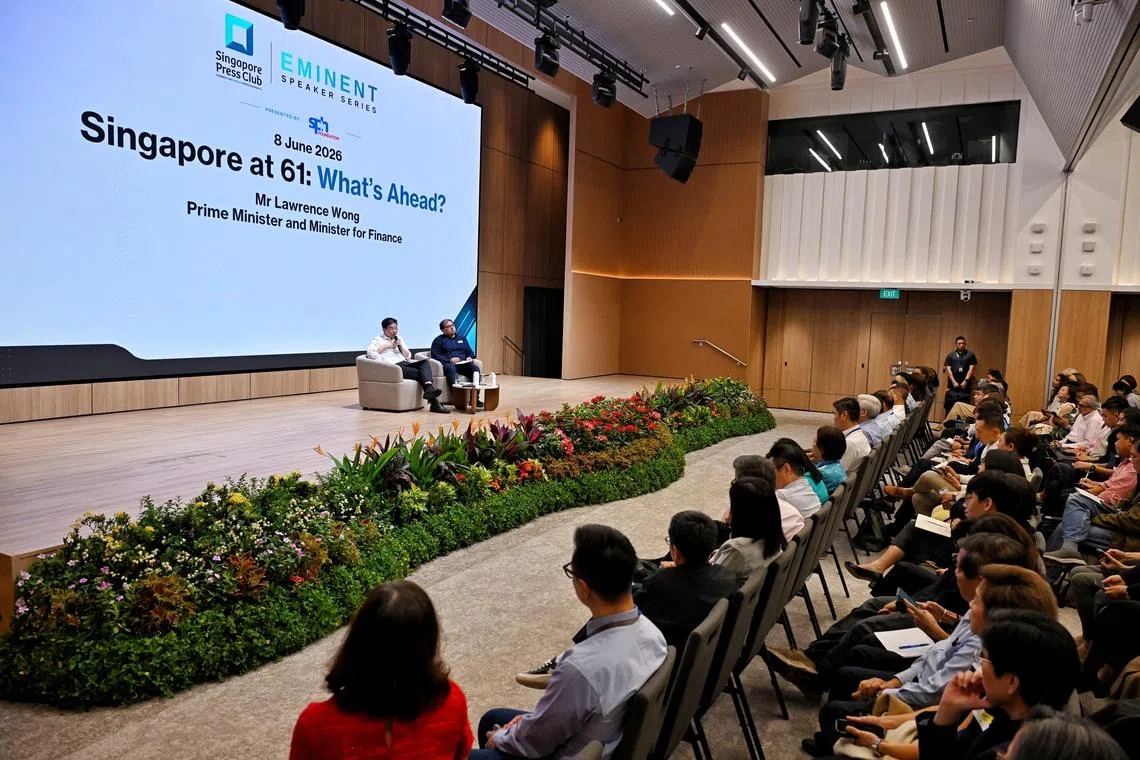
SINGAPORE – Artificial intelligence and other technologies are enabling the creation of more misinformation and disinformation, and when content crosses the line Singapore will take action, said Prime Minister Lawrence Wong on June 8.
Such an environment could make it harder for people to agree on the basic set of facts – making it “impossible to hold a society together”, said PM Wong at a dialogue with the Singapore Press Club held at the SPH Media auditorium in Toa Payoh.
The Government does not want this to happen in Singapore, and that is why it will continue to step up defences and safeguards, he said, addressing a question on a recent move by the authorities to block 14 online posts targeting the Indian community.
Investigations showed that the content most likely originated from a platform based in China and was subsequently carried on other platforms and websites, the Ministry of Home Affairs said in a statement on June 6.
The content selectively used images and footage of crowded streets in Little India and of Indian devotees at a religious festival in Pagoda Street to back claims that Singapore is “overcrowded” with Indians.
Speaking to an audience that included local and foreign journalists, PM Wong said the authorities have safeguards such as the Protection from Online Falsehoods and Manipulation Act to stop such falsehoods from spreading.
But it also depends on the media coming together to build a trusted ecosystem, he said.
The Government wants media outlets to operate in Singapore in a way that is “trusted and responsible”, to inform citizens and create space for serious conversations and discourse on issues that matter to Singapore. This will ultimately contribute to Singapore’s long-term success, he said.
PM Wong also addressed a question on Singapore’s immigration policy amid falling birthrates.
The country is “far away” from getting to the previously stated upper planning limit for its population at 6.9 million, he said. Its population stood at 6.11 million as at June 2025.
It is not so much about articulating a new figure, or what that figure might be – “there is no new figure to be updated, because our population will just grow at a much slower rate than before, and we are just trying to maintain stability and to avoid population decline,” he said.
The authorities will continue to control immigration, because they want to make sure that all new arrivals share Singapore’s values and way of life and are able to integrate well.
But given that the immigration flows will continue to be controlled, given that domestic own fertility rates are not likely to go up sharply, the population is not likely to reach a very high figure at all, he noted. “We’re just talking about maintaining stability.”
On falling birthrates, PM Wong noted that it is a global phenomenon which does not have a clear reason or solution.
The authorities have formed a new workgroup to look at what more can be done to create a family-friendly environment in Singapore, he noted.
But given the realities of where the country’s fertility rates – which fell to a historic low of 0.87 in 2025 – are likely to be, Singapore will remain open as a society, PM Wong said. “We must, because that’s who we are.”
The country should welcome people to work here, and should have some of them who share the country’s values and way of life become Singaporeans, he said.
“We should continue to maintain that posture as an open society, as an immigrant nation.”
He was also asked if there would be a Cabinet reshuffle soon to deal with internal and external challenges and in light of the recent resignation of senior minister of state for manpower and health Koh Poh Koon, which took effect from June 1.
Koh had cited his family as his reason for leaving office, and the father of two will continue as MP for Tampines GRC, where he looks after Tampines Central.
In response, PM Wong said he is “always thinking” about how to strengthen his team, which is “never a finished product”.
He is thinking about who can be better deployed to different roles, he said, and also who can be brought in from the backbench.
“I’m thinking about recruiting for the next round as well. It’s always on my mind, and when I have any updates, I’ll be sure to share them with you in due course.”
There continue to be significant differences between the US and China but increasingly, both sides will have to recognise that they have to coexist, said PM Wong on the relationship between the two powers.
The two economies are just too intertwined, and it is not possible for either side to dominate or exclude the other, he noted.
He drew a parallel between the pair and the US’ old relationship with the former Soviet Union. That dynamic was governed by a principle known as ‘mutually assured destruction,’ where both nuclear powers could not make an aggressive move on the other without resulting in its own destruction.
The US and China are now in a situation of ‘mutually assured disruption’, said PM Wong, even as their leaders and presidents Donald Trump and Xi Jinping discuss having “constructive strategic stability” as a framework for their relationship moving forward.
“Any attempt by one side to impose restrictions on another will trigger a response from the other side, and in the end both parties will be worse off,” PM Wong said.
Singapore hopes this will provide some stabilisation in their bilateral ties and an incentive for both sides to manage their differences well.
There will still be intense competition but that will hopefully not escalate into outright confrontation or conflict, he said.
“It is in the interest of both America and China to maintain this strategic framework and to have that stability in their relationship, it’s also in the interest of countries everywhere in the world.”
Asia also does not want to see a world divided into competing spheres of influence dominated by a single power, PM Wong said.
“I think that arrangement and configuration will be unstable. It will lead only to more competition and rivalry, and eventually may even lead to harm.”
PM Wong, who is also Finance Minister, was also asked about Singapore’s plans as ASEAN chair in 2027.
Chairmanship of the regional grouping rotates between its 11 member states every year.
ASEAN has been working on deeper integration, and while it is doing well on trade and investments, there is still much more that can be done to bring its economies together, PM Wong said.
While the bloc is “virtually tariff-free now”, there are still non-tariff barriers such as regulatory restrictions, and other ways to make things more seamless, he noted.
The group can also look at connectivity in other areas, such as between its people, and across payments, transport and powergrids, he said.
“These are all areas that we are continuing to pursue, and certainly will be one of the key focuses for our agenda,” he said.
Across the board, ASEAN leaders are clear that the bloc has to be more united in order to navigate the new global environment, he said.
The regional grouping, which turns 60 in 2027, is also working on partnerships, “because ASEAN cannot operate alone”, he added.
“We want to maintain that regional order that’s open, that’s inclusive, and we want to find ways to strengthen links with other groups, not just the traditional partners,” he said.