
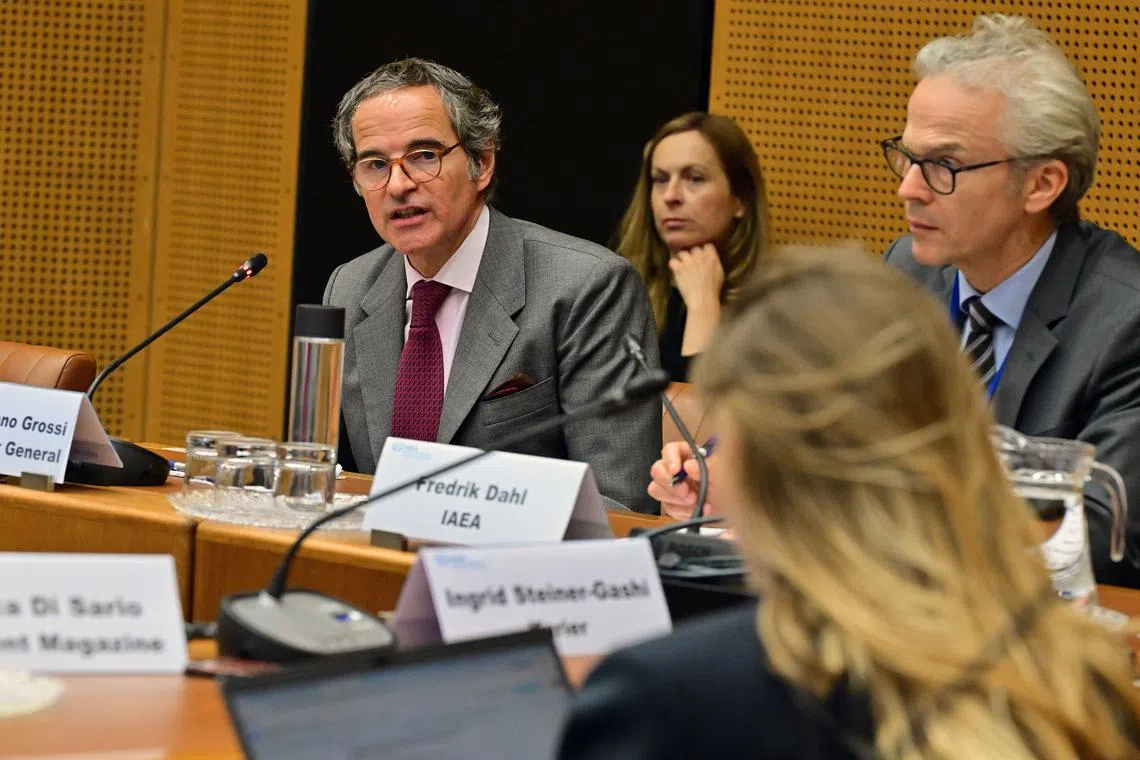
SINGAPORE – Despite the region’s pursuit of nuclear power, there is a lack of public understanding about it, and this can affect whether it is accepted by people, said the chief of the United Nations nuclear watchdog Rafael Grossi.
He is hoping that Singapore’s 2027 ASEAN chairmanship will help to deepen dialogue between the Vienna-based International Atomic Energy Agency which he heads, and the region, where people often mix up nuclear energy with nuclear weapons.
“In (the ASEAN region) there is still an important lack of information… so obviously generalisations appear here and there, and there is an amalgamation of nuclear weapons with nuclear energy,” Grossi told reporters at an IAEA seminar for journalists on June 12.
It was important to educate people about what nuclear energy entails, existing safety networks and how other countries do it, he said.
“What is successful in other parts of the world can also be successful in ASEAN.”
The agency assists newcomer countries in areas such as conducting public opinion surveys and training spokespersons on how to speak to the public about nuclear power.
In recent years, South-east Asia has seen a renewed interest in nuclear power, due to energy security concerns and the push to transition to cleaner forms of power. Atomic energy does not release planet-warming carbon emissions.
In March, Vietnam entered an agreement with Russia on the construction of the Ninh Thuan 1 nuclear power plant, with operations aimed for the early 2030s.
While Singapore has not decided on going nuclear, it will undergo an assessment by the IAEA in 2027 to determine the Republic’s ability to make an informed decision on nuclear energy deployment.
Parts of South-east Asia are also vulnerable to natural disasters like earthquakes and volcanic eruptions, and worsening climate impacts such as typhoons and floods.
On June 8, a 7.8 magnitude earthquake – the Philippines’ strongest tremor in decades – shook the southern island of Mindanao, killing more than 45 people and damaging around 54,000 houses.
Responding to an ST question about the challenges of building nuclear plants on disaster-prone regions, Grossi said: “In terms of natural phenomena, nuclear power plants are extremely resilient,”, adding that many of the over 400 reactors around the world are located on seismically active areas.
After the Fukushima meltdown of 2011 – which was caused by a 15m tsunami knocking out the power supply and cooling of three reactors – global safety standards for nuclear plants were enhanced to account for rare, but high-impact natural hazards. In the European Union, plants underwent stress tests and review processes, while measures to improve the robustness of plants were looked into.
Grossi said he does not preclude the Mindanao island from having a nuclear plant.
“The fact that a place is seismic does not mean that it cannot host a nuclear power plant,” he said.
“It depends on a number of characteristics of the place, the technology, the kind of installation that you’re going to have,” he added.
While a location has not been pinned down nationally, the archipelago aims to have its first nuclear power plant operational by 2032.
The week-long journalism seminar also shed more light on the IAEA mission to Singapore in 2027, where experts will evaluate the country’s capabilities across 19 critical areas such as nuclear safety, managing radioactive waste and emergency planning.
This falls under the first phase of the Integrated Nuclear Infrastructure Review, which is part of the watchdog’s structured process for countries considering a civilian nuclear power programme.
Singapore first has to complete its self-evaluation on the 19 areas, which may also include an action plan to address initial gaps identified.
A few months later, staff from the UN watchdog, and possibly international experts, will run a week-long interview with the Singapore authorities.
“We’ll ask questions, and we’ll try to find gaps in the infrastructure, and we will make recommendations on addressing those gaps. (The country) then takes the information, updates the report and presents it to the government to make a decision,” said Matthew Van Sickle, a senior nuclear power engineer of infrastructure at the IAEA.
Among the 19 areas, countries typically needed to improve on political commitment to develop a nuclear programme, leadership, building a nuclear workforce, as well as legal and regulatory frameworks, he noted.
These areas are trickier because they require major policy decisions at the national level, said Ms Fanny Tonos Paniagua, a programme coordinator for the Integrated Nuclear Infrastructure Review.
“You can draft a very good nuclear law at the technical level… But there at least has to be a government decision on how the law will look like, and how it will be approved, and what will be the timeline,” added Ms Paniagua.
Previous missions in other countries have also shown that many have not quantified how much their nuclear infrastructure will cost.
“By the end of phase one, we expect that a country will have a clear idea of how much the programme will cost, because this is part of making a knowledgeable decision,” she added.