
SINGAPORE – Around December 2025, administrative assistant Luke (not his real name), who is single, was told that there were photos of him with a woman claiming to be his fiancee and the baby they supposedly had together.
In the months that followed, more manipulated images with the same woman popped up.
There were also doctored images of him and his sister’s children, with the woman pretending to have taken the photos of the toddlers.
Luke realised he was being targeted by an online stalker.
He said he was alerted to the photos by his sister. She told The Straits Times that it was one of her friends, who also knew Luke, who first became aware of the images.
The friend knew Luke is not in a relationship or married, and had no children. Luke’s sister said she tried to get in touch with the woman.
She told the woman to remove the images, especially since her then 6-month-old son’s photo was used in the fake images. She did not receive a response.
Luke’s sister, who agreed to speak to ST but wanted to remain anonymous to protect her family’s privacy, said: “We were very worried and concerned that this stranger has photos and videos of my children stored in her phone and was sharing it online as and when she likes.
“It has made us quite paranoid and anxious about sharing anything online now,” she said on finding photos of her son on the woman’s Instagram account.
Luke and his sister said the images shared by the woman looked like they were created using artificial intelligence.
Luke said he has been having trouble sleeping and focusing on work, adding: “It is traumatising to learn that your pictures were used in such an elaborate narrative.”
It was a few weeks after he saw the first images that he realised that the woman was a former schoolmate he last saw about 15 years ago.
He said: “I spoke no more than two sentences to her when we were in school.
“From the very few times I’ve seen or had any interactions with her, I had no idea she was capable of doing this,” he said.
Luke said the images included those of his nephew and niece, then aged six months and a year old, AI-generated images of him and the woman during their schooldays, on dates, and the woman looking like she was pregnant.
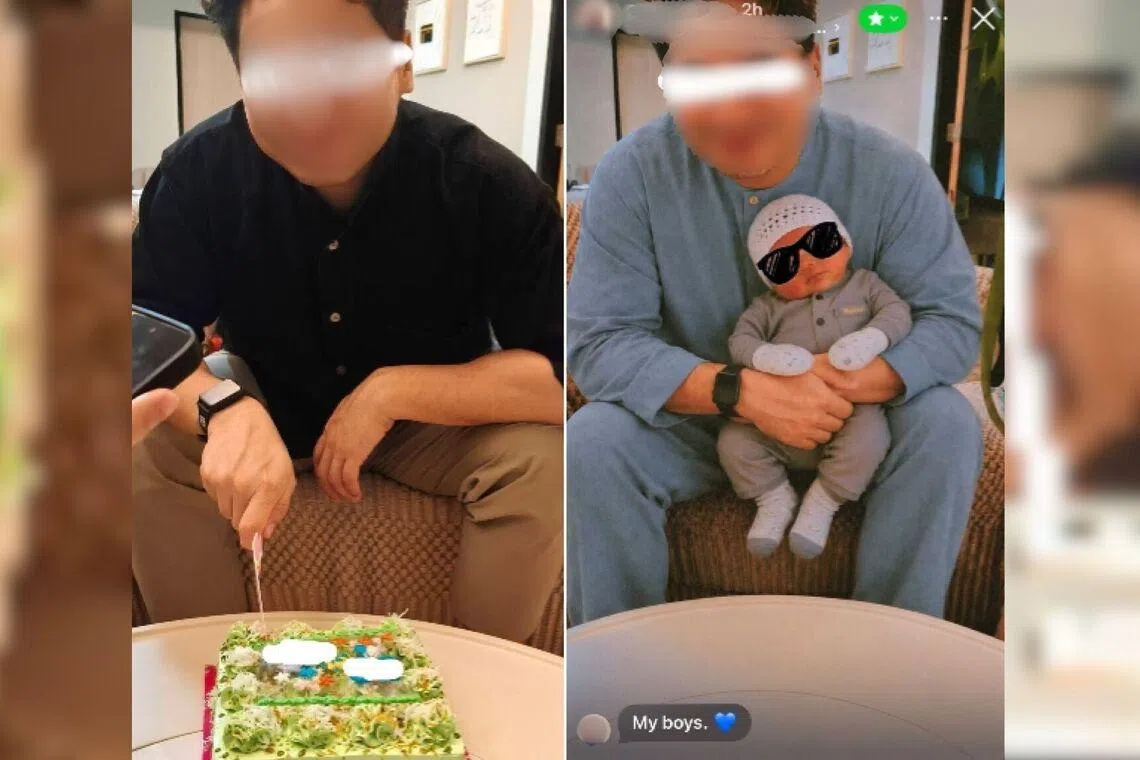
There were also images of Luke holding their supposed newborn with a caption that read: “My boys.”
An examination of the photo against the original showed the pattern on the chair had been distorted by AI.
The original photo shows Luke, clad in a black shirt, posing with a cake on a table. In the edited photo, he is seen in a blue long-sleeved shirt holding a child.
Desperate to help her brother, Luke’s sister put up a post on social media site Threads on June 7 detailing his experience. The post received some traction and more than 12,000 likes.
The woman then responded to Luke’s sister, who added: “She said she did it out of love for my brother. Living in this fairytale world and getting attention made her feel happy and good.”
Following her post, several people contacted Luke’s sister saying they believe the woman had also posed as Luke.
They said she used his photos to befriend them on various online platforms. This took place over a number of years.
The relationships were confined to the online world, without any face-to-face meetings. Some of the accounts where the woman pretended to be Luke go as far back as 2017.
Checks on June 15 found that the woman’s Instagram account, which was previously used to post the fake photos, had been deactivated.
Attempts by ST to reach her on June 16 were unsuccessful.
Clinical psychologist Carol Balhetchet said the woman is showing signs of delusional thinking, and she has a profound desire to gain control and power towards a forced connection with Luke.
She said the woman should get psychological help.
“This can go on forever until such time there is a situation – good or bad in her head – for her to finally get in physical contact with her victim,” said Balhetchet, who added that victims can sometimes feel responsible when such situations spiral out of control.
Since the incident, Luke and his sister have changed the setting of their social media accounts to private, which means only those approved by them can view photos, videos and posts.
Luke made a police report but lawyers he spoke to suggested getting an order under Protection from Harassment Act (POHA) rules.
Lawyer Kevin Liew, the crime practice head at law firm Gloria James-Civetta and Co, said of the civil procedure: “This can cover her acts of posting AI-generated photos, impersonation, and false online posts.”
Liew said it is not always necessary to prove that the offender intended to harass.
“It is enough that the conduct is likely to cause harassment, alarm or distress, which may be proven by the fabricated relationship, the fake pregnancy, and the use of family pictures.”
After a POHA application is filed and served, both parties would need to attend court. Parties may then be directed to attend mediation to resolve the matter.
If parties are unable to resolve the matter amicably, the matter will proceed to trial where the court will determine whether a protection order will be granted.