
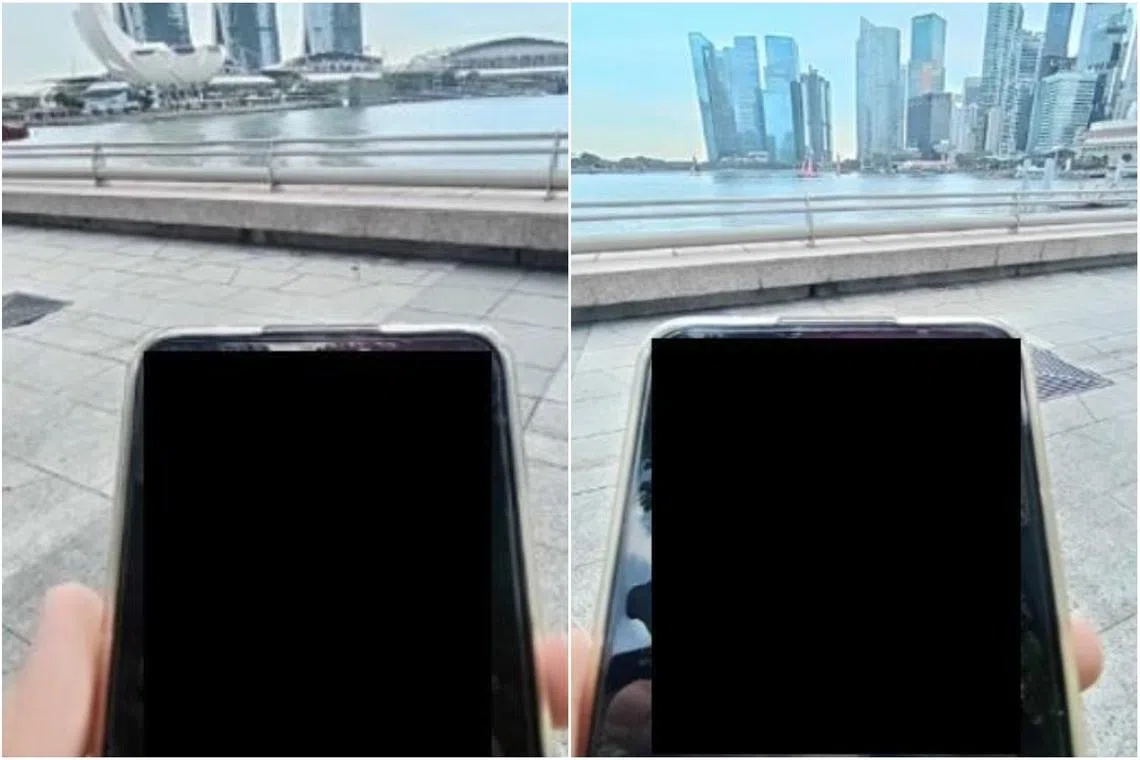
SINGAPORE – A student who took photos of his phone showing Islamist extremist ideologies with Marina Bay Sands in the background was among two Singaporeans issued Internal Security Act (ISA) orders.
Cyrus Dzulqarnain Al-Shahriar, 19, was issued a restriction order, said the Internal Security Department (ISD) on June 24.
Cyrus is the second person dealt with under the ISA after being radicalised by a “salad bar” of ideologies, a form of violent extremism where individuals subscribe to multiple, and sometimes conflicting, extremist beliefs.
A member of the public had seen his anti-Semitic and pro-Hamas online posts and reported them to the ISD.
ISD also issued a detention order to Tarmizi Mohd Taha, a 30-year-old customer service officer, who admitted he was willing to carry out attacks in Singapore if Hamas instructed him to do so.
Tarmizi wanted to use his skills as a logistics assistant during his national service in the Singapore Police Force to contribute to Hamas, believing it would help him achieve martyrdom.
ISD said that while both cases were unrelated, the radicalisation of both Singaporeans was triggered by the ongoing Israeli-Palestinian conflict, following Hamas’ attacks against Israel on Oct 7, 2023.
They are the seventh and eighth Singaporeans dealt with under the ISA whose radicalisation was triggered by that conflict.
In 2022, Cyrus joined several online religious groups to learn more about Islam.
However, he was exposed to anti-Western and anti-LGBTQ content and made online posts inciting violence against the LGBTQ community.
Following Hamas’ attacks against Israel in 2023, Cyrus was exposed to pro-Hamas narratives online. He supported Hamas’ killing of civilians, which he viewed as a form of jihad.
In 2024, Cyrus considered travelling to Gaza to join Hamas and fight Israelis, but he ditched the idea as he lacked the resources to travel overseas and was afraid of engaging in physical violence.
That year, Cyrus saw social media posts by members of a niche online Islamist extremist group that subscribed to violent accelerationist thinking. They believed in creating chaos through violence to establish a future with Islam as the leading global civilisation.
They also believed they needed to destroy the current “world order”, where First World countries, including Singapore, were considered an extension of the United States and under the control of Zionists.
After joining the group’s private online chat in early 2025, Cyrus began glorifying terrorist attacks like Al-Qaeda’s Sept 11 attacks in 2001 that killed more than 2,900 people and the 2002 Bali Bombings that killed over 200.
At the request of one of the group’s members, Cyrus went to the Esplanade area twice to take photos of an e-publication authored by those in the group, with Marina Bay Sands in the background.
Cyrus also pledged allegiance to the group by publicly posting these photos on his social media account in November 2025, and viewed himself as a group member.
He saw it as his duty to participate in the group’s “digital jihad” efforts, which involved harassing anti-Islam users online.
Cyrus posted fake news on social media to defame these individuals and incited violence against them. He also made online posts glorifying Hamas and Syrian Islamist political and militant organisation Hay’at Tahrir al-Sham.
Cyrus also saw online posts in 2025 on school shooter Elliot Rodger, 22, and became intrigued by his incel inclinations.
Incel, short for “involuntary celibate”, refers to a sub-culture of individuals, mostly men, who identify as being unable to find a romantic or sexual partner despite desiring one. They resent society, women and those they perceive as more sexually successful.
In May 2014, Rodger killed six and injured 14 people near the University of California, Santa Barbara, in an attack said to have stemmed from resentment over being bullied, social isolation and rejection by women.
After perusing online incel forums, Cyrus identified as an incel and made online posts threatening to kill or rape women, using derogatory terminology such as “foid”, or “female humanoid”.
He also fantasised about committing violence against certain groups of people in school, including LGBTQ individuals and couples in relationships.
Fortunately, ISD said these thoughts did not progress beyond ideation, and Cyrus did not share his extremist views or violent ideations with his family or schoolmates.
Said ISD: “While Cyrus did not take preparatory steps to execute his violent ideations, his support for terrorist and extremist groups, and his online postings inciting violence against others, are of security concern.”
It added that he will be put through a rehabilitation regime to address his radical beliefs.
ISD said Cyrus’ case underscores the growing diversity of violent extremist ideologies fuelling the domestic self-radicalisation threat, especially among youth.
ISD said Cyrus is the second individual radicalised by Composite Violent Extremism (CoVE), also known as a “salad bar” of ideologies, to be dealt with under the ISA.
Said ISD: “Those radicalised by CoVE draw selectively from multiple extremist ideologies to construct their personalised worldview or hybrid belief system that justifies violence. The lack of a coherent worldview does not diminish the severity of the CoVE threat.”
In the other case, Tarmizi joined several social media channels that discussed Hamas after the October 2023 attacks, and was exposed to Hamas propaganda, which he would frequently rewatch.
By February 2024, Tarmizi had come to view Hamas as defenders of the Palestinians. He believed it was right to engage in armed violence against those responsible for oppressing Palestinians in their homeland.
In late 2024, Tarmizi’s online foreign contact, who claimed to be a Hamas member, offered to help him travel to the Palestinian territories to join Hamas. ISD said Tarmizi had considered the offer, but did not follow up on it at the time.
In August 2025, Tarmizi watched a video of a Palestinian being killed, which re-triggered his earlier intent to join Hamas.
He renewed contact with the Hamas member to seek advice and searched online for travel routes, but did not proceed with his plans as he lacked the financial resources.
Tarmizi had intended to link up with Hamas officials in the Palestinian territories and to take its pledge of allegiance in person.
He admitted that if instructed by Hamas, he would be willing to engage in armed combat against Israel or carry out attacks in Singapore.
ISD assessed him as posing an imminent security threat warranting detention under the ISA.
Singaporean Radjev Lal Madan Lal, 33, who was detained in April 2022 after he was found to have wanted to travel to overseas conflict zones to participate in armed violence, was released from detention on a restriction order in April 2026.
ISD said he showed good progress in his rehabilitation and no longer posed an imminent security threat requiring preventive detention.
Meanwhile, the restriction orders issued against three Singaporeans were allowed to lapse upon their expiry after they made good progress in their rehabilitation.
They include Abd Rahim Abdul Rahman, 57, a former Jemaah Islamiyah (JI) member who was detained in March 2012, and Mohamed Faishal Mohd Razali, 35, who wanted to undertake armed violence in various overseas conflict zones, including Syria. He was detained in April 2018 and issued a restriction order in April 2022, which was allowed to lapse in April 2026.
Husaini Ismail, 67, a former JI member who was detained in June 2012, was released from detention on a restriction order eight years later, which was allowed to lapse in June 2026.
Anyone who knows or suspects that a person has been radicalised should call the ISD hotline on 1800-2626-473.