
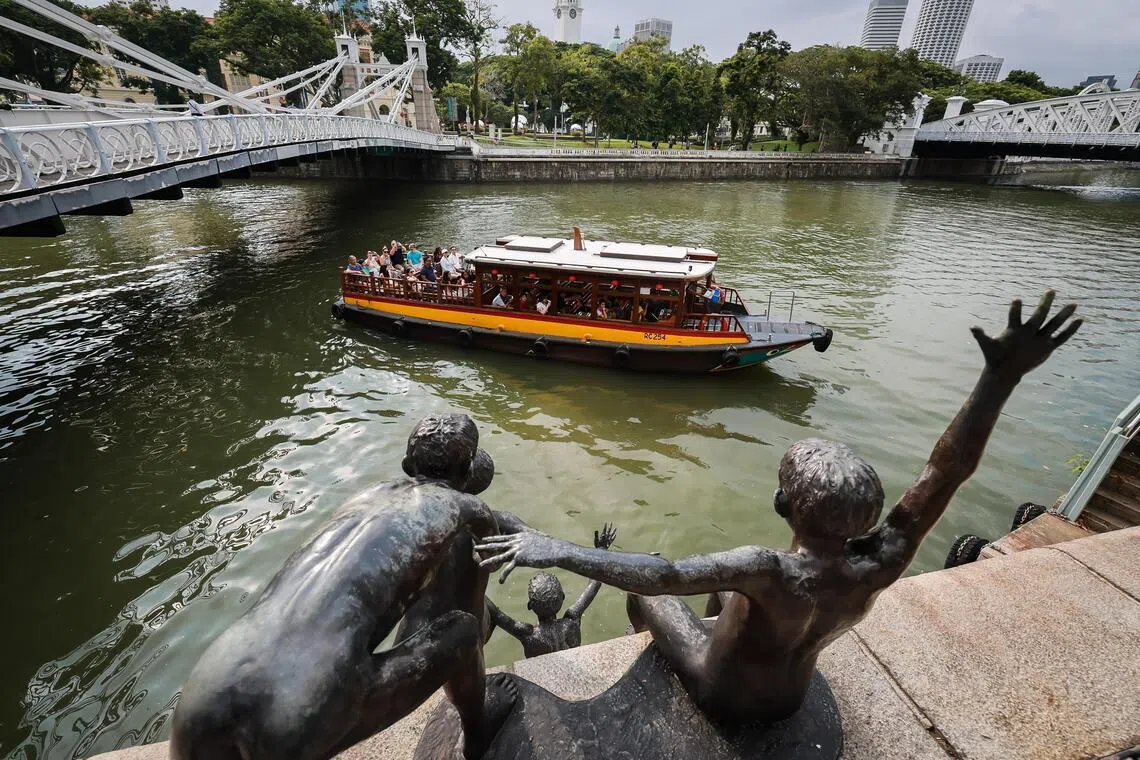
SINGAPORE – In front of The Fullerton Hotel, five boys are either about to jump or already mid-plunge into the Singapore River – the city’s historical lifeblood.
They are part of a bronze sculpture named The First Generation that captures a slice of the river’s history and the communities that grew up around it.
“The sight and sound of boys, swinging from the trees that lined the river and jumping with gusto, breathed charm into the area,” says a sign that describes the work.
The historical communities whose lives were intertwined with the river are now gone. But at the World Cities Summit that Singapore hosted in mid-June, it was clear that such connections – bonds between people, and between communities and places – are what city leaders aspire to forge.
Here are three ideas for how the country can foster a greater sense of belonging – including bringing swimming back to the Singapore River – gleaned from plenaries during the summit.
At the closing plenary, former Paris mayor Anne Hidalgo said the city’s famous clean-up of the River Seine for the 2024 Olympics – and for public swimming for the first time in a century – was “about public health, ecological restoration, civic pride, and proclaiming the river as part of everyday urban life”.
The words of Hidalgo – who herself took a dip in the Seine in 2024 – harkens back to 1984, when Singapore was in the midst of a decade-long effort to clean up its eponymous river.

Participants taking part in a mass swim across the Singapore River organised by the Hong Lim Green community centre.
PHOTO: ST FILE
That year, Hong Lim Green Community Centre organised the first mass swim across it “to promote the river as a pleasant place for a cool dip and aquatic sports”, reported The Straits Times.
“It is no longer the old stinking river, the organisers would like Singaporeans to know,” the article said.
These days – especially since the river became part of Marina Reservoir – swimming has largely been disallowed there, except for events such as the local leg of the T100 Triathlon World Tour.
But going by the experience of other cities, it could be time for swimming to return to the Singapore River – the maritime nation’s first port – as a fresh way for Singaporeans to experience and grow a deeper connection to the (Mer)Lion City.
Zoltan Ero, chief architect of Budapest Municipality, said his city’s efforts to make the Danube River more accessible to the public – including by opening pop-up public baths – “have changed the relationship between the city and its river, and between citizens and their city”.

A public bath along the Danube River in Budapest.
PHOTO: MUNICIPALITY OF BUDAPEST
Singapore, always in need of new ideas to help people fall in love with the city again, has a ready-made solution in its heart. Are Singaporeans ready to take the plunge?
Another panel at the summit examined how former ports have been rejuvenated, and how today’s ports are changing to meet future needs.
Singapore finds itself tackling both issues. Terminals in the city – at Tanjong Pagar, Keppel and Pulau Brani – are slated to close in the next two decades, as are Pasir Panjang Terminals and Sembawang Shipyard. Tuas Port is still being built and set to be completed in the 2040s.
This impending redevelopment of large swathes of seafront land presents Singapore with an unprecedented opportunity to develop new towns and attractions anchored firmly in the country’s maritime heritage.

Clifford Pier, where migrants once set foot in Singapore.
ST PHOTO: LIM YAOHUI
While repurposing buildings associated with the country’s maritime history is not new – Singapore has kept physical reminders of its early trading days by conserving buildings in areas such as Clarke Quay, Boat Quay and Clifford Pier – the ports and shipyard are different from what has been kept thus far in terms of scale and type of infrastructure.
Looking ahead, previous exhibitions by the URA show that the authorities have their eye on reusing Sembawang Shipyard’s infrastructure in new ways, including as a dry dock, naval workshops and warehouses, and a fire station.

The container terminal at Pulau Brani is set to be redeveloped.
ST PHOTO: BRIAN TEO
Port cities from across the globe offer a foretaste of what could come in Singapore.
In Rotterdam, for instance, director of public works Joop Polfliet said his city has blended heritage and modern architecture in Rijnhaven, an old harbour area.
There, an inner-city beach is being built as part of greening efforts, while old warehouses have been converted to restaurants, museums and theatres – one warehouse has even had new apartments built on top of it.
Meanwhile, on the Scheldt Quays in Antwerp, 15 large harbour cranes sit by the river, allowing the public to learn about the infrastructure used in ports, and see how they have changed with time.

Port House Antwerp, the headquarters of the Port Authority of Port of Antwerp-Bruges, integrates a fire station from the 1920s with a modern superstructure.
ST PHOTO: JASON QUAH
There are signs that Singaporeans, too, will get to do this in time to come, with harbour cranes repeatedly showing up in renders from a masterplan for the future of Pulau Brani and Sentosa.
Like these port cities, the impending redevelopment of the city ports and Sembawang Shipyard are a chance for planners to reinforce Singapore’s identity as a maritime nation, and infuse this sense of connectedness to the sea into the everyday lives of Singaporeans.
As cities become denser, there is also less room for community space.
One solution to this space crunch that has been widely adopted worldwide are highrise mixed-use buildings that allow multiple functions – homes, malls and offices – to be built within one plot of land.

Mixed-use development Marina One brings together residences, retail spaces and offices.
ST PHOTO: KUA CHEE SIONG
While conceptually simple as a space-saving tool, such density is a double-edged sword that could have profound impacts on a city’s social fabric.
From one perspective, density brings people together.
Heng Chye Kiang, provost’s professor at the National University of Singapore’s College of Design and Engineering, said at the summit that human relationships are strongly influenced by frequency of encounter.
He said that in dense cities, people are likely to interact with each other more frequently, which helps to build social ties.
But building too densely also has the reverse effect – people would rather retreat to the comfort of their own homes, which increases the phenomenon of social isolation.
What then, is the right balance? Hila Oren, chief executive of the Tel Aviv Foundation, a philanthropic organisation that aims to raise the quality of life in the city, suggested that successful cities are ones where people also feel at home in third places – places where people spend time outside of work and home.
The upcoming Voluntary Early Redevelopment Scheme, which will see public housing precincts rebuilt as older flats are torn down to make way for new ones, allows Singapore to reconsider how it designs such community spaces.

Seniors bond over a game of floor curling at the void deck of a public housing block in Hougang.
ST PHOTO: JASEL POH
Precinct pavilions, for instance, could be assessed for their conduciveness in bringing neighbours to together, while thought could also be put into other ways to build communities between and inside buildings.
Closer to the city centre, there is scope to reimagine what getting comfortable outside of work and home looks like.
Office workers stripping down and taking a dip in the heart of the city is one answer.