
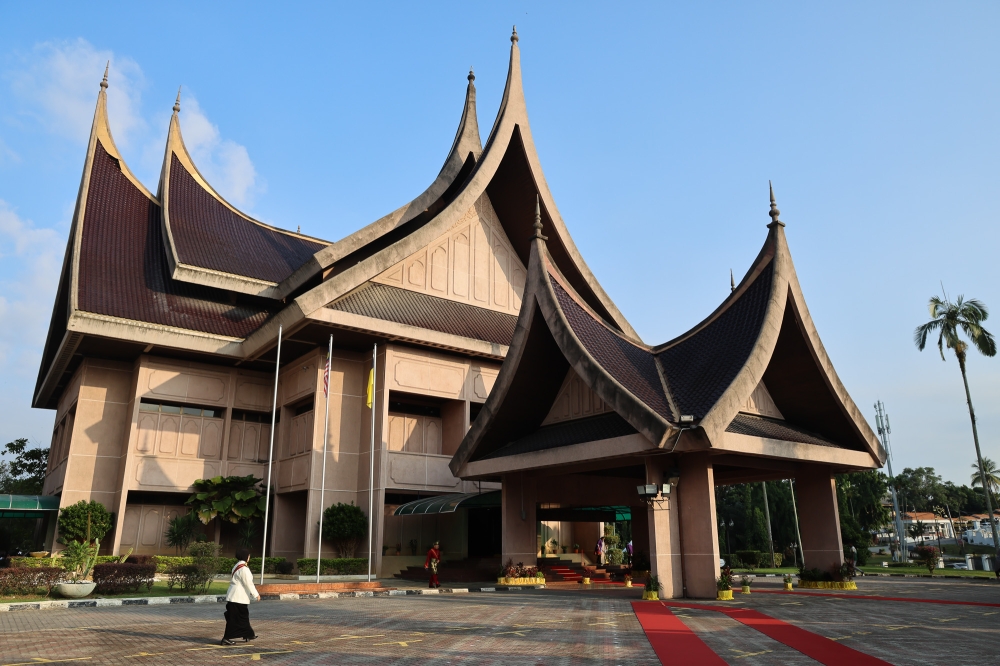
SEREMBAN, June 29 — Voters in Negeri Sembilan will cast their ballots on August 1 in an election that is shaping up to be one of the most unpredictable and constitutionally significant contests in the state’s history.
The state assembly’s early dissolution has paved the way for a 36-seat battle that marks a major shift in the political landscape.
Unlike the 2023 state polls, where Pakatan Harapan (PH) and Barisan Nasional (BN) campaigned as allies, the two coalitions are now expected to face each other directly in a three-cornered fight alongside Perikatan Nasional (PN).
Beyond the political realignment, the campaign is expected to be dominated by two unconventional pillars: a brewing constitutional crisis involving the state’s royal institution and mounting “bread-and-butter” concerns among a rapidly growing population.
Royal institution in the spotlight
One of the most defining and sensitive issues heading into August is the ongoing dispute involving Negeri Sembilan’s unique monarchy.
The state follows the Adat Perpatih system, where the Yang di-Pertuan Besar is elected by the four Undang (territorial chieftains). The current crisis was triggered when the four Undang announced they were deposing the reigning Yang di-Pertuan Besar, Tuanku Muhriz Tuanku Munawir, and proclaimed Tunku Nadzaruddin Tuanku Ja’afar as the 12th Yang di-Pertuan Besar.
This unprecedented move has triggered a series of legal and constitutional challenges. While historical parallels exist, most notably in 1967 when the Undang bypassed a 19-year-old Tuanku Muhriz in favor of Tuanku Ja’afar, the current dispute has spilled into the political arena, raising fundamental questions about the role of traditional institutions and customary law.
Fragmented political landscape
In 2023, the PH-BN “Unity” formula saw the two coalitions sweep 31 of the 36 seats. However, the collapse of that state-level cooperation means voters will now witness a direct confrontation between former partners.
- Pakatan Harapan (PH): Faces the task of defending its incumbency and its urban/non-Malay strongholds.
- Barisan Nasional (BN): Seeks to reassert its relevance as a standalone force, particularly in its traditional rural heartlands.
- Perikatan Nasional (PN): Aims to expand its current five-seat foothold, looking to capitalize on any disenchantment within the Malay middle ground.
The rural belt that includes Jempol, Bahau, Serting, and Gemas will be the primary battleground for Malay votes, while the mixed and urban constituencies in Seremban and Nilai will test whether PH can maintain its dominance amidst the split in the “unity” vote.
Commuter pressures and cost of living
While the constitutional crisis dominates legal circles, the average voter is focused on the rising cost of living.
Negeri Sembilan acts as a massive “commuter state,” with tens of thousands of residents traveling daily to Kuala Lumpur, Putrajaya, and Cyberjaya for work.
Key local issues include:
- Traffic congestion: Rapid development in growth corridors like Seremban, Nilai, Labu, and Bandar Sri Sendayan has outpaced infrastructure.
- Housing affordability: A recurring concern for younger families moving south for cheaper housing who are now feeling the pinch of inflation.
- The ‘report card’ on MVV 2.0: The election will serve as a referendum on Malaysia Vision Valley (MVV) 2.0, the flagship project intended to turn western Negeri Sembilan into a high-tech economic extension of Greater Kuala Lumpur.
A changing electorate
The Negeri Sembilan heading to the polls in August is larger and more urbanised than in previous years. According to the Department of Statistics Malaysia (DOSM):
- The state’s population reached approximately 1.24 million in 2024.
- Seremban remains the largest district, with its population estimated to have grown to 717,000 by 2025.
- Port Dickson (134,000) and Jempol (130,000) follow as the next most populous districts.
While the Bumiputera remain the majority, followed by the Chinese and Indian communities, the influx of young professionals and urban migrants into the Seremban-PD axis has created a more diverse and potentially volatile electorate.
More than a state election
For a state traditionally regarded as politically moderate, the outcome of the August 1 polls will resonate far beyond Seremban.
It will provide the first clear data on how voters respond to political realignment and constitutional instability, serving as a vital bellwether for the health of national coalitions as they look toward the next general election.