
SINGAPORE – When Ang Hao Yao was a university student in California in the late 1980s, he would drive alone to arm-wrestling tournaments in the middle of nowhere, sometimes picking up strangers along the way.
Young and slight – just 1.72m tall and weighing barely 62kg then – he looked nothing like the truckers-and-tough-guys stereotype the sport was known for.
He did not always win, but that did not bother him.
“Looking back, I was quite surprised I was so daring,” the now 52-year-old says with a mild laugh, seated inside the newly reopened headquarters of the National Kidney Foundation (NKF) in Kim Keat Road in Whampoa, refreshed in 2026 after more than $8 million in new donations.
“Going to places you just never thought you’d go, meeting people you never thought you’d meet.”
That sentence probably sums up his philosophy in life. A private investor by trade, a taiji instructor by choice and a serial volunteer-leader by inclination, Ang became NKF chairman in April 2025, stepping into one of Singapore’s most storied, and at one point most scandalised, charitable seats. He did not hesitate.
Ang grew up in a family where achievement was less aspiration than expectation.
His late father Ang Kok Peng made his mark across academia, diplomacy and politics, serving as a Singapore ambassador before returning home for a career that included stints as Minister of State for Health and Communications, four terms as a Member of Parliament and, later, head of chemistry and dean of science at the National University of Singapore.
His mother Ang Wai Hoong charted an equally formidable path, rising from teacher to school principal before moving into leadership roles in the Ministry of Education. Both parents hold PhDs.
His two older sisters are doctors.
“They were the high achievers,” he says, grinning. “Not so much me.”
Instead of following the family script, he preferred charting his own course. As he was good at physics and mathematics, his parents hoped he would study engineering.
However, he quietly changed his major at Santa Clara University in California’s Silicon Valley to mathematics and economics. “I was there and just told them, ‘Well, I don’t think engineering is for me,’” he says.
California deepened two lifelong passions.
The first was finance. Fascinated by currency markets since secondary school, he used to visit bank branches simply to track exchange rates, a habit later fed by The Wall Street Journal, a newspaper readily available on campus.
The second was arm-wrestling.
The sport had surged in popularity after American actor Sylvester Stallone’s 1987 movie Over The Top, about a truck driver who moonlights as an arm wrestler.
Ang, who had always gravitated towards weight training and the raw intensity of one-on-one combat – “from the moment it begins, you’re trying to destroy your opponent” – threw himself in wholeheartedly.
Still in his teens, he drove hundreds of kilometres to competitions in remote towns and even flew to Kansas for the US national championships.
Back in Singapore in the early 1990s, he spent a short stint as a research analyst before national service interrupted the trajectory.
It was during those years that he returned to competitive arm-wrestling, representing Singapore at the World Armwrestling Federation Championships in Sweden in 1994. He was the country’s sole competitor; he had no sponsorship and no support system, just a plane ticket he paid for himself.

NKF chairman Ang Hao Yao competing at the World Armwrestling Federation Championships in Sweden in 1994.
PHOTO: COURTESY OF ANG HAO YAO
After completing his NS, he joined Tat Lee Bank, later absorbed into OCBC Bank. He moved through consumer banking and corporate banking, eventually working in debt restructuring during the 1997 Asian financial crisis.
There, he witnessed first-hand how financial distress quietly dismantles lives.
Families buried under margin-trading losses. Credit card debts compounding at punishing interest rates. Ordinary people overwhelmed, with nowhere to turn.
One experience stayed with him: helping a close friend untangle a maze of debt obligations and chart a repayment plan.
That eventually led him to join Credit Counselling Singapore in 2003, where he remains chairman today.
“Being in debt is very distressing for families,” he says. “I thought: This is a very good cause to get involved in.”

Witnessing first-hand how financial distress can dismantle lives led Ang to join Credit Counselling Singapore, where he is chairman.
PHOTO: LIANHE ZAOBAO FILE
At 27, he left banking. After a couple of brief entrepreneurial detours – a real estate listings magazine and a health supplement business – he returned to what had always interested him most: investing.
Ang is a CFA (chartered financial analyst) charterholder – a mark of rigour in the investing world – and vice-president of Securities Investors Association (Singapore), the main retail investor body championing the rights of ordinary investors. He remains guided by a philosophy shaped by discipline and patience: buy strong companies, ignore speculation, resist the lure of fast money.
He says simply: “You have to be disciplined.”
That same world view eventually drew him into the charity sector, ironically through one of Singapore’s biggest philanthropic controversies: the 2005 NKF saga, which exposed deep governance failures and fundamentally reshaped public expectations of how charities should be run.
Public outrage over executive excesses, poor board oversight and the now-infamous gold tap controversy triggered a nationwide conversation about accountability in philanthropy. The fallout led to the creation of the Charity Council in 2007, ushering in stricter governance standards.
By then, Ang had already built deep expertise in corporate governance through his investor advocacy work. Joining the council in 2015 became a natural next step.
From there, his involvement in the non-profit world steadily deepened. He chaired SATA CommHealth, which provides GP services, home care, telehealth and physiotherapy for seniors, before joining NKF’s board in 2021.
Over the next few years, he worked his way through the organisation’s inner machinery, serving first on the procurement committee, then chairing the finance committee before becoming vice-chairman.
So, when the nomination committee approached him to succeed Arthur Lang as chairman, he was hardly stepping into unfamiliar territory.
The ghost of the 2005 scandal still lingers, though.
People, he says, still occasionally ask about the infamous gold tap, the enduring symbol of the scandal that nearly brought the organisation down.
“That keeps us on our toes,” he says. “It reminds us to run a very tight ship.”
Yet the crisis unfolding on Ang’s watch may prove even more daunting.
Chronic kidney disease in Singapore has risen sharply, with prevalence climbing from 8.7 per cent of the population in 2019-2020 to 14.9 per cent in 2023-2024.
Six people are newly diagnosed with kidney failure every day, nearly three times the rate recorded two decades ago. Projections suggest one in four Singaporeans could be living with chronic kidney disease by 2035.
“Kidney disease is like high blood pressure, a silent killer. You have it and you don’t know,” he says, adding that NKF today supports around 6,000 dialysis patients across 45 centres islandwide.
His response is encapsulated in NKF’s Future Forward 2030 strategy: Prevention, People, Peritoneal Dialysis, Sustainability and Transplant.
A major priority is expanding home-based peritoneal dialysis. Today, only around 500 NKF patients undergo dialysis at home. Ang wants to raise that figure to one in three.
The benefits, he says, are substantial. Patients live more independently, continue working and face fewer dietary restrictions. It is also significantly cheaper than centre-based haemodialysis, which requires patients to travel three times weekly for hours-long treatment sessions.
“Every dialysis centre costs money: space, staff, machines. If more patients do it at home, we can manage the growth without endlessly opening new centres.”

The Aljunied NKF Dialysis centre’s capacity has increased to 28 dialysis stations from 18 previously, and can now serve 168 patients, up from 108.
PHOTO: NKF
In March 2026, NKF unveiled more than $8 million in new initiatives supporting this transition, alongside investments in research, prevention education and sustainability programmes designed to reduce both medical costs and environmental waste.
Meanwhile, a $4 million donation from lifestyle and consumer goods group SUTL Global has expanded the revamped centre’s capacity by 71 per cent. It also funds an automated water-delivery system that more efficiently manages the vast quantities of purified water needed for dialysis treatment, cutting fluid wastage by 10 per cent and eliminating 28,000 plastic containers a year, weaving sustainability directly into healthcare delivery.
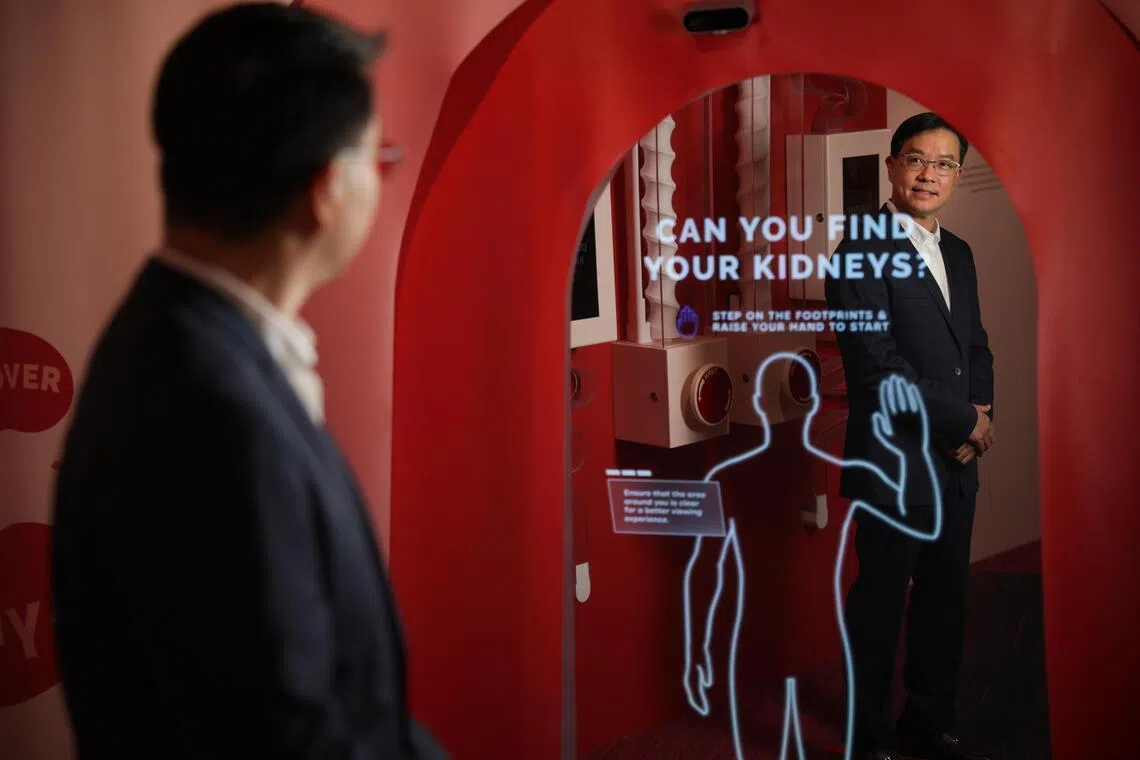
Another $1 million from the Keppel Care Foundation has transformed NKF’s Kidney Discovery Centre into an augmented reality-powered education hub expected to reach 10,000 visitors a year.
Beyond that, a $5.5 million research fund, matched dollar for dollar by the Government, will channel more than $10 million into early detection, new therapies and better support for patients and caregivers.
What concerns Ang most, however, are the estimated half a million Singaporeans living with chronic kidney disease without knowing it.
“Kidney disease has five stages. The first two have no symptoms. By stage five, there’s very little you can do.”
A simple eGFR (estimated glomerular filtration rate) blood test can detect trouble early, while newer medications can slow disease progression for years. NKF now works with about 250 GP clinics and brings schoolchildren through its Kidney Discovery Centre to start prevention conversations early, he says.
Then there is transplantation, still the most sustainable long-term solution.
Fewer than 100 kidney transplants are performed annually in Singapore, while waiting lists stretch as long as a decade.
“Many people,” he says quietly, “will never get to that point.”
Outside work, Ang still practises taiji twice a week, teaching classes through the Jian Chuan Tai Chi Chuan Physical Culture Association. He has been with the group for more than two decades.

Ang practises taiji twice a week, teaching classes through the Jian Chuan Tai Chi Chuan Physical Culture Association.
PHOTO: COURTESY OF ANG HAO YAO
He also still competes in arm-wrestling; his most recent outing was in December 2025, in the Grand Masters category for competitors aged 50 and above.
He sees a direct connection between physical discipline and leadership.
“You set a goal and work towards it slowly. You break it down into smaller goals. It’s no different from running an organisation,” says Ang, who is married to a remisier and has two daughters, aged 18 and 21.
Taiji, in particular, taught him perhaps the most important leadership lesson of all: composure.
“You cannot panic. You stay calm and take deliberate steps.”
He applies the same thinking to philanthropy, scrutinising charities with the same rigour he applies when evaluating investments.
“When I decide to support a charity or join as a volunteer, I look at it the same way I would an investment: what are its activities, who are the directors, who are the stakeholders, what do the financials look like?”
At its core, Future Forward 2030 reflects the same philosophy that has shaped much of his life: identify something undervalued and underpowered, invest for the long haul, hold your nerve and never chase the fast kill.
For the half a million Singaporeans living in the shadow of kidney disease, that may prove a good investment.