
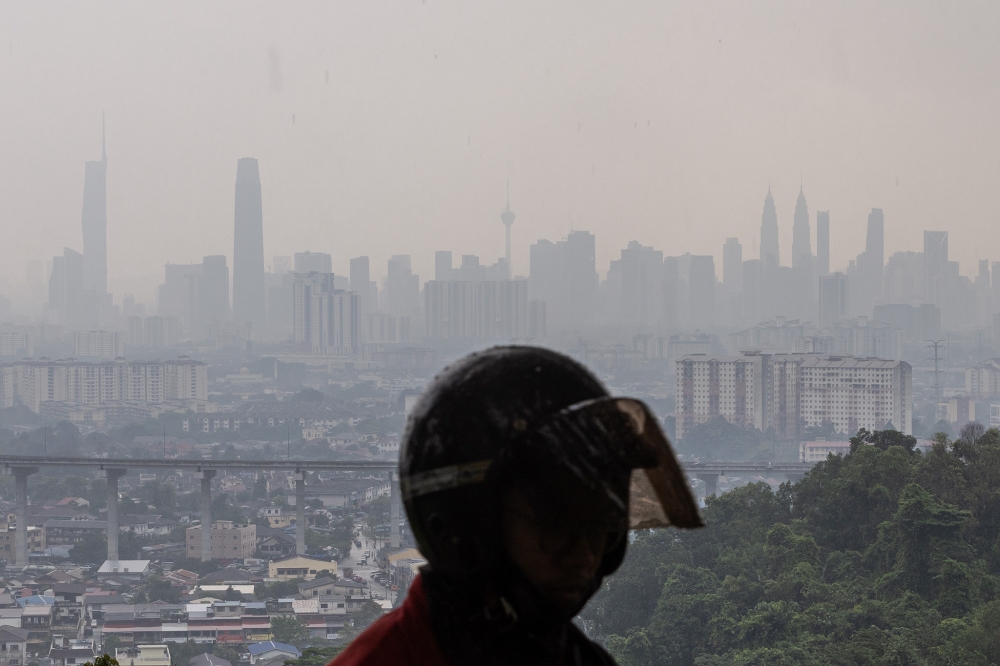
KUALA LUMPUR, Aug 21 — As the haze returns to Malaysia, staying indoors is often the simplest way to reduce exposure to polluted air.
But how much protection do closed doors and windows really provide against microscopic particulate matter such as PM10 and PM2.5 that can enter a home?
According to experts, keeping doors and windows closed can significantly reduce the amount of outdoor particulate matter entering a home, particularly in residences with air-conditioning systems.
Applied Air Quality Specialists Sdn Bhd chief executive Tan Zhi Shen said particles such as PM10 that enter an indoor space will eventually settle on surfaces, while finer particulate matter such as PM2.5 may remain airborne longer before settling.
Tan, whose work focuses on indoor air quality, said conventional residential air conditioning units are generally sufficient to help maintain indoor air quality because they recirculate indoor air rather than drawing air directly from outside.
“Home air conditioners are in a way, ‘air purifiers’ themselves because they have filters inside and can filter haze particulate matter if any is present indoors (when they draw air from the room).
“It is different from a centralised air-conditioning system (in a larger building) where warm air is pulled from outside instead,” he told Malay Mail.
Still, Tan said keeping one’s home completely sealed during haze can create another indoor air-quality concern, as inadequate ventilation allows carbon dioxide to accumulate over time.
“At the very least, your house should be ventilated at least once daily by opening the windows for an hour to reduce the concentration of carbon dioxide in the air,” he said.
Nevertheless, he acknowledged that the challenge is minimising outdoor pollution entering the home while maintaining adequate indoor ventilation when outdoor air quality allows.
“It is therefore not recommended to keep your windows open for too long during haze episodes, but there should still be some ventilation, even if only a little,” he said.
Sunway Medical Centre’s consultant physician Dr Kow Ken Siong explained that staying indoors can reduce exposure to haze but does not completely eliminate it.
“PM2.5 particles are extremely small and can still enter the home through gaps around doors and windows or through ventilation that brings outdoor air inside.
“Staying indoors remains a useful way of reducing exposure, particularly when outdoor air quality is unhealthy but people should also consider that indoor air quality can still be affected by haze,” Dr Kow told Malay Mail.

Sunway Medical Centre’s consultant physician Dr Kow Ken Siong explained that staying indoors can reduce exposure to haze but does not completely eliminate it. — Picture courtesy of Dr Kow Ken Siong
Kow, who is also a qualified respiratory physician and interventional pulmonologist, said the amount of microscopic particles entering indoor spaces depends on the type of building, as well as its existing ventilation and filtration systems.
“During significant haze, a High-Efficiency Particulate Air (HEPA) air purifier appropriate for the room size can provide an additional layer of protection.
“The important thing to understand is that staying indoors reduces exposure, but it doesn’t necessarily mean the indoor air is completely free of haze-like particles,” he said.
Beyond the lungs
Tan said elevated carbon dioxide levels in an enclosed space caused by poor ventilation can result in symptoms ranging from drowsiness and fatigue to dizziness and rapid breathing.
He explained that elevated carbon dioxide levels from poor ventilation can cause tiredness and discomfort, while also indicating that fresh-air ventilation is inadequate.
Dr Kow said fine particulate matter such as PM2.5 can leave a lasting impact especially when inhaled.
“They can irritate the airways and trigger inflammation, which may lead to symptoms such as coughing, phlegm, chest tightness or breathlessness.”
Vulnerable groups, including children and older people, as well as those with pre-existing conditions such as asthma and cardiovascular disease, face a greater risk of experiencing more significant effects from prolonged or repeated haze exposure.
He said PM2.5 exposure can worsen chronic lung conditions and has also been linked to more serious health effects, including an increased risk of lung cancer and recurrent episodes of bronchitis.
Individuals without pre-existing health conditions may also develop upper respiratory symptoms and become more susceptible to viral infections.
“The key distinction is that anyone can experience effects from poor air quality but some groups face a higher risk of more significant symptoms or worsening of existing conditions,” he said.
He also noted that most people view haze primarily as a respiratory problem because pollutants are inhaled, but the health effects of PM2.5 are not necessarily confined to the respiratory system.
On whether the body can naturally remove PM2.5 or if some particles remain in the respiratory system, Dr Kow said the particles’ extremely small size allows them to penetrate much deeper into the respiratory system than larger particles.
“Our respiratory system has several natural defence mechanisms — mucus and tiny hair-like structures called cilia help trap and move inhaled material out of the airways, while immune cells help deal with particles that reach deeper into the lungs.
“How the body responds depends on factors such as the amount and duration of exposure, as well as a person’s underlying health.
“This is why the focus should be on reducing repeated exposure rather than assuming the body can simply clear everything without consequence,” he said.